
Fiber Cement and Hardie Siding Installation in Charlotte, NC
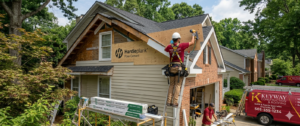 Fiber cement siding has become one of the most requested exterior materials on Charlotte homes over the past two decades, and the reasons are straightforward. It holds up against the heat, humidity, and storm seasons that wear down wood and lower-grade vinyl faster than most homeowners expect. It looks like wood from the street. It does not rot, warp, or attract insects. And when it is installed and finished correctly, it can go well over a decade between paint cycles. The name most Charlotte homeowners associate with it is Hardie, after James Hardie, the manufacturer whose fiber cement products have the largest presence in this market.
Watch for the signs your home needs new siding.
Already have fiber cement siding that needs fixing rather than a full replacement? See our fiber cement siding repair page.
Keyway Construction and Roofing installs fiber cement and Hardie siding on homes across Charlotte, Matthews, Mint Hill, Indian Trail, Waxhaw, Weddington, and Monroe. We are a licensed general contractor based in Matthews, family-owned for over 50 years, and we approach siding installation the same way we approach roofing and exterior repair: full inspection, written estimate, correct installation technique, and a clean job site when we leave. When we install fiber cement, we follow the manufacturer’s published installation guidelines for our climate zone, including fastening patterns, clearances from grade and trim, and sealed cut ends. Those details are what the warranty depends on, and they are what separates a fiber cement job that performs for 30 years from one that develops problems in five.
Call 704-847-7119 to schedule a free fiber cement siding consultation. We serve Charlotte and the surrounding communities. Next-day availability in most cases.
What Is Fiber Cement Siding?
Fiber cement is a manufactured building material made from a mixture of Portland cement, sand, and cellulose wood fibers. The result is a panel or plank that is as hard and dimensionally stable as cement-based material but can be cut, nailed, and finished like wood. It is produced in profiles that closely replicate the look of traditional wood lap siding, cedar shakes, board and batten, and other styles that have defined residential architecture in the Charlotte area for generations.
James Hardie is the dominant manufacturer of fiber cement siding in the United States, which is why the terms “Hardie siding” and “Hardie board” have become shorthand for fiber cement siding in general. Hardie manufactures a range of fiber cement products in different profiles, thicknesses, and finish options, including pre-primed boards that are field-painted and ColorPlus factory-finished boards that arrive with a baked-on paint finish. Other manufacturers produce fiber cement as well, and the material category as a whole shares the same core properties: moisture resistance, dimensional stability, fire resistance, and the ability to hold a painted or factory-applied finish significantly longer than wood.
Why Charlotte Homeowners Choose Fiber Cement Siding
There are several practical reasons fiber cement siding gets chosen over vinyl or wood on Charlotte homes, and understanding them helps you decide whether it is the right fit for your project.
Durability and longevity. Fiber cement does not rot, warp, crack from temperature cycling, or become brittle with age the way wood does. It is dimensionally stable through the full range of Charlotte’s seasonal temperature and humidity swings. A correctly installed fiber cement cladding system is typically rated for 30 to 50 years of service life, which is meaningfully longer than most vinyl products and significantly longer than wood in a humid climate like ours.
Fire resistance. Fiber cement is a non-combustible material. It does not ignite or support the spread of fire the way wood-based cladding does. This is a meaningful consideration for homes in areas where wildfire risk is growing and increasingly for insurance purposes.
Pest resistance. Wood siding is vulnerable to carpenter bees, woodpeckers, and in some applications termites. Fiber cement provides no organic food source for insects and no suitable nesting surface for birds. This is a noticeable advantage in Charlotte’s suburban and semi-rural fringes where these issues are common.
Weather performance in Charlotte’s climate. Charlotte’s climate pushes exterior materials hard: high UV index through long summers, high humidity, periodic high-wind events, and occasional hail. Fiber cement holds up against all of these better than wood and better than most vinyl in impact-resistance terms. Hail that dents or cracks vinyl panels typically leaves fiber cement undamaged.
Curb appeal and design flexibility. Fiber cement can be produced to closely replicate the look of wood lap siding, cedar shakes, board and batten, and other profiles that read as high-end from the street. For homeowners in neighborhoods where vinyl is visually distinguishable from wood and the distinction matters for property value or HOA requirements, fiber cement is often the practical solution.
Low maintenance compared to wood. Wood siding in Charlotte’s climate typically needs repainting every five to seven years to maintain weather protection. Fiber cement with a quality field-applied paint holds significantly longer, and factory-finished ColorPlus products can go 15 years or more before any recoating is needed under normal conditions. There are no annual treatments, no rot patches, and no insect damage to manage.
Long-term value versus upfront cost. Fiber cement costs more to purchase and install than comparable vinyl products. That cost difference narrows considerably when you factor in paint cycles, repairs, and the likely lifespan of each material in this climate. For homeowners who plan to stay in their home for more than ten years, the economics of fiber cement typically compare favorably to vinyl over the full period of ownership.
Fiber Cement Styles and Options
Fiber cement comes in several profiles, and the choice affects both the look and the cost of a project. Here is a plain description of each.
Plank and Lap Siding
Lap siding is the most common fiber cement profile on Charlotte homes. Horizontal planks are installed in overlapping courses from the foundation up, producing the same visual rhythm as traditional wood clapboard. It works on virtually every architectural style in the Charlotte market, from craftsman bungalows in Dilworth to newer two-story homes in Ballantyne and Indian Trail. Plank widths vary from narrow to wide, which affects the overall look. Narrower courses give a more traditional appearance; wider courses read as more contemporary.
Panel and Board-and-Batten Styles
Board-and-batten siding uses wider vertical boards with narrower strips covering the joints, creating a distinctive vertical pattern that is common on farmhouse-style homes and increasingly popular in newer construction in Waxhaw, Weddington, and the Union County suburbs. Fiber cement panel products can also be used in horizontal or vertical configurations as a design accent or as the primary cladding on contemporary-style homes. These profiles are less common than lap siding but are growing in the Charlotte market as the architectural palette of new construction diversifies.
Shingle and Shake-Look Siding
Fiber cement shingle-style panels replicate the look of cedar shake siding without the maintenance, rot susceptibility, or fire risk associated with actual wood shingles. They are frequently used as accent cladding on gable ends, dormers, and front elevations to add visual texture to a home that is otherwise clad in lap siding. On older craftsman and bungalow-style homes in established Charlotte neighborhoods, fiber cement shingle panels can match the character of the original material closely enough to be nearly indistinguishable from the street.
Colors and Finishes
Fiber cement can be installed primed and painted on-site, which gives the homeowner full control over color selection and allows touch-up painting over time. Factory-finished options arrive with a baked-on paint finish that is more uniform and typically more durable than field-applied paint, with significantly longer expected recoating intervals. Factory finishes come in a broad palette of standard colors. When comparing options, the right choice depends on whether precise color control or long-term finish durability is the higher priority. We discuss both at the estimate visit so you can make the decision with accurate information.
Fiber Cement vs Vinyl Siding: What Is Right for Your Charlotte Home?
Both fiber cement and vinyl are legitimate options for Charlotte homes, and the right choice depends on your budget, how long you plan to stay, the character of the neighborhood, and what you are trying to accomplish with the project. Here is an honest comparison of the two materials.
Durability and lifespan. Fiber cement lasts longer in Charlotte’s climate under most conditions. It handles hail, impact damage, and UV exposure better than vinyl, and it does not become brittle with age. Vinyl has improved substantially in quality over the past decade and performs well when installed correctly, but the lifespan ceiling is lower than fiber cement.
Appearance. Fiber cement has a thicker, more substantial look than vinyl when viewed up close. From a distance, quality vinyl can look similar to fiber cement lap profiles, but the difference is noticeable in person, particularly at window returns and corner details. For neighborhoods where visual quality is a differentiator, fiber cement is the stronger choice.
Fire and pest resistance. Fiber cement is non-combustible. Vinyl is combustible. Vinyl does not provide an organic food source for pests, but it can melt and deform in fire conditions. For homeowners where fire resistance is a factor, fiber cement has a clear advantage.
Cost. Vinyl costs less to purchase and install. For a homeowner working within a specific budget who needs to re-side a home this year, vinyl can be the practical decision. For a homeowner planning a long-term investment who can absorb higher upfront cost, fiber cement typically returns more value over the ownership period.
Maintenance. Vinyl requires no painting and is lower maintenance than fiber cement in that respect. Fiber cement requires periodic repainting, though the intervals are longer than wood. Factory-finished fiber cement splits the difference by extending the recoating period substantially.
We install both materials and we do not push one over the other based on margin. We give you our honest assessment of which material fits your project better after we understand your goals and the condition of your home. For our vinyl siding details, see that page.
Our Fiber Cement Siding Installation Process
- Free consultation and on-site assessment. We visit your home, inspect the existing siding and substrate, check for wood rot or sheathing damage that would need to be addressed before new cladding goes on, and discuss your goals for the project. We bring profile samples if helpful. You get an accurate picture of what the project involves before we quote anything.
- Detailed written proposal. You receive a written proposal covering the full scope of the project: which elevations, which profile, which finish option, what substrate work is needed, and the total price. The proposal is specific enough that there are no surprises when the invoice arrives. We do not start work until you have approved it in writing.
- Preparation and removal of existing siding. We strip the existing siding, inspect the housewrap or building paper beneath it, and repair or replace any damaged sheathing, rot in rim joists or framing, or failed flashing around windows and doors. Fiber cement installed over a compromised substrate will develop problems regardless of how good the cladding itself is. We address what is underneath before anything goes on top.
- Professional fiber cement installation. We install fiber cement following the manufacturer’s published installation specifications for our climate zone. That means correct fastening patterns, minimum clearances from grade, roofing, and trim, sealed cut ends at every penetration and trim junction, and correct flashing integration at windows, doors, and transitions. These are the details that determine whether the installation holds for 30 years or develops moisture problems in five. We do not skip them to save time.
- Trim, finishing, and integration with gutters and roofline. Fiber cement installation is not complete until all corner boards, window trim, door surrounds, and other trim details are addressed. We caulk all joints with appropriate paintable sealant, make sure the top course integrates correctly with the soffit and eave, and confirm gutters are properly reattached if they were removed during the project.
- Final walkthrough and warranty. We walk the full perimeter with you before we leave, review the work panel by panel, and confirm every caulk joint, corner, and trim detail is complete. All debris and old material leaves the property with us. The 1-year workmanship warranty applies from the completion date, in addition to whatever manufacturer coverage the fiber cement product carries.
How Much Does Fiber Cement Siding Cost in Charlotte, NC?
Fiber cement siding costs more than vinyl, and the gap is meaningful. For most full-house projects on a typical single-family home in Charlotte, fiber cement is a mid- to high five-figure investment depending on the size of the home, the profile selected, and the amount of substrate work needed. The factors that drive cost up or down most significantly are:
- Home size and number of stories. More square footage means more material and more labor. Two-story homes require more equipment and take longer to complete than single-story homes of the same footprint.
- Architectural complexity. Homes with multiple rooflines, dormers, bump-outs, and complex trim details take longer to side correctly than simple rectangular homes. Every additional transition point requires additional attention and material.
- Profile and product selection. Standard lap siding in a pre-primed product is the baseline. Board and batten, shingle-style panels, and factory-finished products step up in cost from there.
- Substrate and rot repair. If the sheathing or framing behind the existing siding is damaged, those repairs happen before the new cladding goes on. The extent of that work is only visible when the old siding comes off, which is why we document and discuss any repairs we find before proceeding.
- Old siding removal and disposal. If there are multiple layers of existing siding to remove, or if the existing material requires special handling, that affects project cost.
The most important thing to understand about the cost of fiber cement versus vinyl is that the comparison should be made over the full ownership period, not just the installation invoice. Paint cycles on wood siding, repairs on vinyl, and the comparative lifespan of each material in Charlotte’s climate all factor into the real cost of each option over 20 to 30 years. Call 704-847-7119 for a free estimate on your specific home.
Fiber Cement Siding Projects Around Charlotte
Full re-side with lap siding, two-story home in Myers Park. A homeowner with original wood clapboard siding from the 1960s had been managing paint cycles every five to six years and dealing with rot repairs at two window sills and the rear corner board. The home’s character called for a material that looked like wood from the street. We stripped the full exterior, replaced the two sections of rotted sheathing and repaired the window sill framing, and installed fiber cement lap siding in a narrow profile matched to the existing wood. The finished exterior looked like a freshly painted wood home but will not require the same maintenance cycle.
Board-and-batten installation, new construction style home in Weddington. A homeowner renovating a 1990s ranch to a farmhouse aesthetic chose board-and-batten fiber cement for the primary cladding with accent shingle panels on the front gable. We installed the vertical boards with all cut ends sealed and the battens at consistent spacing. The HOA had specific requirements for exterior materials, and the fiber cement product satisfied them where vinyl would not have.
Partial re-side with fiber cement accent panels, Ballantyne subdivision home. The primary cladding on this home was vinyl in good condition, but the front gable ends and dormers were showing paint failure on the original wood shingles. We replaced the wood shingle sections with fiber cement shingle-style panels matched in color to the existing vinyl lap below. The homeowner avoided a full re-side while addressing the sections that were actually failing.
Fiber cement installation following storm damage, Indian Trail home. A hail event damaged the vinyl siding on the front and north elevations of this home beyond repair. The homeowner used the insurance settlement as an opportunity to upgrade from vinyl to fiber cement on the affected elevations. We stripped the two elevations, addressed failed housewrap in one section, and installed fiber cement lap siding in a factory finish matched to the remaining vinyl on the unaffected elevations. When only a few boards are affected, a targeted siding repair is usually the better spend.
Fiber Cement and Hardie Siding FAQs: Charlotte, NC
What is fiber cement siding made of?
Fiber cement siding is made from a mixture of Portland cement, sand, and cellulose wood fibers. The combination produces a panel that has the hardness and moisture resistance of cement-based material while being workable like wood. It can be cut, nailed, and shaped on-site and finished with paint or a factory-applied coating. The cellulose fiber content reinforces the material and reduces cracking under stress.
Is Hardie board the same as fiber cement siding?
Hardie board is a brand name for fiber cement siding manufactured by James Hardie. James Hardie is the largest manufacturer of fiber cement siding in the United States, which is why the brand name has become widely used as a generic term for the material category. Other manufacturers also produce fiber cement siding products with similar properties. When Charlotte homeowners say Hardie siding, they typically mean fiber cement siding in general, though the specific product may or may not be manufactured by James Hardie.
How long does fiber cement siding last?
Fiber cement siding installed correctly and maintained with appropriate paint recoating is typically rated for 30 to 50 years of service life. The actual lifespan depends on installation quality, paint maintenance, and the specific product. In Charlotte’s climate, fiber cement consistently outlasts vinyl in durability terms and significantly outlasts wood in terms of maintenance-free service life.
How does fiber cement compare to vinyl in Charlotte's climate?
Both materials perform well in Charlotte’s climate when installed correctly. Fiber cement handles hail impact better, is non-combustible, and has a longer expected lifespan. It requires periodic repainting, which vinyl does not. Vinyl costs less upfront and is lower maintenance in that respect. The right choice depends on your budget, how long you plan to stay, and what the finished exterior needs to accomplish in terms of appearance and durability. We discuss both options at every estimate visit.
Does fiber cement siding require a lot of maintenance?
Fiber cement requires less maintenance than wood but more than vinyl. The primary maintenance task is repainting. Pre-primed fiber cement that is field-painted typically needs recoating every 10 to 15 years under normal conditions in Charlotte. Factory-finished products can extend that interval further. Beyond painting, fiber cement should be inspected periodically for failed caulk at joints and penetrations, which should be resealed as needed. There is no annual treatment required, and there are no rot, insect, or warping issues to manage.
Can fiber cement siding be installed over existing siding?
In some cases, fiber cement can be installed over existing siding, but we do not recommend it in most situations. Installing over existing material adds weight to the wall, can create moisture trapping conditions, and makes it impossible to inspect or repair the substrate underneath without removing both layers. We prefer to strip the existing siding, inspect the sheathing, address any damage we find, and start fresh. The finished installation performs better and we know exactly what is behind it.
Is fiber cement siding fire resistant?
Yes. Fiber cement is a non-combustible material. It does not ignite or support the spread of flame the way wood-based cladding does. This is a meaningful advantage for homeowners who are concerned about fire risk, and it is increasingly relevant for insurance considerations in some areas. Vinyl, by contrast, is combustible and can melt and release toxic fumes in fire conditions.
How long does fiber cement siding installation take?
Most full-house fiber cement installations on a typical single-family Charlotte home take three to seven days depending on the size of the home, the complexity of the rooflines and trim details, and the amount of substrate work needed when the old siding comes off. We give you a realistic schedule estimate as part of the written proposal so you know what to expect before we start.
What happens if you find wood rot or sheathing damage when you remove my old siding?
We document what we find with photos and contact you before doing any work beyond the original scope. Because Keyway is a licensed general contractor, we repair sheathing, framing, and structural wood damage ourselves rather than subcontracting it. For our full wood rot repair process, see our dedicated page. We do not install fiber cement over damaged substrate.
What warranty comes with fiber cement siding installation?
Every fiber cement installation we complete is backed by a 1-year workmanship warranty. If any issue develops related to our installation within 365 days, we return and fix it at no charge. Fiber cement products also carry manufacturer warranties that vary by product line and cover material defects. We review both coverages with you before work begins so you know exactly what is covered and for how long.
Do you handle the gutters, trim, and roofline as part of the siding project?
Yes. Siding installation is not complete without addressing the trim details, window and door surrounds, corner boards, and the integration with soffit and fascia at the eave. We handle all of these as part of the project. If the gutters need to be removed and reattached, we do that. If we find soffit or fascia damage while working at the roofline, we address it. We can also coordinate gutter replacement if the gutters are due for replacement at the same time.
Schedule Your Free Fiber Cement Siding Consultation in Charlotte, NC
If you are considering fiber cement or Hardie siding for your Charlotte home, the best next step is a free on-site consultation where we can look at your current exterior, discuss your goals, and give you a written estimate that covers the full scope of the project. Keyway Construction and Roofing has been handling exterior work on Charlotte-area homes for over 50 years. We install fiber cement siding, vinyl siding, and handle the full exterior: roof repair, gutters, soffit and fascia, windows, and wood rot repair. One contractor, one warranty, one call.
Call 704-847-7119 today or request your free estimate online. We serve Charlotte, Matthews, Mint Hill, Ballantyne, Indian Trail, Waxhaw, Weddington, Monroe, and the surrounding communities. Next-day availability in most cases. Written estimates, no obligation, no pressure.
Keyway Construction also provides siding repair and replacement across Charlotte, residential roofing, commercial roofing, and attic insulation across the greater Charlotte metro. Call 704-847-7119 for a free estimate on any exterior project.
Explore Our Siding Services
Siding Overview | Vinyl Siding | Fiber Cement Siding | Soffit & Fascia | Siding in Charlotte | Siding in Ballantyne | Fiber Cement Siding (Alt)
Related Siding Services
Comparing options? See our vinyl siding, explore soffit and fascia repair, or return to our main siding services.
Protect Your Gutters With Gutter Caps
Eliminate tedious maintenance tasks and unsightly clogs with time-saving gutter guards.Proudly Serving
Matthews | Stallings | Mint Hill | Indian Trail | Weddington
Waxhaw | Monroe | Ballantyne | South Park | Arboretum |
Myers Park | Pineville | Fort Mill
Matthews | Stallings | Mint Hill | Indian Trail | Weddington
Waxhaw | Monroe | Ballantyne | South Park | Arboretum |
Myers Park | Pineville | Fort Mill