

Attic Insulation in Charlotte, NC
Quick answer
Most Charlotte attics should sit at about R-38 to R-49, which is roughly 13 to 18 inches of blown-in fiberglass. Keyway installs Owens Corning AttiCat blown-in insulation, seals the air leaks first, and protects your soffit vents so the attic still breathes. Family-owned, based in Matthews, Owens Corning certified, with free next-day estimates and a 1-year workmanship warranty. Call 704-847-7119.
An under-insulated attic is the most expensive thing in your house that you never look at. You feel it instead. The upstairs bedroom that runs five degrees hotter than the rest of the house in July. The HVAC that never seems to shut off. The power bill that keeps creeping even though nothing about how you live has changed.
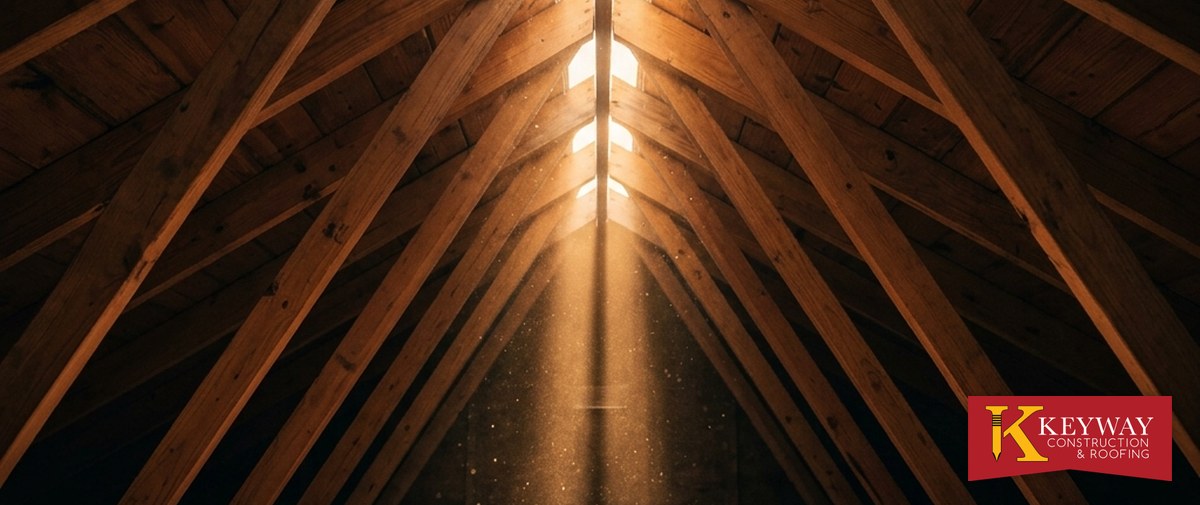
Keyway has worked in Charlotte attics for more than 50 years, mostly as roofers. That is the difference here. We are not an insulation-only crew that blows fiberglass to a depth and leaves. We look at the attic as part of your roof system, because that is what it is.
How much attic insulation does a Charlotte home actually need?
Charlotte sits in climate zone 3A, warm and humid. North Carolina’s energy code puts the attic minimum at R-38 for new construction. The Department of Energy’s guidance for our zone runs up to R-49, and that is the number we aim for on most retrofits.
In blown-in fiberglass, that works out to roughly 13 to 18 inches of settled depth. Here is the part homeowners get wrong: R-value is not about how much insulation is in the bag, it is about depth and coverage after it is installed. A patchy R-49 with gaps around the perimeter performs worse than an even R-38.
If your home was built before 2000, there is a decent chance you are sitting somewhere between R-11 and R-19. That was normal then. It is not close to current code now.
What we measure before quoting anything
- Current depth, measured in several spots, not just at the attic hatch where it always looks deepest.
- Coverage at the perimeter, where insulation thins out over the top plate and where most heat actually escapes.
- Whether the existing insulation is dry. Wet or compressed insulation has lost most of its R-value and needs to come out, not get buried.
- Whether the soffit vents are clear. Blown insulation packed into the eaves is one of the most common problems we find.
Want to know where your attic stands? Call 704-847-7119 or request a free attic assessment. No charge, no pressure.
Blown-in or batts: which works better in a Charlotte attic?
For an attic floor, blown-in wins almost every time. Batts are rectangles. Attics are not. Every truss web, every wire run, every ceiling box leaves a gap that a batt cannot fill, and those gaps are where the heat moves.
Blown-in fiberglass flows around all of it and lands as a continuous blanket. It also lets us top up an existing layer instead of tearing everything out, which keeps the job smaller when the old insulation is still dry and in decent shape.
Batts still have their place. Knee walls, the back of attic access hatches, floored storage areas, the occasional small crawl space. We use both, we just use them where each one belongs.
The Owens Corning AttiCat system we install
- Self-feeding system that expands the fiberglass inside the machine and puts it exactly where it belongs.
- Low-dust, no demolition, and no disruption to the living space in most standard attics.
- Virtually no settling, so the R-value you pay for is the R-value you keep.
- Non-combustible, and it does not sustain mold growth.
- We are an Owens Corning certified contractor, so our installers are trained on the exact product going into your attic.
Signs your Charlotte attic insulation is failing
You rarely see the problem. You notice the symptoms first.
- Energy bills climbing year over year, most obvious in the deep summer months and again during January cold snaps.
- Rooms that will not hold the same temperature. The bonus room over the garage is the classic one in Charlotte.
- HVAC that runs constantly and still cannot catch up on a 95 degree afternoon.
- Insulation that looks flat, grey, or patchy when you shine a light across the attic floor.
- Ice at the eaves after a rare freeze, or frost on the underside of the roof deck in winter.
- A house built before 2000, which usually means insulation well under today’s code.
- Dark staining on the sheathing, which points to a moisture and ventilation problem, not an insulation problem. Different fix entirely.
Any of that sound familiar? An hour in your attic tells us exactly what you are dealing with. If a top-up is all you need, that is what we will tell you.
Why insulation alone does not fix a hot attic
This is the part most insulation companies skip, and it is the reason we get called back out to attics other people already did.
An attic needs three things working together. Insulation to slow heat transfer into your ceiling. Air sealing to stop conditioned air leaking up through gaps. Ventilation to move the hot, damp air back out. Get one right and ignore the other two and you have wasted the money.
Air sealing comes first
Blowing insulation over an unsealed attic floor is like putting a sweater over a screen door. The air still moves. Before any fiberglass goes down, we seal the leaks: top plates, wire and pipe penetrations, the gap around the chimney chase, recessed can lights, and the attic hatch itself. ENERGY STAR puts the average saving from air sealing plus insulation at around 15 percent of heating and cooling costs. The sealing is doing a lot of that work.
Ventilation has to stay open
Your roof pulls cool air in at the soffit and pushes hot air out at the ridge. Bury the soffit vents under blown insulation and that stops. The attic superheats in summer, holds moisture in winter, and your shingles age faster from underneath. We install baffles at every rafter bay before we blow, so intake air still has a path. If your ventilation is already undersized, we will say so and show you why. More on that in our guide to attic ventilation and how it works, and how ventilation decides how long your roof lasts.
The things we find that nobody expected
Bath fans venting straight into the attic instead of out through the roof. Dryer ducts doing the same. Knee walls with bare drywall facing an unconditioned space. Duct runs leaking cold air into the attic all summer. Old insulation soaked from a roof leak nobody caught. We photograph what we find and walk you through it before we quote. Honest read, even when the honest read is smaller than what you were expecting to spend.
Call 704-847-7119 or book your free attic inspection. We will tell you what your attic needs, and what it does not.
What attic insulation installation looks like, step by step
- Free attic assessment. We measure existing depth, check coverage at the perimeter, look at the ventilation, and check for moisture damage.
- Written scope and price. You see the target R-value, the areas covered, and what is included, before anyone starts.
- Protect the house. Drop cloths on the path to the attic access, and the hose run stays off your floors.
- Air seal. Seal top plates, penetrations, and can lights so the new insulation has something solid to work against.
- Install baffles. Every rafter bay at the eaves gets a baffle so soffit intake stays open.
- Box out heat sources. Flues, chimneys, and any fixture that needs clearance get dammed off to code.
- Blow to depth. Even coverage across the whole attic floor, with depth markers so the result can be verified, not guessed.
- Clean up and walk through. We clear the site and show you photos of the finished attic, since most homeowners never go up there.
Most Charlotte attics are done in a single visit. Larger or cut-up attics, or attics that need old insulation removed first, take longer.
What drives the cost of attic insulation in Charlotte
We give written prices after we see the attic, never over the phone from a square footage guess. Our attic insulation cost guide walks through each factor in more detail. These are the factors that move the number:
- Attic square footage and how much of it is accessible.
- Target R-value and how much insulation is already up there.
- Removal. Wet, contaminated, or rodent-damaged insulation has to come out first. That is a separate scope.
- Air sealing volume. An attic with dozens of can lights takes longer to seal than one with none.
- Ventilation corrections, if intake or exhaust is undersized or blocked.
- Access. A low-pitch attic with 30 inches of headroom is slower work than one you can stand up in.
What we see in Charlotte attics, by the era the house was built
Charlotte’s building stock tells you a lot before we even open the hatch.
Homes built in the 1960s to 1980s
Usually ranches and split levels around Matthews, Mint Hill, and east Charlotte. Expect original insulation somewhere near R-11 to R-19, often settled to half its original depth. Frequently no baffles at all, because nobody installed them then. These attics give the biggest comfort jump for the money.
Homes built in the 1990s and 2000s
The two-storey stock across Waxhaw, Weddington, Indian Trail, and Ballantyne. Insulation is usually closer to R-30, which is not terrible, but the bonus room over the garage is almost always the weak point. Those knee walls and the floor under the bonus room get skipped or done badly, and that is why the room runs hot.
Homes built after 2010
Generally at or near code on depth. The problems here are different: insulation blown into the eaves and choking the soffit vents, bath fans dumping into the attic, and duct runs leaking in unconditioned space. Adding more fiberglass will not fix any of that.
What an under-insulated attic does to your roof
This is the cost nobody puts on the estimate. In a Charlotte August, an attic with weak insulation and poor airflow can run far hotter than the air outside. That heat sits against the underside of your roof deck all day, every day, for months.
Shingles age from both sides. The sun works on the top, trapped attic heat works on the bottom. Asphalt dries out faster, granules let go sooner, and a roof rated for 25 years starts looking tired at 15. In winter the same attic holds moisture, which shows up as dark sheathing, rusted nail tips, and eventually delamination.
So the insulation conversation is really a roof conversation. Fix the attic and you are protecting the most expensive part of the building envelope, not just chasing a power bill.
Insulation and your roof: do them in the right order
If a roof replacement is anywhere in your next couple of years, sequence matters. New shingles go on from outside. Ventilation, decking repairs, and anything that needs the roof open all happen at the same time. Blowing fresh insulation in first, then tearing off a roof and disturbing the attic, is backwards.
The better order: roof first, ventilation corrected while the roof is open, insulation right after. We handle both scopes, so you are not coordinating two contractors who blame each other. Read more on how attic insulation and your roof work together, or start with a free roof inspection if you are not sure where your roof stands. If it turns out the roof is near the end, here is what a roof replacement in Charlotte involves.
While we are up there we often catch soffit and fascia problems too, since rotted soffit and fascia is where blocked intake ventilation usually shows itself first.
Where we install attic insulation
We work across the Charlotte metro from our shop in Matthews: Charlotte, Matthews, Mint Hill, Stallings, Indian Trail, Waxhaw, Weddington, Monroe, Ballantyne, Pineville, and Fort Mill. See the full service area for the rest.
Why Charlotte homeowners choose Keyway for attic insulation
We have been based in Matthews for more than 50 years, at 740 Stallings Road. Same family, same phone number. Not a franchise, not a call center routing you to whoever is available.
Roofing is our core trade, which is exactly why our insulation work holds up. We know what an attic is supposed to do, how ventilation and insulation interact, and what happens to a roof when you get that balance wrong. An insulation-only crew is not thinking about your shingles. We are.
Every job comes with free next-day estimates, upfront written pricing with no hidden fees, and our 1-year workmanship warranty. If something is not right within 365 days, we come back and fix it. No argument. We are Owens Corning certified, rated on Angi, and accredited with the Better Business Bureau.
Beyond insulation we handle residential roofing, siding, windows, gutters, and home repairs across Charlotte. One contractor, one warranty, one call.
Attic insulation FAQs
How much attic insulation does a Charlotte home need?
Plan on R-38 to R-49, which is roughly 13 to 18 inches of blown-in fiberglass. R-38 is North Carolina’s code minimum for new construction and R-49 is the Department of Energy target for our climate zone. Older Charlotte homes often measure closer to R-19.
How do I know if my attic insulation needs replacing?
Climbing energy bills, rooms that will not hold temperature, an HVAC that runs nonstop, and insulation that looks flat or patchy are the usual signs. A free attic inspection settles it in about an hour.
Is blown-in insulation better than batts for an attic?
For an attic floor, yes. Blown-in fiberglass fills around joists, wiring, and odd corners where batts leave gaps, and those gaps are where the heat moves. We still use batts for knee walls and hatches.
Do you have to remove the old insulation first?
Not usually. If the existing insulation is dry and clean we blow over the top of it. If it is wet, contaminated, or rodent damaged, it comes out first, and we will show you why before quoting.
How long does attic insulation installation take?
Most Charlotte attics are finished in a single visit. Bigger attics, cut-up layouts, or jobs that need removal and air sealing first can run longer.
Will new attic insulation fix a hot upstairs bedroom?
Often it helps a lot, but insulation alone is not always the answer. Air leaks, blocked soffit vents, and leaking ductwork cause the same symptom. We check all of it before recommending work.
What does attic insulation cost in Charlotte?
It depends on attic size, target R-value, whether old insulation has to come out, how much air sealing is needed, and access. We give a written price after we see the attic, never a phone estimate.
Can you install insulation and replace my roof at the same time?
Yes, and that is usually the smart order. Roof and ventilation first, insulation right after, so the attic is not disturbed twice. We handle both scopes under one warranty.
Get a free attic insulation estimate in Charlotte
If your power bill is telling you something, let us go look. Free next-day estimates, honest assessments, and no pitch for work you do not need. Call 704-847-7119 or request your free estimate online.
Protect Your Gutters With Gutter Caps
Eliminate tedious maintenance tasks and unsightly clogs with time-saving gutter guards.See For Yourself
View Our Gallery of Projects
Proudly Serving
Matthews | Stallings | Mint Hill | Indian Trail | Weddington
Waxhaw | Monroe | Ballantyne | South Park | Arboretum |
Myers Park | Pineville | Fort Mill
Matthews | Stallings | Mint Hill | Indian Trail | Weddington
Waxhaw | Monroe | Ballantyne | South Park | Arboretum |
Myers Park | Pineville | Fort Mill