

How Long Does a Roof Last in Charlotte NC?
A roof that was installed in 2000 in Charlotte is now 25 years old. Whether it still has life left, needs repair, or should be replaced before the next storm season is a question that depends on the shingle type, how the roof was installed, how well it has been maintained, and how many significant storm events it has absorbed over those two and a half decades. This guide gives you honest, specific answers on how long different roofing systems last in Charlotte’s climate and what to watch for when yours is getting close to the end of its useful life.
Keyway Construction & Roofing has been inspecting and replacing roofs across Charlotte, Matthews, Mint Hill, Ballantyne, Indian Trail, Waxhaw, Weddington, and the surrounding communities since 1975. If your roof is approaching or past its expected lifespan, call us at 704-847-7119 for a free next-day inspection. We give you a straight answer on what we find.
How Charlotte’s Climate Affects Roof Lifespan
Charlotte sits in a humid subtropical climate, which means the roofing conditions here are more demanding than in many other parts of the country. Understanding what this climate actually does to a roof helps you calibrate your expectations for your specific situation.
Summer UV and heat: Charlotte regularly records surface temperatures on south and west-facing roof slopes of 150 to 180 degrees Fahrenheit during July and August afternoons. That level of heat exposure accelerates granule loss on asphalt shingles, dries out the asphalt binder that holds the shingle together, and over years causes the characteristic curling and cracking that signals a shingle approaching the end of its life. A shingle rated for 30 years in a moderate climate often delivers 22 to 25 years in Charlotte’s heat profile.
Humidity and moisture cycling: Charlotte averages 44 inches of rainfall annually, distributed fairly evenly across the year with peaks in spring and late summer. Roofing systems that cycle between wet and dry conditions repeatedly experience stress at every joint, penetration, and seam. Flashing that stays properly sealed in a dry climate may lift at a caulk joint within a few years in Charlotte’s moisture environment. This is why annual inspections matter here in a way they may not in drier markets.
Storm activity: Charlotte and the surrounding metro experience three to five significant hail events annually on average, along with frequent thunderstorm wind events producing gusts above 50 miles per hour and occasional remnants of Atlantic tropical systems. Each significant storm event that a roof absorbs affects its remaining service life. A roof that has taken two major hail events in five years has aged more than its calendar age suggests.
Algae and biological growth: Charlotte’s humidity and tree canopy density create conditions where algae, moss, and lichen grow readily on shaded roof slopes. North-facing slopes and areas under tree cover are most vulnerable. Algae growth by itself does not damage shingles quickly, but moss and lichen hold moisture against the shingle surface and accelerate deterioration over time. Black streaks on Charlotte roofs are almost always algae (Gloeocapsa Magma), not structural damage, but they are a maintenance item worth addressing.
How Long Different Roofing Systems Last in Charlotte
Three-Tab Asphalt Shingles
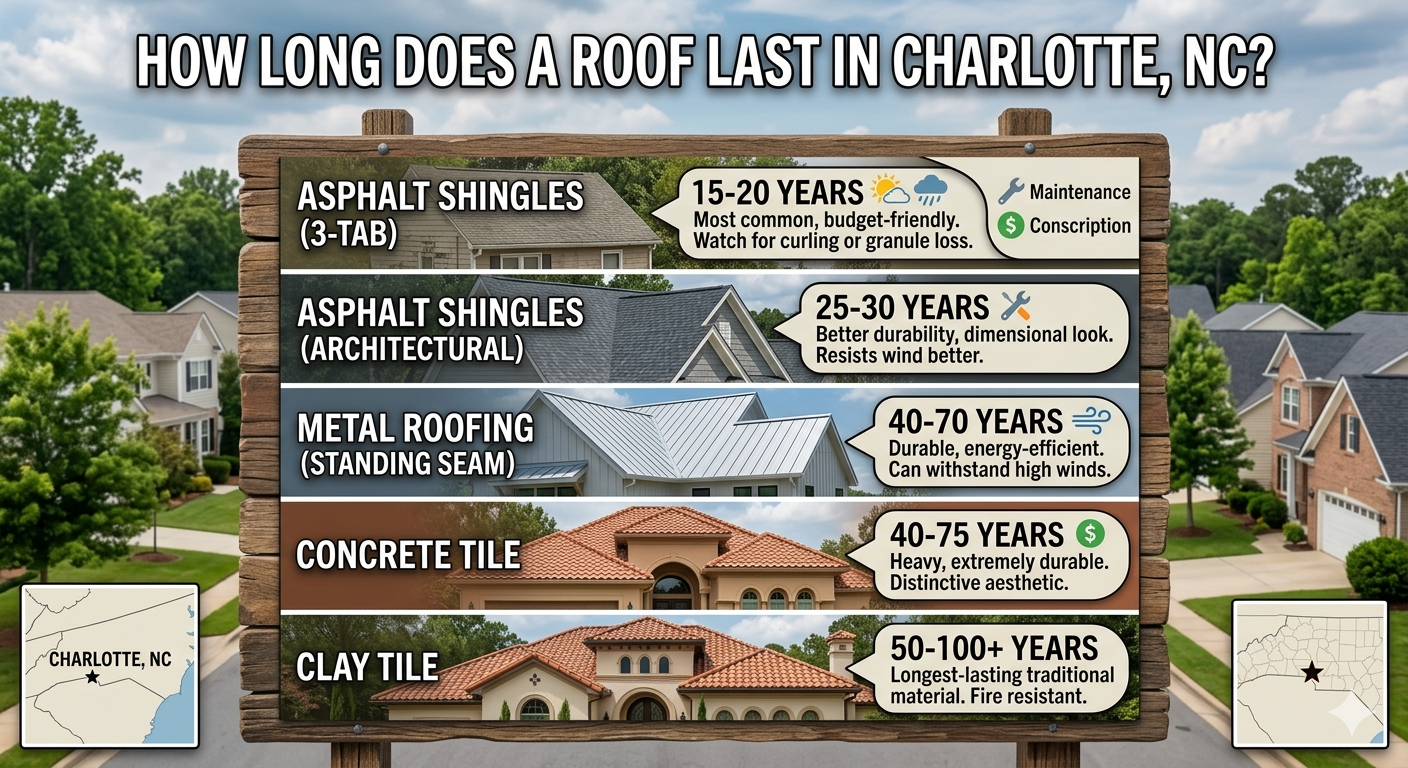
Three-tab shingles are the flat, uniform-appearance shingles that were standard on most Charlotte residential construction through the 1990s and early 2000s. They have a manufacturer-rated lifespan of 20 to 25 years and a real-world lifespan in Charlotte’s climate of 15 to 20 years in most cases. Three-tab shingles are lighter and thinner than architectural shingles, with a lower wind resistance rating, less granule coverage, and less impact resistance. A three-tab roof installed in 2000 in Charlotte is effectively at or past its expected service life now, regardless of whether it is currently leaking. Its ability to absorb the next significant storm event is meaningfully compromised.
If your home has three-tab shingles and they are 18 or more years old, replacement planning is appropriate even without a specific trigger event. Waiting for a visible failure on an aged three-tab roof often means waiting until interior damage has already begun.
Architectural (Dimensional) Shingles
Architectural shingles are the heavier, textured, multi-layer shingles that became the residential standard in the Charlotte market through the 2000s and remain the dominant product today. They have a manufacturer-rated lifespan of 25 to 30 years and a real-world lifespan in Charlotte of 22 to 28 years for a properly installed, well-ventilated roof that has not absorbed major storm damage.
The wide variability in that range reflects how much installation quality, attic ventilation, and storm history affect real-world performance. An architectural shingle roof with proper attic ventilation, installed by an experienced crew over a clean deck with correct fastening patterns, regularly reaches 27 to 30 years in this climate. One installed over an existing roof with inadequate ventilation and a nail gun pattern that was a fastener or two off might start showing performance issues at 18 to 20 years. Poor airflow shortens roof life; ask us about attic ventilation.
The most common scenario we see in Charlotte is an architectural shingle roof installed between 1998 and 2005 that is now in its last five years of reliable service life. The owners know it is getting old, have had a few repair calls in recent years, and are trying to determine whether to continue maintaining it or replace before the next storm season. In most cases, a professional inspection gives a clear answer based on granule coverage remaining, shingle tab adhesion, and flashing condition.
Impact-Resistant Architectural Shingles (Class 3 and Class 4)
Impact-resistant shingles, rated under UL 2218 testing, are engineered to withstand hail impact significantly better than standard architectural shingles. Class 3 shingles are tested to withstand 1.75-inch hail without cracking. Class 4 shingles are tested to withstand 2-inch steel balls dropped from 20 feet with no cracking, which simulates approximately two-inch hail impact.
In Charlotte’s storm environment, Class 4 impact-resistant shingles have a meaningful performance advantage over standard architectural shingles. Their lifespan in this market runs 25 to 35 years, and several North Carolina insurance carriers offer premium discounts for homes with Class 4 shingles, which can partially offset the higher material cost over time. For homeowners replacing a roof after storm damage or proactively before a high-risk storm season, the upgrade to Class 4 is worth discussing seriously.
Metal Roofing (Standing Seam and Steel Panel)
Metal roofing has a dramatically longer lifespan than any asphalt product in Charlotte’s climate. A properly installed standing seam metal roof typically lasts 40 to 70 years with minimal maintenance. Steel panel systems run 25 to 45 years. Metal is essentially immune to the granule loss and UV degradation that limits asphalt lifespans, does not crack under freeze-thaw cycling, and performs well in hail events at standard impact sizes.
The trade-off is upfront cost. Metal roofing in Charlotte typically costs two to three times the price of an architectural shingle replacement. For homeowners who are committed to staying in a home for 20 or more years and want to install the last roof they will ever need to deal with, the economics can work. For most standard residential replacement situations, architectural shingles remain the practical choice.
Tile and Slate Roofing
Concrete tile and clay tile roofing have lifespans of 30 to 50 years and are occasionally found on Charlotte-area homes, more commonly in higher-end custom construction. Slate roofing, which is rare in the Charlotte market, can last 80 to 150 years when properly maintained. Both materials are significantly heavier than asphalt, require structural support designed for their weight, and are more expensive to repair when individual pieces crack or break. They are not practical considerations for most standard Charlotte residential roof replacements.
The Factors That Shorten Roof Lifespan in Charlotte Specifically
Based on our inspections across the Charlotte metro over 50 years, these are the conditions that consistently produce roofs that fail before their rated lifespan:
Inadequate attic ventilation: This is the single most common cause of premature shingle failure in Charlotte. When an attic is inadequately ventilated, heat builds up in the attic space and essentially cooks the shingles from below. Attic temperatures that should peak around 130 degrees in summer reach 160 or higher in poorly ventilated spaces, and the shingle binder breaks down years ahead of schedule. The signs are premature curling at the edges and cracking across the shingle field on a roof that should have more life remaining. Proper attic ventilation is a ratio of intake area at the soffits to exhaust area at the ridge, and getting that ratio right matters significantly for shingle longevity. Our insulation service includes attic assessment that identifies ventilation deficiencies alongside insulation inadequacies.
Layering new shingles over old: Building codes in many jurisdictions allow up to two layers of asphalt shingles. Adding a new layer over an existing one saves money on tear-off but creates several problems. The old layer adds deck weight, traps heat between layers, and prevents full inspection of the deck condition before new material is installed. A roof installed over a rotted deck section or a deteriorated first layer will fail at those points regardless of the new shingle quality. We always recommend single-layer installation over a clean, inspected deck.
Storm accumulation without inspection: Charlotte homeowners who have never had their roof professionally inspected after a significant hail event may be living under a roof that has absorbed two or three qualifying hail events over 15 years without any of the granule displacement and mat bruising being documented. That damage is real, it has shortened the roof’s remaining life, and it may have been claimable if caught shortly after each event. Annual inspections after storm events prevent this accumulation from going unrecognized.
Poor original installation: Improper fastening patterns, inadequate flashing installation, insufficient underlayment, and sloppy valley construction all produce failures well before the rated shingle lifespan. These are not always obvious to a homeowner at the time of installation but show up clearly during a professional inspection. A roof that is leaking at a valley after 10 years when the shingles should have 15 more years of life is almost always an installation quality issue at that specific location.
Deferred maintenance: Gutters that overflow repeatedly against the fascia, moss that is allowed to grow unchecked on north-facing slopes, pipe boots that are cracked and leaking for years before they produce an interior stain, and debris buildup in valleys all contribute to shortened roof lifespan. These are maintenance items that catch and fix for modest cost before they become replacement triggers.
Signs Your Charlotte Roof Is Approaching Replacement
These are the indicators that tell you a professional inspection is overdue and replacement may be in your near future:
- Curling at the edges: Shingles that cup upward at the tab edges or cup at the center indicate advanced age and UV damage. This is most visible on south-facing slopes in Charlotte where sun exposure is highest.
- Granule loss across the field: Patchy dark areas on the shingle surface where granules are missing expose the underlying mat to UV radiation and dramatically accelerate the remaining degradation timeline. Large volumes of granules in gutters or at downspout outlets after a rainstorm are a leading indicator of widespread granule loss.
- Cracking across individual shingles: Shingles that are cracking perpendicular to their length indicate the binder has dried out beyond recovery. This typically occurs 18 to 22 years into a three-tab shingle’s life in Charlotte’s climate.
- Flashing failures around penetrations: Multiple flashing failures at different penetrations on the same roof indicate the system as a whole is aging. One flashing failure can be repaired economically. Four or five on the same roof suggest the overall system is near end of life.
- Daylight visible in the attic: Any visible daylight penetrating the roof deck in an attic inspection indicates an active penetration that needs immediate attention regardless of the overall roof condition.
- Roof age over 20 years with no recent inspection: If your roof is more than 20 years old and has not had a professional inspection in the past two to three years, scheduling one before the next storm season is the most cost-effective thing you can do. The inspection itself is free, and knowing your roof’s actual condition is better than being caught unprepared.
When to Repair vs. When to Replace
This is the question we field most often during inspections, and the answer depends on two things: the age of the roof and the distribution of the problem.
A repair is the right call when the roof is under 15 years old, the problem is isolated to one or two specific locations (a pipe boot, a valley, a chimney flashing), and the rest of the roof is performing well. A repair at that point is economical and extends the life of a system that still has meaningful value.
Replacement is the right call when the roof is past 20 years, when problems are appearing at multiple locations simultaneously, when the shingle field shows widespread granule loss or cracking rather than isolated damage, or when a storm event has caused widespread impact damage across the roof surface. At that point, the cost of ongoing repairs approaches or exceeds the cost of replacement over a three to five year horizon, and replacement produces a reliable system under warranty rather than a patched one that will continue to require attention.
We tell you honestly which situation you are in during the inspection. We do not recommend replacement when repair is genuinely the right answer, and we do not recommend repair when the roof has reached the point where continuing to invest in it does not make financial sense.
Keyway Construction: Honest Roof Assessments in Charlotte Since 1975
Keyway Construction & Roofing is a licensed general contractor based in Matthews, NC, with over 50 years of roofing experience across the greater Charlotte metro. We inspect residential and commercial roofing systems throughout Charlotte, Matthews, Stallings, Mint Hill, Ballantyne, Indian Trail, Waxhaw, Weddington, Monroe, and surrounding communities.
Our roof inspections are free and come with no obligation to proceed with any work. We document what we find, tell you clearly what it means for your roof’s remaining service life, and give you a written estimate if repair or replacement is warranted. Our 1-year workmanship warranty covers all installation work, and our Owens Corning certification means manufacturer warranty coverage is available on qualifying replacements.
Call 704-847-7119 or contact us online for a free next-day roof inspection anywhere in the greater Charlotte metro. If your roof is approaching 20 years or has been through several significant storms without a professional inspection, now is the right time to know what you are working with.
Roof Lifespan FAQs for Charlotte Homeowners
How long does an asphalt shingle roof last in Charlotte NC?
Three-tab asphalt shingles typically last 15 to 20 years in Charlotte’s climate. Architectural (dimensional) shingles last 22 to 28 years under good conditions. The real-world numbers are shorter than manufacturer ratings because Charlotte’s combination of summer heat, UV exposure, storm activity, and humidity is more demanding than the moderate conditions manufacturer ratings assume. A well-ventilated, properly installed architectural shingle roof on a Charlotte home that has not absorbed major storm damage regularly reaches 25 years. One with poor ventilation or multiple storm hits may show performance issues at 18 to 20 years.
My Charlotte roof is 25 years old but it is not leaking. Does it still need to be replaced?
Not necessarily immediately, but a professional inspection is overdue. A 25-year-old architectural shingle roof in Charlotte may have several years of service remaining if it was installed well, has good attic ventilation, and has not absorbed significant storm damage. Or it may be at the point where granule coverage and shingle integrity are compromised enough that the next significant storm will produce multiple failures. You cannot assess this from the ground or from inside the house. A free professional inspection tells you exactly where you stand and what the realistic remaining service life is based on what we actually find rather than what the calendar says.
How does a hail storm affect how long my Charlotte roof will last?
Significantly, depending on hail size and the roof’s current age. A significant hail event, typically one inch or larger, displaces granules across the roof field and compresses the shingle mat at impact points. Granules are the shingle’s UV protection. Their displacement accelerates the binder degradation that eventually causes cracking, curling, and water infiltration. A roof that absorbs a significant hail event at 12 years old may now behave like a 17-year-old roof in terms of remaining performance. Multiple hail events compound this acceleration. This is why professional inspection after every significant hail event in Charlotte matters practically, not just for insurance purposes.
What is the best roofing material for Charlotte's climate?
For the majority of Charlotte homeowners, architectural shingles from a major manufacturer (Owens Corning, CertainTeed, GAF) represent the best balance of cost, durability, and availability. In Charlotte’s storm environment specifically, impact-resistant Class 4 architectural shingles are worth the modest upgrade cost for homeowners who plan to stay in their home for 15 or more years. They perform meaningfully better in hail events and qualify for insurance premium discounts from several NC carriers. Metal roofing is the highest durability option with the longest lifespan, but at two to three times the cost of architectural shingles it makes financial sense only for specific situations.
How often should I have my Charlotte roof inspected?
We recommend a professional roof inspection at least once every two to three years for roofs under 15 years old and annually for roofs 15 years or older. In addition, we recommend an inspection within a week of any storm event that produced documented hail of three-quarters of an inch or larger in your area. Many hail damage claims in Charlotte are missed because homeowners wait to see a leak before calling. By the time a hail-damaged shingle leaks, the granule loss and mat compression have already shortened the roof’s service life by years. Our inspections are free. There is no downside to knowing what you have.
Does Keyway offer free roof inspections in Charlotte?
Yes. We offer free next-day roof inspections across Charlotte, Matthews, Stallings, Mint Hill, Ballantyne, Indian Trail, Waxhaw, Weddington, Monroe, and surrounding communities. The inspection includes the full roof surface, all penetrations, gutters, fascia, and visible soffit. You receive a written summary of findings and, if repair or replacement is warranted, a written estimate. There is no obligation to proceed with any work. Call 704-847-7119 to schedule.
Keyway Construction provides free roof inspections, residential and commercial roof repairs, and full roof replacements across the greater Charlotte metro. Related services include residential roofing, roof repair in Charlotte, insurance claim assistance for storm-related roof damage, storm damage roofing in Ballantyne, storm damage in Matthews, storm damage in Waxhaw, storm damage in Weddington, and attic insulation (which directly affects how long your roof lasts). Also read our blog on attic insulation cost in Charlotte and how to file a roof insurance claim in Charlotte. Call 704-847-7119 for a free next-day inspection anywhere in the Charlotte area.
Recent Posts

Protect Your Gutters With Gutter Caps
Eliminate tedious maintenance tasks and unsightly clogs with time-saving gutter guards.See For Yourself
View Our Gallery of Projects
Proudly Serving
Matthews | Stallings | Mint Hill | Indian Trail | Weddington
Waxhaw | Monroe | Ballantyne | South Park | Arboretum |
Myers Park | Pineville | Fort Mill
Matthews | Stallings | Mint Hill | Indian Trail | Weddington
Waxhaw | Monroe | Ballantyne | South Park | Arboretum |
Myers Park | Pineville | Fort Mill