

Exterior Wood Rot and Trim Repair in Charlotte, NC
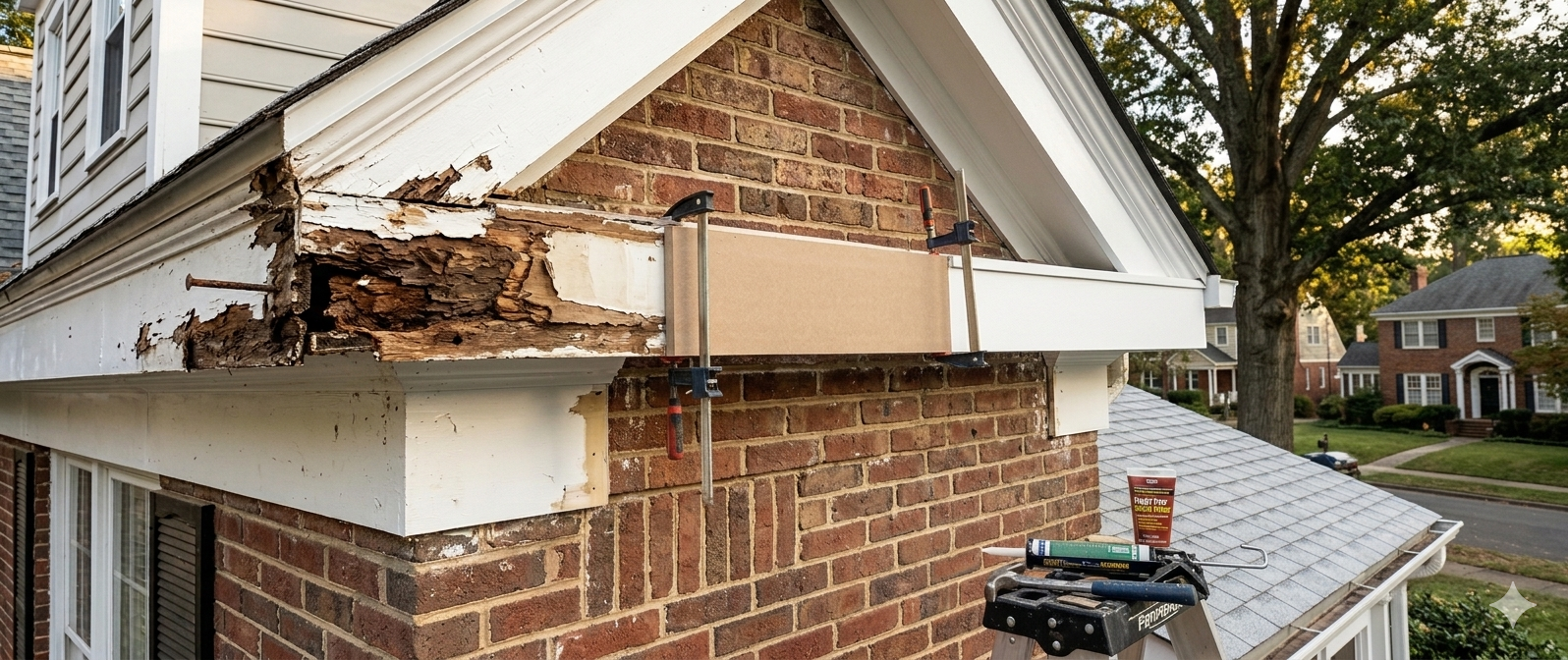
Exterior trim is the most exposed wood on any Charlotte home. Corner boards, door casings, brick molding, frieze boards, band boards, and rake trim sit at the exact locations where wall meets roof, wall meets window, and wall meets door , the joints where water concentrates, caulk fails first, and end grain sits fully exposed to whatever the season brings. Charlotte’s humid subtropical climate gives these joints almost no rest. Summer thunderstorms drive rain into every caulk crack. High humidity keeps wood at elevated moisture levels for weeks after a rain event. UV exposure through long summers dries out whatever oil remains in aging pine, making it brittle and prone to splitting at nail points and joints.
If the rotted trim is on a dormer, the flashing is usually involved too. Our dormer repair guide explains why.
Keyway Construction provides exterior trim repair in Charlotte, NC and across the greater metro. We are a licensed general contractor headquartered in Matthews with over 50 years of exterior carpentry work in this market. We repair rotted trim components using the right approach for the specific location and material, replace boards where decay has progressed beyond restoration, and finish every repair to match your existing exterior. Free next-day estimates. Call 704-847-7119 or request yours online.
Why Exterior Trim Fails Faster in Charlotte Than Most Homeowners Expect
The trim components on a Charlotte home face a specific combination of stresses that accelerate decay faster than the product specifications suggest. Understanding where and why trim fails in this climate helps you catch problems before they become expensive.
End Grain Exposure at Every Joint
Every cut end of a piece of wood trim exposes the end grain directly to the environment. End grain absorbs moisture at roughly 10 to 15 times the rate of face grain. A corner board cut to length and butted against a horizontal trim piece has its end grain sitting directly at a joint that accumulates water during every rain event. When caulk at that joint fails, which it does on virtually every Charlotte home within 5 to 8 years of application, the exposed end grain begins absorbing and holding moisture through each wet period. Fungal spores activate when wood moisture content exceeds 20 percent. In Charlotte’s climate, that threshold is crossed regularly at failed trim joints throughout the warm season.
Charlotte’s Thermal Cycling Works Against Caulk
Charlotte’s temperatures swing from summer highs above 95 degrees Fahrenheit to winter lows that occasionally dip below 20 degrees. That range exceeds 70 degrees of thermal cycling. Wood and caulk expand and contract at different rates through this range. Flexible caulk becomes less flexible with age and UV exposure. After several years of this cycling, caulk at trim joints cracks and pulls away from one or both surfaces, opening a direct water path to the end grain and the back of the board. This is why paint bubbles and peels at the same locations year after year on older Charlotte homes, even when the repair is done carefully. The paint is not failing. The joint beneath it is failing, and moisture is coming from behind.
Tree Canopy Creates Persistent Moisture Zones
Many of the most desirable Charlotte neighborhoods, including Dilworth, Myers Park, Elizabeth, Eastover, and the mature corridors of Matthews and Mint Hill, have established tree canopy that shades north and east-facing walls for much of the day. Shaded trim dries significantly slower after rain events than trim in full sun. A shaded corner board that absorbs moisture during a morning rain may still be at elevated moisture content two days later when the next storm arrives. That sustained moisture exposure is exactly the environment where decay advances fastest, and it explains why rot on shaded elevations of Charlotte homes consistently outpaces the visible wear on south and west-facing trim.
Every Exterior Trim Component We Repair in Charlotte
Exterior trim is not a single component. It is a system of boards, moldings, and profiles that together define the exterior character of a home and protect every vulnerable joint in the wall assembly. Here is what we repair and replace across Charlotte homes:
Corner Boards
Corner boards run vertically at the outside corners of a home, covering the exposed ends of the siding courses and providing a finished edge where two wall planes meet. They are among the most vulnerable trim locations on any Charlotte home because they face two weather exposures simultaneously and collect water running down from above. Rot at corner boards typically starts at the base, where the board contacts or comes close to grade, and at the mid-point joints where two boards are spliced. Once rot reaches the corner board, it frequently travels into the sheathing behind it, which requires opening the wall cavity to properly address.
We replace rotted corner board sections with properly primed material, address any sheathing damage behind the board, and integrate the repair with the adjacent siding courses. For high-moisture locations at corners, particularly at grade level or below overhangs where water concentrates, we recommend PVC composite corner boards that eliminate the decay cycle entirely.
Door Casing and Brick Molding
The trim that frames your exterior doors, the casing and brick molding that runs along the sides and head of the door opening, is the highest-traffic trim location on any home from a water exposure standpoint. Every time it rains, water runs down the door face, into the door sweep, and along the casing sides. The bottom corners of the door casing where it contacts the threshold and sill are chronically exposed to standing water during heavy events. On most Charlotte homes built before 2005, the original door casing is paint-grade pine that has been through enough moisture cycles to develop significant end grain decay at those bottom corners even when the visible paint surface looks acceptable.
We replace door casing and brick molding using properly primed material and, for chronic moisture situations, PVC profiles that match standard casing dimensions and accept paint the same as wood. Every replacement includes re-caulking the full door perimeter, addressing the threshold condition, and priming and painting the completed installation to match the surrounding exterior finish.
Window Trim and Brick Molding
The trim surrounding exterior windows fails by the same mechanism as door casing, with one additional factor: window sills are designed to slope water away from the wall, but the caulk joint at the sill-to-casing corner collects water during wind-driven rain and holds it against the end grain of the side casing. Once that joint fails, decay at the base of the window side casing is predictable. Older Charlotte homes frequently have rot at the bottom 6 to 12 inches of window side casing that is not visible from ground level because paint holds the surface intact while the interior of the board has softened.
We repair window trim in coordination with window sill work when needed. For detail on window sill rot specifically, see our window sill repair page. For homes where window replacement and trim repair are both needed, see our Charlotte window replacement page for how we handle both under one contract.
Frieze Boards
Frieze boards run horizontally at the top of the wall where it meets the roofline, sitting directly below the soffit. They are a chronic moisture problem on Charlotte homes because water that gets under the shingle edge or behind the fascia runs down and sits against the top of the frieze board. Gutter overflow during heavy events saturates the frieze from above. On homes with any degree of soffit deterioration, moisture that accumulates in the soffit cavity works into the frieze board from behind. Frieze rot is almost always more extensive than it appears from the ground because the decay starts at the back of the board, where it contacts moisture from above, before it shows on the painted face.
We repair and replace frieze boards in coordination with fascia and soffit work when those components are also affected. See our fascia and soffit repair page and our soffit and fascia overview for how these components relate to the full roofline assembly.
Band Boards
Band boards, also called belt courses or water tables, run horizontally across the wall face to mark the transition between floors or between different siding materials. They are designed to shed water away from the wall below them, but the horizontal top surface of a band board accumulates water during rain events and holds it against any crack, gap, or end-grain exposure in the board. On two-story Charlotte homes, band boards that have not been maintained or recaulked in several years develop decay along their top edge that is invisible until the board is probed.
We replace rotted band board sections, address any sheathing damage at the joints behind them, and integrate the installation with the adjacent siding above and below. For homes with fiber cement or Hardie siding where the band board transitions between materials, we ensure the new board profile matches the existing specification exactly.
Rake Boards
Rake boards run along the sloped edges of a gable roof, covering the transition between the roof surface and the gable wall. They are fully exposed to wind-driven rain from multiple directions and take the direct impact of any debris coming off the roof during storms. On Charlotte homes with significant tree canopy, debris accumulation against the rake board keeps those surfaces wet far longer than bare rake boards in open locations. Rake board rot typically begins at the junction with the horizontal fascia board at the eave and progresses upward along the gable slope.
Decorative Molding and Millwork
Older Charlotte homes in established neighborhoods, particularly the craftsman bungalows and colonial revival homes common in Dilworth, Plaza Midwood, and Myers Park, frequently have decorative exterior millwork: pediment heads over doors, pilasters, decorative frieze details, and custom molding profiles. These components require careful material matching to restore properly. We work with these profiles and, where original wood is no longer the right choice for a high-moisture location, can fabricate matching profiles in PVC composite that paint to an identical appearance.
Repair vs. Full Replacement: How We Decide
| Situation | Epoxy Repair | Full Replacement |
|---|---|---|
| Decay depth | Surface layer only, back of board solid | Full thickness compromised, board crushes under pressure |
| Spread | Contained to defined section with clear boundaries | Has spread to adjacent boards or into sheathing behind |
| Structural role | Cosmetic trim with no structural load | Load-bearing or structural component |
| Future moisture exposure | Moisture source can be corrected | Chronically wet location, consider PVC composite |
| Board age and condition | Otherwise sound, damage isolated | Original installation, board near end of service life |
We probe every affected area before recommending an approach. Epoxy consolidants and fillers work well for isolated surface rot where the board structure is still intact. They are cost-effective and, when done properly, produce a surface that accepts paint identically to the surrounding wood. When decay has penetrated through the full board thickness, when it has spread to adjacent material, or when the location is chronically wet enough that wood replacement will just restart the rot cycle, we recommend full board replacement with the right material for that location. For more on this decision, see our wood rot treatment vs. repair guide.
Material Selection for Charlotte’s Climate
The material choice for exterior trim replacement matters more in Charlotte’s climate than in more temperate regions. Here is how the main options compare:
- PVC composite trim (AZEK, Versatex, Kleer) , will not rot under any moisture exposure, does not require painting for preservation, accepts paint extremely well, and handles Charlotte’s thermal cycling without the joint movement that causes caulk failure on wood. The best long-term choice for any high-moisture location: door and window base casing, corner board bases, frieze boards, and band board top edges. Costs more than paint-grade pine upfront but eliminates the rot cycle at that location permanently.
- Finger-jointed primed pine , the standard for most trim replacement on Charlotte homes. More affordable than PVC composite, takes paint well when properly primed on all six faces before installation, and performs acceptably in moderate moisture exposure situations. Requires proper caulking and periodic maintenance to remain rot-free. Not recommended for locations with chronic moisture problems.
- Clear-grade western red cedar , naturally rot-resistant, appropriate for exposed locations where knot-free appearance matters. More expensive than finger-jointed pine, better than pine in moisture-exposed situations, but not as durable as PVC composite in Charlotte’s sustained humidity environment.
- Fiber cement trim (HardieTrim) , dimensionally stable, will not rot, and holds paint well. A strong choice for trim replacement on homes already sided with fiber cement where material matching matters. Heavier and more brittle than PVC composite, requiring more careful handling during installation.
We discuss material options during every estimate and explain the trade-offs for your specific locations. We never push a premium material where a standard one will perform well, and we never install paint-grade pine in a location where the moisture exposure guarantees a repeat repair visit in three years.
How Exterior Trim Repair Connects to the Rest of Your Exterior
Exterior trim rot almost never exists in isolation. Every trim location sits adjacent to other exterior components, and the moisture that rots the trim is almost always coming from a failure in one of those components. Understanding how these systems connect is what separates a permanent repair from one that is repeated two seasons later.
Exterior Trim Repair Across Charlotte, Matthews, and Union County
We repair exterior trim across the full greater Charlotte metro. The character of trim repair work varies meaningfully by neighborhood and housing era:
Charlotte historic neighborhoods (Dilworth, Myers Park, Elizabeth, Plaza Midwood, NoDa) carry original wood trim from the 1920s through 1960s, much of it old-growth pine that has lasted decades but is now fully saturated with moisture history. Repairs in these areas require profile matching to original trim dimensions, which differ from modern off-the-shelf profiles. We measure and match existing profiles before ordering material. For the Charlotte-specific wood rot scope, see our Charlotte wood rot repair page.
Matthews and Stallings are our home market. We are headquartered at 740 Stallings Road and respond here faster than anywhere in the metro. Matthews’ mix of 1970s ranches and newer subdivisions means we see both original wood trim on its last cycle and builder-grade trim on its first major maintenance window. See our Matthews wood rot repair page for the full local scope.
Ballantyne and south Charlotte homes from the 1995 to 2015 build era are entering the window where original caulk at trim joints has failed completely, original door and window casing has absorbed enough moisture to develop corner rot, and band boards and frieze boards show their first real deterioration. HOA appearance requirements in many Ballantyne communities mean finished repairs need to match the surrounding exterior precisely. Our Ballantyne wood rot repair page covers this market in detail.
Monroe and Union County properties span from historic downtown homes with original millwork to new subdivisions where trim rot relates to construction-era flashing and caulking quality. For Monroe-specific work, see our Monroe wood rot repair page and our Monroe roof repair page for how roofing and trim often need to be addressed together.
Indian Trail, Waxhaw, and Weddington are Union County growth communities where 2000s-era homes are hitting their first major trim maintenance cycle. HOA standards in Weddington and Waxhaw subdivisions require careful material selection and appearance matching. See our Weddington and Waxhaw pages for how we serve these communities.
Mint Hill and Cornelius carry housing stock across multiple eras, with Mint Hill’s older neighborhoods showing established tree canopy and persistent moisture conditions on north-facing trim, and Cornelius properties near Lake Norman experiencing above-average trim deterioration from the additional humidity. See our Mint Hill and Cornelius service pages.
Frequently Asked Questions , Exterior Trim Repair in Charlotte
What types of exterior trim does Keyway repair in Charlotte?
We repair and replace all exterior trim components on Charlotte homes including corner boards, frieze boards, band boards, door casing, brick molding around windows and doors, rake boards, and decorative molding and millwork. We handle both epoxy restoration for early-stage decay and full board replacement when rot has penetrated through the full thickness of the material. As a licensed general contractor, we also handle any structural damage to sheathing or framing behind the trim when the inspection reveals it.
What is the best material for exterior trim replacement in Charlotte, NC?
For most high-moisture trim locations in Charlotte’s climate, PVC composite trim (brands like AZEK, Versatex, or Kleer) is the strongest long-term choice. It will not rot under any moisture exposure, handles Charlotte’s thermal cycling without joint movement, and accepts paint exactly like wood. For moderate exposure locations where budget is a priority, properly primed finger-jointed pine performs well with regular maintenance. For historic homes where matching original profiles matters, cedar or finger-jointed pine with proper all-six-face priming before installation is appropriate. We discuss the right material for each specific location during the estimate.
Can Keyway handle trim repair and roofing or siding on the same job?
Yes. As a licensed general contractor, Keyway handles exterior trim repair alongside roofing, siding, fascia, soffit, and wood rot repair throughout the home under one contract. Trim rot rarely exists in isolation , it usually travels alongside roofline failures, siding gaps, or gutter overflow. Handling the full scope together means one estimate, one crew, and one 1-year workmanship warranty. This is a core advantage of working with a licensed GC rather than a trim-only or roofing-only specialty company.
How do I know if my exterior trim has wood rot or just surface paint failure?
Press a screwdriver or your thumb firmly into the trim surface. If the wood compresses, feels spongy, or crumbles, rot is present below the surface. Paint that bubbles and peels repeatedly in the same location on a trim board indicates moisture coming from within the wood rather than just UV surface degradation. Trim that has pulled away from the wall at the caulk line has usually been cycling through moisture expansion, and those joints almost always have rot at the end grain when probed properly.
How long does exterior trim repair take on a Charlotte home?
Most single-location repairs, a section of corner board, a door casing, a band board run, are completed in a half-day to one day including priming and painting. Larger scopes covering multiple elevations or full roofline trim replacement typically take two to three days. We give you a clear timeline in the written estimate and do not leave repairs unpainted or unfinished at the end of a work day.
Get Your Free Exterior Trim Repair Estimate in Charlotte
If your Charlotte home has trim boards that are soft, pulling away from the wall, bubbling paint in the same spots year after year, or visible decay at door and window corners, the right first step is a free inspection from a licensed contractor who can probe the actual extent of the damage and give you an accurate written estimate before any work begins.
Keyway Construction provides free next-day exterior trim repair inspections across Charlotte, Matthews, Ballantyne, Mint Hill, Monroe, Indian Trail, Waxhaw, Weddington, Cornelius, and the full greater metro. We have been doing this work in this market since 1975. We tell you what we found, what the right repair approach is, and exactly what it will cost before we start. No pressure. No obligation.
Call 704-847-7119 or request your free estimate online.
Related services: Wood rot repair hub | Fascia and soffit repair | Window sill repair | Deck wood rot repair | Porch column repair | Carpentry and wood rot repair | Soffit and fascia | Siding | Roof repair | Gutters
Protect Your Gutters With Gutter Caps
Eliminate tedious maintenance tasks and unsightly clogs with time-saving gutter guards.Proudly Serving
Matthews | Stallings | Mint Hill | Indian Trail | Weddington
Waxhaw | Monroe | Ballantyne | South Park | Arboretum |
Myers Park | Pineville | Fort Mill
Matthews | Stallings | Mint Hill | Indian Trail | Weddington
Waxhaw | Monroe | Ballantyne | South Park | Arboretum |
Myers Park | Pineville | Fort Mill