

Why DIY Roof Tarps Fail Ballantyne Homeowners (And What to Do Instead)
After a storm damages your Ballantyne roof, the immediate instinct is right: cover the breach before the next rain. The problem is that 90% of DIY tarping attempts on Ballantyne residential roofs fail within two weeks. Most fail within one additional wind event. And a failed tarp, one that lifts, tears, or channels water rather than deflecting it, doesn’t just fail to protect your home. It can actively damage your insurance claim.
Keyway Construction & Roofing has performed emergency tarping and follow-up storm damage roof repair across Ballantyne, NC for over 50 years. We’ve inspected the aftermath of hundreds of DIY tarping attempts, after the 2020 Easter event, after the 2022 derecho, and after every significant storm since. Here is exactly why they fail, what correct Ballantyne roof tarping looks like, and why getting it right matters for more than just keeping your ceiling dry.
Why DIY Ballantyne Roof Tarping Fails: 5 Root Causes
1. Wrong Tarp Weight
The blue poly tarps sold at home improvement stores are 5 to 6 mil polyethylene. They are designed for covering lumber piles, garden furniture, and other ground-level applications. Ballantyne experiences sustained wind events regularly, the same I-485 corridor geography that produces our hail exposure also funnels storms that sustain 35 to 50 mph wind across the area for hours at a time after a major front passes through.
At those wind speeds, a 5-6 mil poly tarp on a pitched roof acts like a sail. The edge flutters, the grommets tear free, and the tarp peels back, often within the first wind event after it’s installed. Professional roof tarping requires a minimum of 12-mil polyethylene for any application intended to last more than a few days. For coverage expected to remain through a full storm cycle, 18-mil or reinforced mesh-laminated tarps are appropriate.
We have never seen a standard 5-6 mil blue tarp installed by a homeowner remain weather-effective through a second Ballantyne wind event. Not once in 50 years.
2. Improper Anchoring Without 2×4 Furring Strips
The most common DIY anchoring method is running rope through tarp grommets and tying off to anything available, a gutter bracket, a vent pipe, a chimney cap. This method concentrates all wind load at the grommet points. Grommets tear free. The rope cuts into shingles, creating additional damage. And the entire coverage area shifts or collapses as soon as the tarp loses a single attachment point.
Correct professional anchoring uses 2×4 furring strips laid horizontally across the tarp every 4 feet and screwed into the roof decking through the tarp. The furring strips distribute wind load across the entire strip rather than concentrating it at grommet points. The tarp cannot flutter freely between attachment points because the strips pin it flat against the roof surface every 4 feet. This is the only anchoring method that survives a sustained Ballantyne wind event reliably.
Note: furring strip anchoring requires penetrating the roof deck with screws, which should only be done by someone who knows how to seal those penetrations properly afterward. Done wrong, the anchoring creates additional water entry points. Done right, it is the only method that actually holds.
3. Valley and Seam Coverage Neglect
DIY tarping almost always covers the obvious breach, the missing shingles, the visible damage point, and stops there. What it routinely misses: the roof’s valleys (the internal angles where two roof planes meet) and the seam areas around dormers and chimneys adjacent to the damage.
Valleys are the highest water-concentration points on any roof during a rain event. All runoff from the surrounding roof planes channels through the valleys. If a storm has displaced flashing or cracked shingles within 24 inches of a valley and the tarp doesn’t extend well past the valley, the covered area sheds water directly into the uncovered breach point below.
A properly installed emergency tarp extends a minimum of 4 feet past the damage in every direction, crosses any valley within its coverage area completely, and wraps over the ridge by at least 3 feet so water running up the roof under wind pressure cannot access the covered breach from the uphill side. This coverage geometry is not intuitive for someone who isn’t a roofer, and getting it wrong means the tarp creates a new water routing problem rather than solving the existing one.
4. HOA Violation Risk in Ballantyne
This one surprises homeowners every time. Many of Ballantyne’s HOA governing documents include restrictions on the visibility of exterior repairs, including emergency tarping. Blue poly tarps are explicitly prohibited by the architectural standards in several Ballantyne communities because they violate the community’s appearance standards. HOA enforcement in active Ballantyne communities does not pause during storm season.
Keyway’s professional emergency tarping uses neutral-toned or brown tarps where HOA restrictions apply, installed as flat as possible to minimize visual impact. This is a detail that simply doesn’t occur to most homeowners in the immediate aftermath of a storm, and a blue tarp violation notice from your HOA adds a bureaucratic problem on top of an already stressful situation.
5. Insurance Claim Complications from Failed Tarping
Here is the issue most homeowners don’t consider until it’s too late. Your homeowner’s insurance policy includes a duty-to-mitigate clause: you are required to take reasonable steps to prevent additional damage after a covered storm event. A well-documented, properly installed tarp is evidence of mitigation. It shows the carrier you acted responsibly to limit further damage exposure.
A DIY tarp that fails and allows additional water intrusion creates the opposite problem. Your carrier can argue, and in many cases successfully does, that damage which occurred after the initial storm event is attributable to inadequate mitigation by the homeowner rather than the original covered storm loss. Additional water damage becomes a maintenance issue rather than a storm damage claim. The carrier covers the original storm damage; you pay for everything that happened after the tarp failed.
Professional tarping with photographs documenting installation and materials creates a clear mitigation record. It protects the full scope of your claim from being divided into what the storm caused and what the homeowner’s response allowed.
What Keyway’s Emergency Tarping Includes
When Keyway responds to an emergency tarping call in Ballantyne, here is exactly what happens:
- Same-day or next-morning response across all Ballantyne communities, Matthews HQ is 15 minutes away, and we prioritize active water intrusion situations
- 12-mil minimum polyethylene for all installations; 18-mil reinforced for larger coverage areas or when a full repair timeline extends beyond one week
- 2×4 furring strip anchoring on 4-foot centers across the full tarp coverage area, sealed at penetration points
- Valley-to-ridge coverage geometry, we extend past every valley within the damage zone and over the ridge by a minimum of 3 feet
- Pre- and post-installation photography documenting the damage condition and the tarp installation, images formatted for direct submission to your insurance carrier as mitigation evidence
- HOA-compliant materials and installation where applicable, we know which Ballantyne communities have tarp appearance restrictions
Before vs After: What Correct Tarping Looks Like
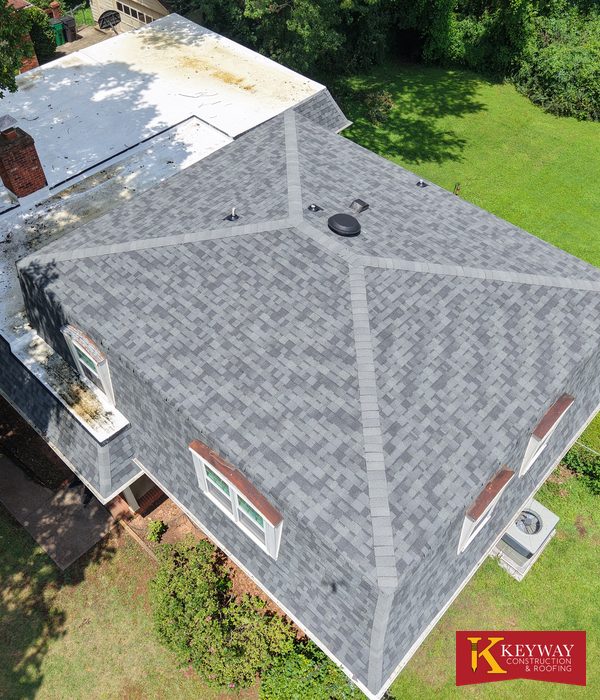
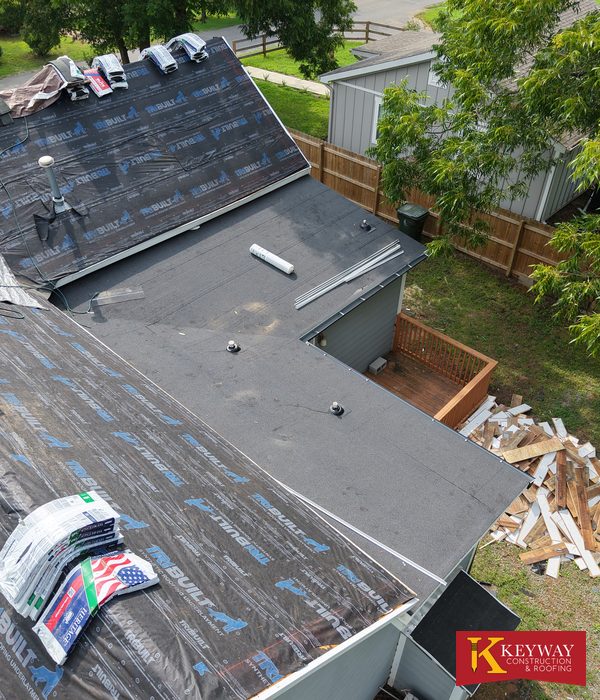
The visual difference between a correctly installed professional tarp and a DIY installation is significant. A professional tarp lies flat against the roof surface, crosses every valley cleanly, wraps over the ridge, and shows no flutter or loose sections. A DIY tarp typically balloons in wind, has visible tension points at grommets, and leaves gaps at edges where coverage geometry wasn’t calculated.
The functional difference is more significant. After the 2022 derecho, we re-inspected 14 Ballantyne properties that had DIY tarps installed by homeowners between the derecho and the next rainfall event two days later. Of those 14, 11 had experienced additional water intrusion under or around the tarp during the second rain event. That’s a 79% additional-damage rate for DIY installations in a real-world Ballantyne post-storm scenario.
If Your Roof Was Damaged in the Last Storm, Call Now
Do not wait until the next rain event to decide whether your roof needs emergency coverage. If you saw shingles displaced, ridge caps missing, or any debris impact on your roof during the last Ballantyne storm, the probability of active water entry risk is high enough that immediate professional assessment is warranted.
Keyway Construction & Roofing provides emergency tarping and Ballantyne storm damage roof repair with 50 years of local response experience. We carry the materials, we know the HOA requirements, and we document everything your insurance carrier needs to process your claim without dispute.
Also read: 8 Hidden Storm Damage Signs Your Ballantyne Roof Is Showing and How to Spot Storm Chaser Scams in Matthews and Ballantyne. Read what Ballantyne homeowners say about Keyway’s storm response.
Call 704-847-7119 for emergency tarping response or submit your address online and we’ll confirm a response time within the hour.
Recent Posts

Protect Your Gutters With Gutter Caps
Eliminate tedious maintenance tasks and unsightly clogs with time-saving gutter guards.See For Yourself
View Our Gallery of Projects
Proudly Serving
Matthews | Stallings | Mint Hill | Indian Trail | Weddington
Waxhaw | Monroe | Ballantyne | South Park | Arboretum |
Myers Park | Pineville | Fort Mill
Matthews | Stallings | Mint Hill | Indian Trail | Weddington
Waxhaw | Monroe | Ballantyne | South Park | Arboretum |
Myers Park | Pineville | Fort Mill