

8 Signs Your Ballantyne Roof Survived a Storm (But Won’t Next Time)
Keyway Construction & Roofing has performed storm damage roof repair in Ballantyne, NC for over 50 years. Our inspectors have documented what roofs look like in the 24 hours, three weeks, and eight months following a hail or wind event. The damage that destroys a Ballantyne roof is almost never what you can see from the driveway. It’s the damage that looks like nothing from 30 feet below but is already letting water in every time it rains.
Here are the 8 signs we find on nearly every Ballantyne roof that “survived” a storm, but is already compromised.
1. Granule Trails in Gutters and Downspouts
Check your gutters before anything else after a storm. The gritty coating on asphalt shingles, granules, is the shingle’s UV barrier and its primary waterproofing layer. Hail knocks granules loose. A significant hail event dislodges enough to fill gutter troughs and concentrate at downspout exits.
What to look for: dark gray or black gritty material at gutter seams and downspout exits, clearly distinct from general leaf and rain debris. A small amount of granule wash is normal wear over years. A concentrated deposit in a single downspout after one storm is a direct hail damage indicator.
The consequence of ignoring it: a shingle that has lost 30% of its granule surface is exposing raw asphalt. That asphalt blisters in Charlotte’s summer heat, becomes brittle in winter, and begins absorbing moisture within 12 to 18 months. By the time a ceiling stain appears, that section of roof has been failing quietly for over a year.
2. Ridge Cap Nail Pops
Ridge caps sit at the peak of your roof and absorb every wind gust and hail strike at the most exposed point on the structure. After a wind event, even one that doesn’t lift caps entirely, the nails holding ridge caps can back out of the decking by a fraction of an inch. This is nail pop, and it is completely invisible from the ground.
A popped nail raises a small bump under the cap that breaks the factory seal strip adhesion. Once that seal is open, wind finds the gap on every subsequent storm. Within one to three seasons, a nail-popped ridge cap lifts, cracks, or blows off entirely, often during a storm that would otherwise cause zero damage.
Ballantyne’s HOA communities are especially vulnerable. Cedar Woodlake, Ballantyne Country Club, and Highgate have mature roofs aged 15 to 25 years where ridge caps have cycled through hundreds of heat seasons. Nail pop is endemic in roofs of that age after any wind event above 40 mph. It appears on nearly every Ballantyne storm damage inspection we conduct in the 28277 zip code.
3. Bruised or Cracked Shingles from 1″+ Hail
Hail bruising is the most misunderstood of all Ballantyne roof storm damage signs. A bruised shingle looks intact from the street. Press your thumb against the impact point and you’ll feel a soft depression where the asphalt mat beneath the granule surface has been compressed or fractured. From the driveway: invisible.
The threshold that matters for insurance is approximately 1 inch, quarter size. Hail of that diameter and larger produces what the industry calls functional damage: damage that measurably reduces the shingle’s service life and waterproofing performance. The 2020 Easter storm dropped 1.75-inch hail across Ballantyne’s 28277 zip code. Every roof in its path more than 8 years old sustained functional hail damage, whether it looked like it or not.
On older 3-tab shingles common in communities built before 2005, bruise points often crack outright. On architectural shingles the impression is subtler but equally serious, and equally accepted by insurers as documented functional damage when photographed correctly.
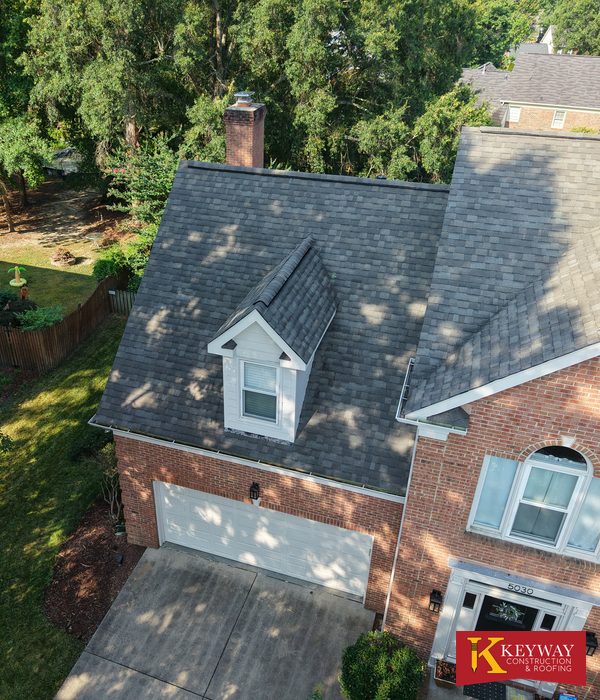
4. Flashing Separation at Chimneys and Dormers
Flashing is the metal barrier sealing the joint between your chimney, dormer, or skylight and the surrounding roof plane. Wind and debris impacts can bend step flashing out of plane. The rapid temperature drop during a storm can crack aged caulk seals at flashing terminations. Even the pressure differential from high winds crossing the roof peak can flex flashing enough to open a gap.
That gap is all water needs. In Ballantyne’s townhome communities, Ballantyne Meadows, The Pines at Ballantyne, chimney flashing sits between two units. A single failure point can route water into both properties simultaneously, immediately raising HOA master policy versus individual homeowner coverage questions that drag into months of dispute.
Flashing separation does not resolve itself. If you feel airflow around a chimney base on a windy day, or if the caulk bead around your chimney flashing is cracked or pulling away, you have an open water entry point. It needs professional repair before the next rain.
5. Attic Discoloration and Moisture
Pull your attic hatch within 48 hours of any major storm. Bring a flashlight. Look up at the underside of the roof decking and check for dark water staining on the panels, water droplets on rafters, or any daylight showing through the deck. Any of those three means water has entered the roof system.
Concentrated staining in one location indicates a specific breach: a nail pop, a failed flashing joint, a cracked shingle. Widespread staining across large sections signals underlayment failure, the felt or synthetic paper beneath your shingles has been compromised, and moisture is wicking broadly rather than at a single entry point.
Either pattern requires immediate professional response. Wet decking left in place for more than 48 to 72 hours begins growing mold. Mold remediation layered on top of roof repair dramatically changes the scope, and most carriers distinguish between storm damage and resulting mold in ways that can reduce what your policy pays.
6. Siding Hail Marks, The HOA Complication
Visible dents or impact pitting on vinyl or aluminum siding are the most reliable ground-level indicator of hail large enough to cause functional shingle damage. If your siding was hit, your roof absorbed the same impact. Most insurance adjusters accept siding denting as corroborating evidence in a hail roof claim. It is among the most useful Ballantyne roof storm damage signs for building a strong insurance file.
In Ballantyne’s HOA communities, siding damage adds a complication. Most HOA governing documents require uniform exterior appearance across all units. A storm that dents one unit’s siding in a row of townhomes affects the visual conformity of the entire street. HOA boards that delay addressing siding damage after a storm often face maintenance violation notices and coverage disputes that drag on for months.
Photograph your siding damage with time-stamped images immediately after the storm. Those photographs are admissible evidence for both your homeowner’s claim and any HOA master policy claim that may apply.
7. Tree Rub Streaks, Cedar Woodlake and Country Club Drive
High winds cause overhanging branches to repeatedly contact the roof surface in a single directional motion throughout a storm event. The result is elongated streak patterns where granules have been abraded away, distinct from the circular pattern of hail bruising and the uniform thinning of age-related granule loss. Tree rub streaks follow the prevailing wind direction and concentrate directly below the canopy line.
Cedar Woodlake and the wooded sections along Ballantyne Country Club Drive are the most frequently affected areas we inspect. Mature willow oaks and water oaks extending over rooflines create continuous abrasion during 45+ mph wind events. A single storm strips 6 to 18-inch granule streaks across multiple shingle courses in the affected sections.
Beyond granule loss, direct branch contact during a storm can displace valley flashing and deposit organic debris in low spots where moisture accumulates. We always inspect valley areas and sections below tree lines on Ballantyne roofs with significant canopy, it’s where secondary damage hides the longest after a storm.
8. Loose Gutter Brackets and Pulled Fascia
Gutters are structural indicators as much as they are drainage systems. Heavy rain volume combined with lateral wind force puts significant stress on gutter attachment points. After any storm, press gently upward on each gutter section at mid-span. Any section that moves more than half an inch has a bracket that has pulled loose from the fascia board.
A loose bracket means two things: the drainage system is no longer properly directing water away from your foundation, and the fascia board the bracket was nailed into may have already softened from moisture exposure. Softened fascia is a precursor to wood rot that spreads into rafter tails, a structural repair that costs significantly more than fascia board replacement alone.
On Ballantyne homes built between 1990 and 2005, fascia is frequently the first wood component to show deterioration. A storm that loosens gutter brackets on an aging fascia board often reveals existing rot that must be addressed before the gutter system can be properly rehung. Our inspectors assess fascia condition on every storm damage call we run in Ballantyne.
Recognized Any of These? Here’s Your Next Step
If even one of these Ballantyne roof storm damage signs matches what you’re seeing, your roof needs a professional assessment before the next storm arrives. The window between a repairable roof and a full replacement can close in a single additional storm season.
Keyway Construction & Roofing offers free next-day inspections across all Ballantyne communities. We document every finding with photographs your insurance carrier can use directly, attend your adjuster visit at no charge, and give you an honest scope, repair where repair will solve the problem, replacement only when it’s warranted. Read what Ballantyne homeowners say about working with Keyway before you call anyone else.
Also useful: Charlotte Hail Events 2020 to 2026: What Ballantyne Homeowners Need to Know, and if a contractor has already knocked on your door, read How to Spot Storm Chaser Scams in Matthews and Ballantyne first.
Call 704-847-7119 or request your free storm inspection online. We respond within the hour.
Recent Posts

Protect Your Gutters With Gutter Caps
Eliminate tedious maintenance tasks and unsightly clogs with time-saving gutter guards.See For Yourself
View Our Gallery of Projects
Proudly Serving
Matthews | Stallings | Mint Hill | Indian Trail | Weddington
Waxhaw | Monroe | Ballantyne | South Park | Arboretum |
Myers Park | Pineville | Fort Mill
Matthews | Stallings | Mint Hill | Indian Trail | Weddington
Waxhaw | Monroe | Ballantyne | South Park | Arboretum |
Myers Park | Pineville | Fort Mill