

Storm Damage Roofing Stallings NC | Hail & Wind Repair | Keyway Construction
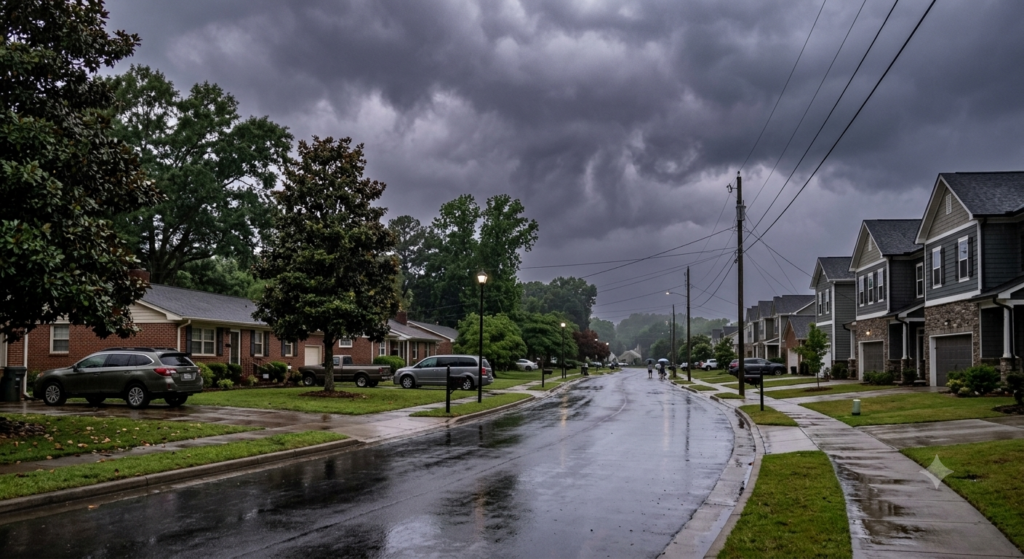 Most contractors who say they cover Stallings are driving in from somewhere else. We are headquartered at 740 Stallings Road, in the heart of the community, which means when a storm moves through and a homeowner here needs eyes on a roof, we are responding in our own backyard, not an hour out. Keyway Construction & Roofing has been inspecting, documenting, and repairing storm-damaged roofs across Stallings and Union County since 1975, the same year the Town of Stallings was incorporated. We have grown alongside this community for over 50 years, and after a hail or wind event we are on roofs here, not following the weather to the next state.
See everything Keyway does across Stallings and the surrounding area.
Own a business here? See our commercial roofing in Stallings page for flat and low-slope roof repair after a storm.
Call 704-847-7119 for a free next-day storm damage inspection anywhere in Stallings.
Stallings Is Two Housing Markets, and Storms Hit Each One Differently
Stallings does not have one roofing profile. It has two, and a storm exposes the difference. Understanding which one your home falls into changes everything about what a storm did to your roof and what your options are afterward.
On one side are the established neighborhoods, subdivisions like Shannamara and the older sections built through the late 1990s and early 2000s. Many of those original roof systems are now in the 20 to 30 year range, past or approaching the end of their realistic life in Charlotte’s climate. When a hail event hits a roof that age, it does not start from a healthy baseline. The granule coverage has thinned from years of heat and UV exposure, the mat underneath has dried out, and the tab adhesion has weakened. A one-inch hail event on a twenty-five-year-old Stallings roof causes measurably more damage than the same storm on a newer one, because the impact bruises and cracks a mat that was already brittle.
On the other side is the wave of newer growth, the townhomes and single-family developments that rose through the 2010s and into the 2020s along the Idlewild Road corridor and near the I-485 interchange. These roofs are young, but young does not mean storm-proof. A new shingle can still be bruised by significant hail, and the homeowner who assumes a recent roof cannot be damaged is exactly the one who misses a claim. These roofs need a different inspection conversation than the aging stock, focused on impact damage and seal integrity rather than end-of-life wear.
We have repaired and replaced roofs on both sides of that divide for over 50 years. We do not walk onto a 1990s home and a 2020 townhome with the same assumptions, and after a storm that distinction is the whole game. For the full picture of roofing across both housing types, our Stallings roofing company page covers it in depth.
The Storm Path Through Northwestern Union County
Stallings sits in the path of the severe weather that moves through this corner of the metro. The storm systems that build over the Piedmont to the northwest track northeast through Union County, and Stallings, positioned as the gateway between Mecklenburg and Union County, takes those cells as they cross the county line. Hail, straight-line wind, and heavy wind-driven rain are all part of the pattern this area absorbs.
Union County has recorded hail events in each of the recent years, with documented hail sizes ranging from smaller caliber events up to stones an inch or more in diameter. Stallings runs along the track these systems tend to follow through northwestern Union County, the same corridor that affects our neighbors in Matthews just to the northwest and Indian Trail just to the southeast. A cell that damages roofs in one of those towns has very often passed directly over Stallings on the same track. For homeowners here, storm exposure is not a rare event. It is a recurring reality the housing stock has been absorbing for decades.
The Two-County Wrinkle Most Contractors Miss
Stallings has a feature no other town in our service area shares: it straddles two counties. It was the first Union County town to extend into Mecklenburg County, and parts of the town sit on the Mecklenburg side of the line. For most of daily life this is invisible. After a storm, it can matter.
Building code requirements, permitting, and even some aspects of how a roof replacement is handled can differ depending on which county a property falls in. A storm repair on the Mecklenburg side of Stallings is not always processed identically to one a mile away on the Union County side. A contractor who works across both counties every week knows where those lines fall and how to handle a job on either side without surprises mid-project. A crew passing through after a storm does not, and that gap can cost a homeowner time exactly when the insurance clock is running. Because we are based right here and work both counties constantly, the line through Stallings is something we navigate as a matter of routine, not something we discover halfway through your repair.
Why Hail Damage Is So Easy to Miss
The hardest part of storm damage on a Stallings roof is that it is almost never visible from the ground. Impact bruising and granule displacement on an asphalt shingle show clearly when you are standing on the roof looking down at the surface, but you cannot see any of it from a ladder at the eave, let alone from the street. This is exactly why so many homeowners conclude their roof is fine after a storm when it is not.
What you can check from the ground are the secondary indicators. These are the surfaces that show hail impact plainly, and if they took hits, the shingles above them did too.
Check these from the ground after a storm in Stallings:
- Gutters and downspouts. Dents in the metal are a reliable sign hail reached the property. Granules collecting like coarse black sand at the downspout outlet point to shingle surface loss.
- HVAC unit and fins. The aluminum fins on your outdoor AC unit dent easily. Damage there means hail hit hard enough to affect the roof.
- Window screens, wraps, and soft metal. Torn screens and dented metal trim, vents, and ridge caps all show impact the shingle field shares.
- Painted and wood surfaces. Fresh chips or spatter marks on a deck rail, mailbox, or fascia indicate a significant hail event.
- Loose or lifted shingles after wind. Tabs flipped up along the rake edges or ridge after a wind event mean the seal strips may be broken even where the shingles look intact.
If you find any of these, the right next step is a professional inspection of the roof surface itself, not a guess from the ground. We document every area of impact with close-up photography organized by roof section and give you a written assessment of what is there and what it means for the roof’s remaining life. If you are also trying to tell whether what you are seeing is storm damage or simple age, our guide on the signs you need a new roof can help you sort it out.
Storm Damage on Stallings Townhomes and Shared Roofs
The townhome growth along the Idlewild corridor and elsewhere in Stallings adds a layer most storm articles ignore: shared rooflines. When attached homes sit under one continuous roof, a storm that damages one section is rarely confined to a single owner’s portion, and that complicates both the repair and the claim.
On a shared roof, the question of who is responsible for what, the individual owner or the HOA, depends on the community’s governing documents, and it varies. Damage that crosses unit lines, repairs that have to match across a continuous roof plane, and the coordination between multiple owners and an HOA all make these jobs more involved than a standalone single-family repair. A contractor needs to document the full affected area, not just one owner’s slice, and understand how the community handles a roof that serves multiple homes. We work these situations regularly across the metro’s townhome communities and can help you understand where your responsibility begins and ends before the repair starts.
What a Complete Stallings Storm Inspection Involves
A real storm inspection is more than a glance at the shingles. Here is what we actually do on a Stallings property, and why each step matters for both the repair and any insurance claim.
Our storm inspection process:
|
1
|
Ground and perimeter assessment. We start with the secondary indicators, the gutters, downspouts, HVAC fins, and soft metal, to confirm the property took an impact and gauge its severity before we go up. |
|
2
|
Full roof surface inspection. We inspect every slope at the shingle level, reading granule patterns and the condition of the mat at each impact point. Hail damage often concentrates on the slopes facing the storm’s direction. |
|
3
|
Flashing and penetration check. We examine flashing at chimneys, pipe boots, and roof-to-wall transitions, since wind loading separates these first and they are a common hidden water entry point. Aged pipe boots in older Stallings homes are a frequent culprit. |
|
4
|
Documentation package. We photograph every area of damage with close-up detail organized by section. This is the package that makes an insurance claim stand up, and it is far stronger built right after the event than weeks later. |
|
5
|
Honest written assessment. We tell you whether the damage warrants a claim, a targeted repair, or nothing at all. If it does not meet your deductible or does not warrant a claim, we say so plainly. |
Hail Damage vs. Wind Damage: What We Find on Stallings Roofs
Storms bring two distinct types of damage, and they present very differently. Knowing which one hit your roof shapes both the repair and the claim.
| Factor | Hail damage | Wind damage |
|---|---|---|
| What it looks like | Circular bruises, displaced granules, cracked mat at impact points | Lifted or missing tabs, broken seal strips, creased shingles |
| Where it concentrates | Slopes facing the storm, soft metal, the whole field | Rake edges, ridge, and the most exposed slopes |
| Visible from ground | Rarely; needs close surface inspection | Sometimes, when tabs are clearly missing or flipped |
| When the leak shows | Often months later, after granule loss progresses | Can be soon after, once a seal is broken and rain drives in |
| Where it bites in Stallings | Aged shingles in established subdivisions bruise readily | Exposed newer rooflines and shared townhome ridges lose tabs |
On the older Stallings housing stock we frequently find both at once: hail bruising across the field plus tab loss along the edges from the wind that came with it. The combination is exactly why a roof can look fine from the street and still be compromised.
The Insurance Claim Window Is Real, and It Closes
North Carolina insurance policies have reporting windows. Some carriers require storm damage to be reported within a set period after the event, and even where the window is broader, claims get harder to work as time passes and additional weather moves through. On a Stallings roof where the damage is invisible from the ground, that creates a trap: the homeowner sees nothing, assumes nothing happened, and the reporting window quietly closes on damage that was there all along.
There is a second wrinkle on the older established homes. When an adjuster looks at a twenty or twenty-five year old roof, the impact bruising from a recent storm overlaps with granule loss from normal aging. That distinction, storm damage versus pre-existing wear, is what determines whether the settlement is a partial repair payment or a full replacement. Accurate, prompt documentation that separates the two is what protects the claim, and it is the package we build before you ever meet the adjuster.
The single most important thing we tell Stallings homeowners: call us before you call your insurance carrier. The independent inspection and documentation should come first. We walk through the full sequence and why it matters in our Charlotte roof insurance claim guide.
Emergency Tarping and Active Leaks
When a storm leaves an active opening in your roof, temporary protection comes first, before the full repair is even scoped. A leak left open does not stay the same size. Water tracks along the decking and framing, reaches the insulation and drywall, and turns a roofing problem into an interior one.
Done right, emergency tarping stops the water without creating new damage. A tarp has to be secured to the decking and extended well past the visible entry point, not draped over the shingles where the next gust will lift it, and never nailed straight through good shingles where it creates fresh penetrations. We document the tarping before and after for the insurance record, then plan the permanent repair. Being headquartered right on Stallings Road means that when you have an active leak here, we are among the closest qualified contractors to your door. Call 704-847-7119 and do not wait for it to spread.
Why Stallings Homeowners Call Keyway
After a major storm, out-of-town crews appear across Union County within days, knock on doors, and push homeowners to sign before they have thought it through. Some do acceptable work. The problem is what happens later. A workmanship warranty means nothing if the company that issued it has followed the weather to another state by the time a leak shows up.
We are a licensed general contractor headquartered at 740 Stallings Road, in the community itself, and we have been here since 1975, the same year Stallings became a town. Being a general contractor rather than a roofing-only operation matters more on storm jobs than people expect, because when a limb comes through a roof or the decking is compromised, the repair crosses into structural work that a roofing-only outfit is not licensed to handle. We take the full scope from inspection through completed repair, with one point of accountability and a reputation in this town we have spent over 50 years building.
Storm moved through your Stallings neighborhood? Call us at 704-847-7119 for a free next-day inspection, or start with our storm damage resource center. We serve all of Stallings on both the Union and Mecklenburg sides, plus Matthews, Indian Trail, Mint Hill, and the surrounding communities.
Frequently Asked Questions: Storm Damage in Stallings
How soon after a storm should I get my Stallings roof inspected?
As soon as you reasonably can, ideally within days. Two things work against you the longer you wait. First, insurance reporting windows close, and some North Carolina carriers require storm damage to be reported within a set period after the event. Second, documentation built right after the storm is far stronger evidence than photos taken weeks later, especially once more weather has moved through and muddied the timeline. The inspection itself is free and takes under an hour. Even if you see nothing from the ground, an inspection tells you whether there is damage and whether a claim path exists while it is still open. Since we are based right on Stallings Road, we can usually get to you quickly.
My roof is only a few years old. Can a storm really have damaged it?
Yes. A newer roof resists storms better than an aged one, but new does not mean immune. Significant hail can still bruise a recent shingle and compress the mat underneath, and high wind can break the seal strips on a roof of any age. The homeowner who assumes a young roof cannot be damaged is often the one who misses a legitimate claim, because they never had it looked at. This matters in the newer Stallings developments along the Idlewild corridor, where a lot of roofs are young enough that owners assume they are storm-proof. They are not. If a real hail or wind event came through, a young roof deserves the same inspection an older one does.
My home is in a Stallings townhome community with a shared roof. How does a storm claim work?
Shared rooflines add a coordination layer that standalone homes do not have. When attached homes sit under one continuous roof, storm damage rarely stays inside a single owner’s section, and responsibility for the repair, the individual owner versus the HOA, depends on your community’s governing documents. The damage has to be documented across the full affected area, not just one unit, and repairs need to match across the continuous roof plane. We work these situations regularly across the metro’s townhome communities and can help you understand where your responsibility begins and ends, and how to coordinate with your HOA, before the repair starts. Bring your governing documents to the inspection if you have them handy.
Does it matter that Stallings is in two counties for my roof repair?
It can. Stallings straddles the Union and Mecklenburg county line, and building code requirements and permitting can differ depending on which county your property falls in. For a simple repair this rarely surfaces, but on a larger storm replacement it can affect how the job is permitted and what code requirements apply. A contractor who works both counties every week knows where the line falls and handles a job on either side without surprises mid-project. Because we are based right here in Stallings and work both counties constantly, this is routine for us rather than something we figure out partway through your repair.
Should I call my insurance company or Keyway first?
Call us first. An independent inspection and documentation package before you file consistently produces a stronger claim than walking into the adjuster meeting with nothing in hand. The adjuster works for your carrier and documents what they find during a quick, high-volume visit. When you have your own thorough photo documentation organized by roof section, especially the part that separates fresh storm damage from normal aging on an older Stallings roof, you are in a far stronger position. We can also attend the adjuster meeting with you. The inspection is free, so there is no downside to knowing exactly what is on your roof before you start the claim.
Related: Storm damage resource center | Storm damage roofing in Matthews | Storm damage roofing in Indian Trail | Stallings roofing company | Roof insurance claims in Charlotte | Roof repair services
Protect Your Gutters With Gutter Caps
Eliminate tedious maintenance tasks and unsightly clogs with time-saving gutter guards.Proudly Serving
Greater Charlotte
Matthews | Stallings | Mint Hill | Indian Trail | Weddington
Waxhaw | Monroe | Ballantyne | South Park | Arboretum |
Myers Park | Pineville
Matthews | Stallings | Mint Hill | Indian Trail | Weddington
Waxhaw | Monroe | Ballantyne | South Park | Arboretum |
Myers Park | Pineville