

Storm Damage Roofing Charlotte Metro | Hail & Wind Repair
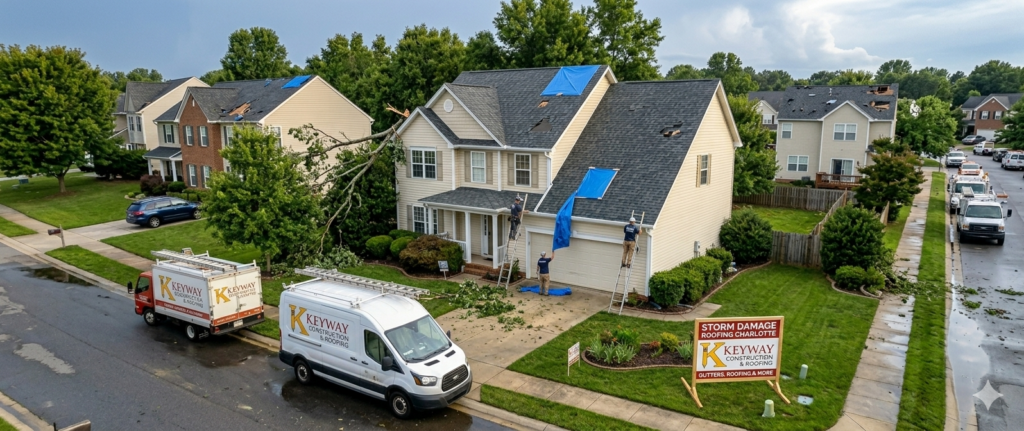 The Charlotte metro has been hit by documented hail events more than 150 times in the past decade. Doppler radar has detected hail at or near Charlotte on over 151 occasions, with 85 severe weather warnings issued across Mecklenburg and Union County in a recent 12-month period alone. The most recent significant event, golf-ball-sized hail at 1.75 inches recorded on June 26, 2023, is the kind of storm that leaves thousands of homeowners across the metro with damaged roofs they cannot see from the driveway. Keyway Construction & Roofing is a licensed general contractor based in Matthews, NC. We have been inspecting, documenting, and repairing storm-damaged roofs across the greater Charlotte metro since 1975. This page is your starting point for understanding storm damage in this market, finding the right location-specific information for your community, and knowing exactly what to do when a storm comes through your neighborhood. Call 704-847-7119 for a free next-day storm damage inspection.
Wind and storms frequently tear loose soffit panels and fascia, which we repair alongside the roof. See soffit and fascia repair.
Storm hit a flat roof? Here is how flat roof repair cost is figured.
The Charlotte Storm Corridor: What the Data Actually Shows
Most homeowners in the Charlotte metro underestimate how frequently this region experiences qualifying storm events. The common assumption is that significant hail is a once-in-a-decade event. The documented data tells a different story.
Charlotte sits at the convergence of two distinct severe weather patterns. The first is the Piedmont corridor, where storm systems developing over the mountains to the northwest track northeast toward the coast, building intensity as they move across the open Piedmont and delivering hail, straight-line winds, and high-intensity rainfall to communities throughout Mecklenburg and Union County. The second is the Gulf moisture pattern, where warm, humid air masses from the Gulf of Mexico fuel summer thunderstorm development that produces the afternoon and evening storm events Charlotte residents recognize from spring through early fall.
The result is a storm frequency profile that ranks Charlotte among the more active severe weather markets in the Southeast. Union County, which encompasses Indian Trail, Waxhaw, Weddington, Monroe, and the communities south and east of Charlotte, sits in a particularly active hail corridor. Storm cells that develop southwest of the metro near Gastonia frequently track northeast through Union County before dissipating east of Monroe, depositing hail along a corridor that directly overlaps with the fastest-growing residential communities in the region.
| Storm Type | How It Damages Charlotte Roofs | What to Check Afterward |
|---|---|---|
| Hail (1 inch or larger) | Displaces granules, compresses fiberglass mat, reduces UV protection. Damage is invisible from the ground but accelerates aging and can void manufacturer warranty. | Gutters and HVAC covers for dents. Downspout outlets for granule surge. Call us for a professional inspection. |
| Straight-line winds (50+ mph) | Lifts shingle tabs at rake edges and ridge. Separates flashing at chimney bases and wall transitions. Displaces ridge cap shingles. | Ridge cap shingles visible from street. Lifted rake edges. Interior ceiling stains appearing within days. |
| High-intensity rainfall (2+ in/hr) | Overwhelms partially clogged gutters, drives water behind gutter onto fascia. Exposes any existing penetration weakness under surge volume. | Fascia boards for softness behind gutters. Interior stains at ceiling penetrations. Gutter overflow marks on siding. |
| Tree and limb impact | Impact force travels through decking and framing beyond visible surface damage. Structural assessment required before surface repair begins. | Do not attempt to remove the limb yourself. Call us immediately for structural assessment and emergency tarping. |
| Tropical remnants and hurricanes | Sustained wind loading over 6 to 12 hours stresses every flashing point and tab adhesion joint simultaneously. Far more damaging than brief thunderstorm gusts at the same speed. | Full roof inspection after any storm with sustained winds above 40 mph for more than 2 hours. Document all exterior components before any cleanup. |
The Three Mistakes Charlotte Homeowners Make After a Storm
After 50 years of storm damage work in the Charlotte metro, the pattern of mistakes is consistent. These three decisions consistently cost homeowners money that the insurance claim process would otherwise have covered.
Filing before getting an independent inspection. The insurance adjuster works for your carrier. Their job is to document damage and write an estimate based on what they find during their visit, quickly, across a high volume of properties during a post-storm period. Homeowners who call the carrier before calling a contractor are walking into the most important conversation in the claim process without the documentation that changes its outcome. The pre-adjuster inspection and documentation package we build before you file consistently produces more complete settlements. Call us before you call your carrier.
Waiting to see if a leak develops. Hail damage does not produce a leak immediately. Impact bruising on asphalt shingles displaces granules and compresses the fiberglass mat, reducing UV protection and accelerating deterioration at impact points. The leak may not appear for 12 to 24 months, by which point the granule loss has progressed significantly and the storm event connection becomes harder to establish for the insurance documentation. Annual inspections after storm events, not waiting for interior stains, is the right timing for Charlotte homeowners in the Charlotte storm corridor.
Not knowing their coverage type before filing. North Carolina insurance carriers have been quietly shifting older roofs from Replacement Cost Value to Actual Cash Value coverage at renewal. On an older roof, the difference between RCV and ACV settlement on the same storm damage can be over $10,000. Knowing your coverage type before the claim process begins is not a detail, it is foundational to making an informed decision about whether and how to file. Your declarations page shows your coverage type under “loss settlement” or “roof payment schedule.”
What Happens the Moment You Call Keyway After a Storm
Our storm damage process, from your call to a completed repair:
Storm Damage by Location: Your Community’s Specific Page
Every community in the greater Charlotte metro has specific storm damage characteristics driven by its housing age, tree canopy profile, storm track exposure, and HOA landscape. We have written a dedicated storm damage page for each of the communities we serve, because the inspection and insurance process on a 1995 Weddington custom home under heavy canopy is different from the same process on a 2008 Indian Trail builder-grade subdivision home on the US-74 corridor. Find your community below for location-specific information.
|
Charlotte All of Mecklenburg County. Mixed housing eras from 1920s intown to 2010s suburban. 150+ documented hail events. View Charlotte Storm Damage → |
Matthews Our home base. 1980s to 2000s housing. Missed claims from 2020 to 2024 storm seasons are the primary focus here. View Matthews Storm Damage → |
Mint Hill Heavy canopy accelerates what hail starts on aging roofs. ACV vs RCV critical on older eastern Mecklenburg homes. View Mint Hill Storm Damage → |
|
Indian Trail US-74 hail corridor. Thousands of 2000s builder-grade roofs hitting their first major storm decision window now. View Indian Trail Storm Damage → |
Waxhaw HOA compliance for storm replacements. Larger homes with complex rooflines require deeper structural assessment. View Waxhaw Storm Damage → |
Weddington High-value custom homes and strict HOA requirements. Storm replacement documentation needs to cover both simultaneously. View Weddington Storm Damage → |
|
Cornelius Lake Norman wind microclimate creates higher loading on lake-facing slopes. HOA compliance in The Peninsula and Antiquity. View Cornelius Storm Damage → |
Monroe Dual-era housing: downtown historic homes and US-74 corridor suburbs require completely different insurance approaches. View Monroe Storm Damage → |
Ballantyne South Charlotte corridor. High-value homes with active storm exposure and insurance-funded replacement activity. View Ballantyne Storm Damage → |
Storm Damage Beyond the Roof: What Belongs in the Same Claim
Most Charlotte homeowners think of storm damage as a roofing problem. The insurance claim, correctly documented, covers far more than the roof.
A hail event that damages shingles on your Charlotte home also impacts gutters, downspouts, siding panels, and in some cases skylights and HVAC covers. All of that damage comes from the same storm event and belongs in the same insurance claim. Filing separate claims for the roof and the gutters, or missing the siding damage entirely, leaves money on the table that your policy is designed to cover.
As a licensed general contractor, we assess the complete exterior during every storm inspection and document every component affected by the same event. We then include all storm-related damage in the pre-adjuster documentation package so the carrier’s estimate captures the full scope from the first pass. This is not about inflating claims, it is about ensuring your settlement covers what your policy actually provides for.
| Component | Same Claim? | What We Look For |
|---|---|---|
| Gutters and downspouts | Yes | Hail denting, seam displacement, downspout crushing from hail impact |
| Siding panels | Yes | Hail impact cracking on vinyl, denting on aluminum, fiber cement surface damage |
| Fascia and soffit | Yes, if storm-related | Storm-driven gutter overflow damage or direct wind/debris impact at roofline |
| Skylights | Yes | Hail impact on glass or curb, flashing displacement from wind loading |
| HVAC equipment covers | Yes | Metal HVAC covers are the most reliable ground-level evidence of hail size, document before any cleanup |
| Pre-existing deferred maintenance | No | Gradual wear, biological growth, and neglected maintenance are not storm damage, we distinguish these clearly in documentation |
Why Keyway for Storm Damage Across the Charlotte Metro
We are a licensed general contractor, not just a roofing company. That distinction matters for storm damage work in specific ways. When storm damage reveals structural involvement at a rafter tail or decking area, we handle it in the same scope. When the adjuster’s estimate misses fascia and gutter damage from the same event, we supplement it with documentation already in hand. When an HOA-governed community in Waxhaw or Weddington requires material compliance on a storm replacement, we verify it before ordering. None of these require coordinating additional contractors, they are part of the scope we bring to every storm damage call across the Charlotte metro.
We have also been in this market since 1975. Every storm chaser who arrived after the last major Charlotte hail event and will not be here for the next one is a contractor whose warranty means nothing when a problem appears 14 months after installation. Our 1-year workmanship warranty is backed by a company that has been continuously operating in the Charlotte metro for over 50 years. We will be here to honor it.
Call 704-847-7119 for a free next-day storm damage inspection anywhere in the greater Charlotte metro. We serve Mecklenburg and Union County including Charlotte, Matthews, Mint Hill, Ballantyne, Indian Trail, Waxhaw, Weddington, Cornelius, Monroe, and surrounding communities.
Storm Damage FAQs
How do I know if my Charlotte area roof has storm damage?
Check your gutters, downspouts, and HVAC covers for new dents after any storm event. Metal components show hail impact clearly and reliably. If those surfaces have fresh dents, your shingles received the same impact. You can also check hail track data for your specific address through NOAA Storm Events or HailTrace, which map documented hail size by GPS coordinate. If a qualifying event shows for your address, call us at 704-847-7119. We inspect the full roof surface and tell you clearly whether claimable damage is present.
Should I call my insurance company or a roofer first after a storm?
Call us first. The pre-adjuster inspection and documentation package we build before you file consistently changes the outcome of the claim. The adjuster visit is the most consequential moment in the claim process. Walk into it prepared, with contractor documentation in hand, not reactive. Once we complete the inspection and confirm damage warrants a claim, you file with the documentation package already organized. We then attend the adjuster meeting with you.
Does Keyway handle storm damage claims across all of the Charlotte metro?
Yes. We serve all of Mecklenburg and Union County for storm damage inspections and insurance claim support. This includes Charlotte, Matthews, Stallings, Mint Hill, Ballantyne, Indian Trail, Waxhaw, Weddington, Monroe, Cornelius, Huntersville, and Davidson. Find your specific community in the location grid above for local-specific information about storm damage in your area.
What is the difference between RCV and ACV coverage for storm damage?
RCV, Replacement Cost Value, pays the current cost to replace your damaged roof with comparable materials minus your deductible, regardless of the roof’s age. ACV, Actual Cash Value, pays the depreciated value of the roof at the time of the storm. On an older roof, ACV settlements can be dramatically lower than RCV for the same scope of damage. Check your declarations page under “loss settlement” or “roof payment schedule” to find your coverage type before filing any storm damage claim. We walk through what your coverage type means for your specific situation during every storm damage inspection.
How long after a storm can I still file an insurance claim in North Carolina?
Most North Carolina homeowners insurance policies require storm damage to be reported within a reasonable time. Some have explicit deadlines. The key factors are when the storm event occurred, whether additional weather events have complicated attribution, and what your carrier’s specific policy language says. If you are uncertain about your reporting window, call your carrier to ask about their requirements for the specific storm date, then call us. We have helped Charlotte homeowners document and file claims for storm events from multiple seasons ago when the documentation supported the timeline. Call 704-847-7119.
Does Keyway handle storm damage on flat and commercial roofs in Charlotte?
Yes. We handle storm damage on flat and low-slope commercial roofing systems including TPO, EPDM, and modified bitumen membranes across the Charlotte metro. Storm damage on flat commercial roofs typically presents as impact punctures at significant hail sizes, flashing failures at HVAC curbs and penetrations, and membrane stress at seams from wind loading. We provide post-storm inspections on commercial properties with the same documentation standard as residential work. See our flat roofs page and commercial roofing page for more detail. Keyway also handles chimney flashing repair where the chimney meets the roof.
Keyway Construction provides storm damage roofing inspection, repair, replacement, and insurance claim support across the greater Charlotte metro and Union County. Related services: roof insurance claim assistance, full process walkthrough, residential roofing, flat roof repair, commercial roofing, fascia and soffit repair, gutters, gutter guards, and siding repair. For the North Carolina insurance claim process walkthrough see our roof insurance claim guide and our roof repair vs replacement guide. Call 704-847-7119 for a free next-day storm damage inspection anywhere in the Charlotte metro.
Protect Your Gutters With Gutter Caps
Eliminate tedious maintenance tasks and unsightly clogs with time-saving gutter guards.Proudly Serving
Greater Charlotte
Matthews | Stallings | Mint Hill | Indian Trail | Weddington
Waxhaw | Monroe | Ballantyne | South Park | Arboretum |
Myers Park | Pineville
Matthews | Stallings | Mint Hill | Indian Trail | Weddington
Waxhaw | Monroe | Ballantyne | South Park | Arboretum |
Myers Park | Pineville