

Siding Replacement in Charlotte, NC
Quick answer
Siding replacement in Charlotte means stripping the old cladding down to the sheathing, fixing any rot or failed flashing underneath, installing a new water-resistive barrier, and putting up new vinyl, fiber cement, or engineered wood siding with new trim. Most whole-house jobs take one to two weeks of work on site. Keyway is a licensed general contractor based in Matthews, so the wall repairs behind your siding are handled by the same crew. Free estimates: 704-847-7119.
Your siding is twenty-something years old. It’s faded on the south side, there’s a soft spot under the kitchen window, and the last two repairs didn’t really match. At some point you stop patching.
That point is what this page is about. We’ll walk through how to tell when replacement is the right call, which materials hold up in Charlotte’s heat and humidity, what actually happens on a tear-off, and what moves the price. If you’re not there yet, our siding repair page covers fixing what you’ve got.
When does siding need to be replaced instead of repaired?
Replace when the problem is the whole wall system, not one board. If damage keeps turning up on different sides of the house, if moisture has been getting behind the siding for years, or if your material is discontinued and every patch stands out, a repair is just buying time.
Here’s the checklist we actually use on a walk-around:
- Swelling or crumbling bottom edges on hardboard or fiber cement, especially low on the wall near mulch beds and downspouts.
- Soft sheathing. Push on the siding near windows and corners. If the wall gives, the wood behind it is wet.
- Warped, wavy, or loose vinyl across a whole elevation, not just a panel next to the grill.
- Paint that won’t stay on. Peeling a year or two after a fresh coat usually means moisture is pushing out from behind.
- Stains or mildew inside on the drywall under windows. That’s water that got past the siding and the wrap.
- Repairs that cost a lot and keep coming. A common rule of thumb: once repair quotes pass about half the cost of replacement, replacement is the better spend.
- Discontinued profiles. Older vinyl colors and hardboard patterns often can’t be bought anymore.
- You’re planning to sell. Buyers and inspectors in this market notice tired siding fast.
One or two of those? Probably a repair. Four or more, spread around the house? It’s time to talk about a full replacement.
The Charlotte siding problem nobody mentions: 1980s and 1990s hardboard
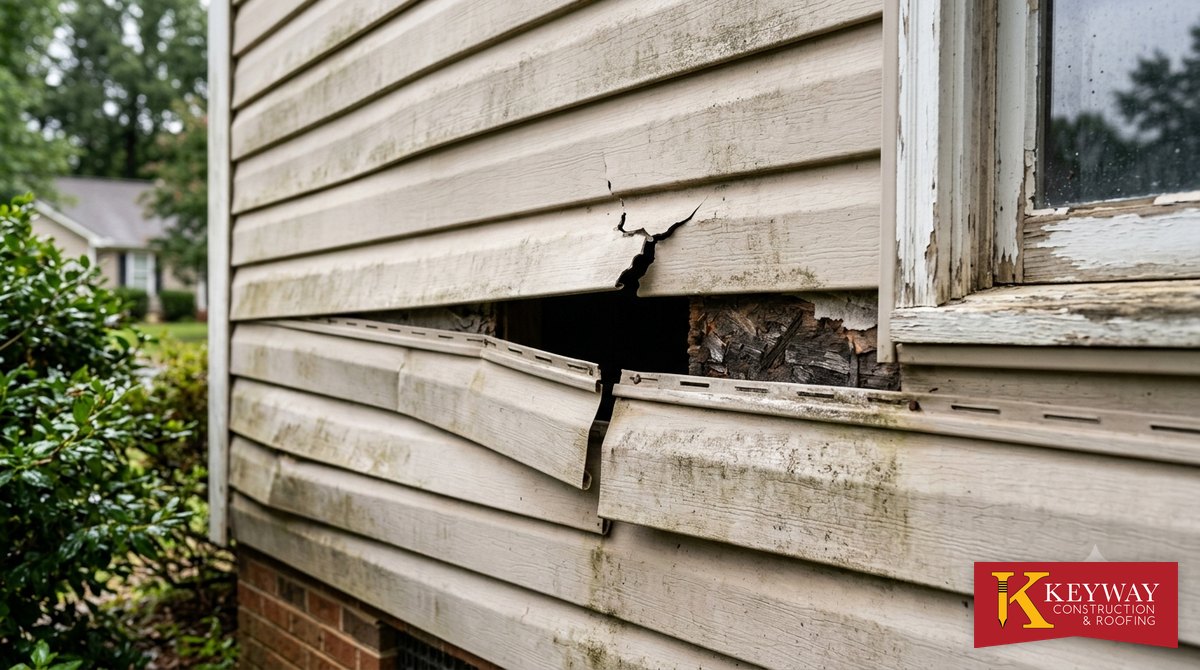
A lot of the subdivisions built around Charlotte, Matthews, Mint Hill, and Indian Trail in the 1980s and 1990s went up with pressed hardboard lap siding. It looked fine for years. Then the paint wore thin at the drip edges, water wicked into the board, and the bottom edges started to swell and flake.
You can’t really fix hardboard that has started to mushroom. You can cut out the worst boards, but the rest of the wall is the same age and the same product, and it’s absorbing water the same way. Hardboard from that era was the subject of large class action lawsuits in the late 1990s, and many of those products are no longer made, so matching it is hard too.
If you have it, you’ll usually see it first on the north side and behind shrubs, where the wall stays damp. That’s the most common reason we get called for whole-house siding replacement in the Charlotte area.
Which siding material is best for a Charlotte home?
For most Charlotte homes it comes down to vinyl or fiber cement, with engineered wood as a third option. All three work here. The right one depends on your budget, your HOA, how long you plan to stay, and how much maintenance you’ll actually do.
| Material | Good at | Watch out for | Upkeep | Relative cost |
|---|---|---|---|---|
| Vinyl | Lowest upfront cost, never needs paint, fast install, insulated options | Can warp near reflective windows and grills, thin panels crack in hail, fades on hot elevations | Wash once a year | Lowest |
| Fiber cement (James Hardie and others) | Won’t rot, resists fire and insects, holds paint well, looks like real wood | Heavy, needs exact clearances and sealed cut ends, labor heavy | Repaint roughly every 10 to 15 years (factory finishes last longer) | Mid to high |
| Engineered wood | Lighter than fiber cement, long board lengths, takes impacts well | Cut edges and ground clearance have to be done right or it soaks up water | Repaint on a similar schedule to fiber cement | Mid |
| Cedar and natural wood | Classic look on historic and custom homes | Rot, carpenter bees, and woodpeckers in our climate | Highest, regular stain or paint | High |
Our honest take for this area: fiber cement if you plan to stay ten years or more and want the house to look like painted wood. Good-quality vinyl if the budget matters more and you never want to paint again. Want the long version? Read vinyl vs fiber cement siding for Charlotte homes.
Mixing is fine, too. Plenty of homes do lap siding on the body with shake or board and batten on the gables and dormers.
What happens during a full siding replacement?
The siding is the part you see. The work that decides whether it lasts is everything behind it. This is how a Keyway replacement runs, start to finish.
- Free inspection. We walk every elevation, probe the soft spots, look at the windows, roof edges, and gutters, and check the attic if there are signs of water.
- Written scope. You get the material, profile, color, trim plan, and a separate line for sheathing and rot repair, so you can see what’s known and what’s an allowance.
- Protect the property. Tarps over beds and AC units, and windows and doors covered where we’re cutting.
- Tear-off. Old siding and trim come off down to the sheathing, one or two elevations at a time so the house isn’t left open.
- Fix the wall. Rotted sheathing, framing, sill plates, and rim joists get replaced. We show you anything we find before it’s covered back up.
- Wrap and flash. New water-resistive barrier, lapped shingle style so water runs down and out. New flashing at windows, doors, and where walls meet the roof.
- Install the siding. Fastened to the manufacturer’s instructions for your material: vinyl hung loose so it can move, fiber cement face-nailed or blind-nailed with the required gaps and clearances.
- Trim, caulk, and finish. Corners, window and door casings, frieze boards, and paint where the material calls for it.
- Clean up and walk-through. Magnetic sweep for nails, debris hauled away, and we walk the house with you before we call it done.
Most whole-house jobs take about one to two weeks of working days. Weather, rot repair, and the number of stories change that, and we’ll give you a realistic timeline in the estimate.
Why the layer behind the siding matters more than the siding
Siding isn’t waterproof. Every type lets some water in at the joints and laps. The North Carolina residential code expects that, which is why it calls for a water-resistive barrier behind exterior cladding and flashing at openings. That wrap and flashing are what keep your walls dry.
Plenty of failed siding in Charlotte didn’t fail because of the siding. It failed because the window heads had no flashing, or the wrap was lapped backwards, or the boards were run tight to the roof shingles where they sat in water.
So on a replacement we pay attention to a few spots that cheap jobs skip:
- Kickout flashing where a roof edge dies into a wall. Missing kickouts are one of the most common causes of rotted walls we open up.
- Roof-to-wall clearance. Fiber cement manufacturers require a gap between the siding and the shingles so the bottom edge doesn’t wick water.
- Ground clearance. Siding shouldn’t touch mulch or soil. We’ll tell you if your beds need to come down a few inches.
- Window and door heads. Head flashing that actually sheds water past the trim.
What drives the cost of siding replacement in Charlotte?
We don’t publish a per-square-foot number because it would be wrong for most houses. Two homes the same size can come in very far apart. These are the things that move your price:
- Wall area, measured in squares (100 square feet), minus windows and doors.
- Material and profile. Vinyl costs less than fiber cement. Shake, board and batten, and premium colors cost more than plain lap.
- Stories and access. A two-story with a walkout basement needs more staging than a ranch.
- How much is behind the siding. Sheathing and rot repair is the biggest unknown. That’s why we price it as its own line.
- Trim package. Wrapping or replacing window casings, corners, and soffit and fascia adds cost, and is often worth doing at the same time.
- Insulation upgrades like insulated vinyl or foam board under the siding.
- Removal and disposal, plus extra care if your home was built before 1980 (more on that below).
- Paint, if you choose primed fiber cement instead of a factory finish.
Your estimate is written and itemized. If we open a wall and find more rot than expected, you see it and approve it before we replace it.
Older homes: lead paint and asbestos siding
This one matters for homes in Charlotte’s older neighborhoods and for any house built before 1978.
Painted wood siding on older homes may have lead paint layers. Ask any contractor you’re considering whether they’re EPA RRP lead-safe certified before they disturb it. That’s the federal rule for paint on pre-1978 homes.
Some mid-century homes also have cement-asbestos shingle siding: stiff, brittle, often with a dimpled face. Don’t break it, sand it, or power wash it hard. Have a sample tested before any removal, because removal rules are different when it’s positive. Sometimes the best answer is to leave it in place and side over it, which is something we can talk through once the test is back.
Can you replace siding and other exterior work at the same time?
You can, and it usually saves money. Once the siding is off, the walls are open and the scaffolding is up. That’s the cheapest moment to deal with everything around it.
- Window replacement: new windows get flashed properly into the new wrap instead of trimmed around old siding.
- Wood rot repair on rim joists, sills, and framing.
- Gutters: they come down for the siding anyway.
- Roof replacement: if the roof is near the end too, doing both lets us get the roof-to-wall flashing right in one go.
Because Keyway is a licensed general contractor, those trades are one crew and one warranty. You’re not left coordinating a siding company, a carpenter, and a window installer who all blame each other.
Do you need a permit or HOA approval?
Often you need HOA approval, and sometimes a permit. Most HOAs around Charlotte, Ballantyne, Waxhaw, and Weddington want a color and material submission before work starts. Get that approved first, because changing colors after the order is placed costs time.
Permit rules depend on your town and the scope of work, especially if framing or sheathing is being replaced. We confirm whether a permit is needed when we do your estimate.
What should you ask a siding replacement contractor?
You’ll probably get two or three quotes. They won’t line up neatly, so these are the questions that show you what each price actually includes. If you already have a quote in hand, this guide shows how to read a siding quote line by line.
- Are you tearing off or covering over? If they’re siding over the old material, ask how they’ll know what the sheathing looks like.
- How is rot repair priced? A quote with no line for sheathing either assumes the wall is perfect or plans to charge you later. Ask for the rate in writing.
- What wrap and flashing are included? Housewrap brand, kickout flashing, window head flashing. If the answer is vague, the work probably will be too.
- Who does the install? Their own crew or a sub? Either can be fine, but you want to know who’s responsible.
- Do you install to the manufacturer’s instructions? Fiber cement and engineered wood warranties depend on it, especially clearances and fastening.
- What happens to the trim, soffit, and gutters? Replaced, wrapped in aluminum, or reused? Each one changes the price and the look.
- What’s the workmanship warranty, in writing? The product warranty only covers the siding itself, not how it was put up.
- Are you licensed and insured in North Carolina? Ask for the certificate, not just a yes.
Cheapest quote doesn’t mean worst job. But the cheapest quote usually leaves something out, and it’s almost always the stuff behind the siding.
Insulated siding: is it worth it?
Maybe. Insulated vinyl has a foam backer glued to each panel. It makes the wall feel stiffer, helps the panels lie flat on uneven walls, and adds a little thermal value. Another route is a thin layer of rigid foam over the sheathing before the siding goes on.
In Charlotte, your attic does far more for your energy bill than your walls do. If comfort and cooling cost are the goal, start with attic insulation and air sealing. Insulated siding is a nice upgrade on top of that, not a substitute for it.
There’s one thing worth knowing if you add foam: window and door trim has to be built out to match the thicker wall, or the casings end up looking sunk in. We plan that in the estimate so it isn’t a surprise.
Where we replace siding
We’re based at 740 Stallings Road in Matthews and replace siding across Charlotte and the surrounding towns, including Matthews, Mint Hill, Stallings, Indian Trail, Monroe, Waxhaw, Weddington, and Ballantyne. In Matthews? See our siding page for Matthews homeowners.
Siding replacement FAQs
How do I know if I need new siding or just repairs?
If the damage is in one area and the wall behind it is dry and solid, repair it. If problems show up on several sides of the house, the sheathing is soft, or repairs keep coming back, full replacement is usually the better value.
How long does siding replacement take?
Most whole-house siding replacements take about one to two weeks of working days. Two-story homes, heavy rot repair, and rain delays can stretch that. We give you a timeline in writing with the estimate.
What is the best siding for the Charlotte climate?
Fiber cement is the most durable choice for Charlotte heat, humidity, and storms, and it doesn’t rot. Quality vinyl is the lowest maintenance option at a lower price. Engineered wood sits in between. All three work here when they’re installed to the manufacturer’s instructions.
Can new siding be installed over old siding?
Sometimes, but we usually don’t recommend it. Covering old siding hides rot and wet sheathing, and it can void some manufacturer warranties. Tearing off lets us fix the wall and install new wrap and flashing. The main exception is asbestos siding that’s best left in place.
How much does siding replacement cost in Charlotte?
It depends on wall area, material, number of stories, trim, and how much rot is behind the old siding. We price every job after an on-site inspection and give you a written, itemized estimate with wall repairs listed separately.
Do I need to be home during siding replacement?
No. Most homeowners go about their day. We’ll need access to outdoor outlets and water, and we’ll ask you to move cars and patio furniture away from the walls.
Does homeowners insurance pay for new siding?
It can when the damage comes from a covered event like hail, wind, or a falling tree. Wear and age usually aren’t covered. Photograph the damage before anything is touched, and see our storm damage page for how claims work.
What warranty comes with a Keyway siding replacement?
Our work is covered by a 1-year workmanship warranty, and the siding itself carries the manufacturer’s product warranty for the material you choose.
Get a free siding replacement estimate
Not sure if it’s repair or replacement? That’s the first thing we’ll answer. We’ll come out, look at every side of the house and what’s behind the soft spots, and give you a written estimate either way. Call 704-847-7119 or request an estimate online.
Protect Your Gutters With Gutter Caps
Eliminate tedious maintenance tasks and unsightly clogs with time-saving gutter guards.Proudly Serving
Matthews | Stallings | Mint Hill | Indian Trail | Weddington
Waxhaw | Monroe | Ballantyne | South Park | Arboretum |
Myers Park | Pineville | Fort Mill
Matthews | Stallings | Mint Hill | Indian Trail | Weddington
Waxhaw | Monroe | Ballantyne | South Park | Arboretum |
Myers Park | Pineville | Fort Mill