

Roof Repair Indian Trail NC | Builder-Grade First Failures
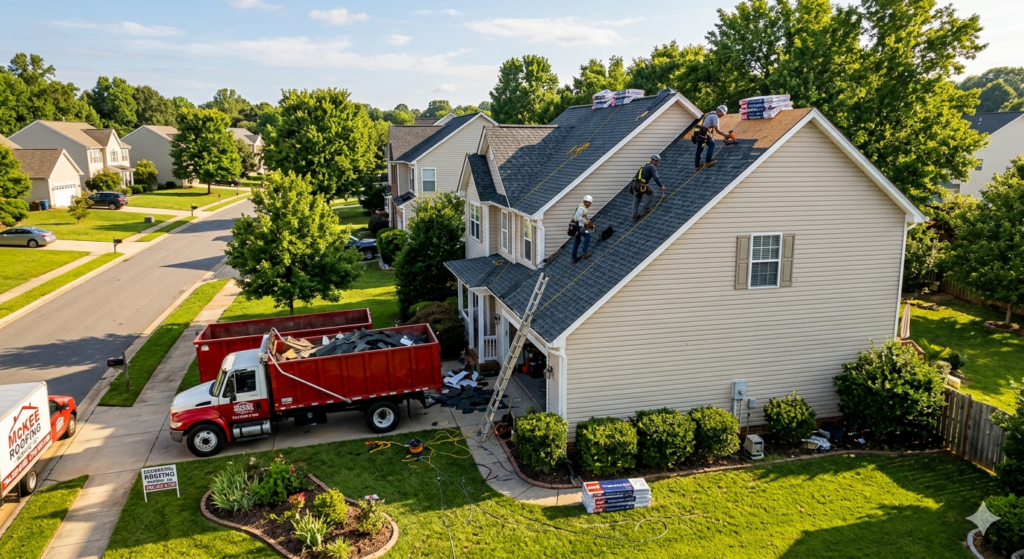 Indian Trail’s roof repair situation in 2026 is specific and data-driven. The subdivisions built along US-74, Potter Road, Unionville-Indian Trail Road, and the corridors feeding Bonterra, Brandon Oaks, Sun Valley, and Chestnut Square between 2000 and 2015 are now producing a wave of first repair calls on roofing systems that have never had professional attention. Pipe boots installed in 2005 are at or past their expected service life. Chimney flashings installed with caulk rather than step flashing have been cycling through Charlotte’s thermal swings for 15 to 20 years. Tab adhesion on builder-grade shingles that have absorbed multiple Union County hail events has been reduced from both sides simultaneously. These are not catastrophic failures. They are predictable first failures on systems that have lived a full first phase of service life and are telling their owners it is time to pay attention. Keyway Construction & Roofing has been working in Union County since 1975 and we handle roof repair throughout Indian Trail with the same crew that serves our core Matthews service territory. Call 704-847-7119 for a free next-day inspection.
The Indian Trail First-Failure Window: What Is Happening Right Now
A builder-grade architectural shingle roof installed in Indian Trail between 2000 and 2010 has now lived through the most demanding first half of its service life in Union County’s specific weather environment. Here is what that means in practical terms.
Peak summer attic temperatures in Indian Trail subdivisions regularly reach 130 to 150 degrees Fahrenheit. Over 15 to 20 years, that heat has cycled through the rubber gaskets at pipe boots, the caulk points at chimney flashings, and the adhesive strips on shingle tabs thousands of times. Each cycle opens and closes any small gap or weakness in the roofing assembly slightly. By year 15 to 18, the accumulated effect of those thermal cycles has brought most of the high-risk failure points in a typical Indian Trail builder-grade installation to the threshold where the next rain event produces the first visible interior stain.
At the same time, Union County’s position in the Charlotte hail corridor means these roofs have absorbed storm events. NOAA Storm Events data shows qualifying hail affecting Union County zip codes in most recent years. A roof that has absorbed two or three moderate hail events since installation has reduced granule coverage on south and west-facing slopes, compressed mat at impact points, and reduced tab adhesion compared to an equivalent roof in a less storm-exposed location. The first failure on such a roof is not just a maintenance signal, it is often the beginning of a more active repair period that will produce additional failure points in the same season or the next.
Understanding this context changes how we assess Indian Trail repair calls. We do not just fix the visible problem. We assess the full system condition and tell you honestly whether you are dealing with an isolated first failure or the beginning of a pattern that will produce recurring repair calls on a system that is ready for replacement.
The Most Common Indian Trail Roof Repairs We Handle
| Repair Type | Why It Hits Indian Trail Homes in This Age Range | Our Repair Approach |
|---|---|---|
| Pipe boot failure | Builder-grade EPDM boots installed at original construction are now at the end of their designed service life under Charlotte’s UV. Cracking at the collar is the most common single source of first roof leaks on Indian Trail homes in this age range. | Two-part boot replacement. We check all other boots on the same visit, if one has failed at this age, the rest are close behind. |
| Lifted or missing shingles after storm events | US-74 corridor storm cells regularly produce gusts above 50 mph. Builder-grade tab adhesion that was marginal after 15 years of thermal cycling fails at those speeds on rake edges and ridges. | Matching shingle replacement with adjacent tab adhesion check. Ridge cap assessment always included, ridge damage and shingle loss often occur in the same wind event. |
| Flashing separation at wall-to-roof transitions | Builder construction from the 2000s frequently used caulk-only flashing at garage roof-to-wall transitions and dormer sidewalls. 15 to 20 years of thermal movement has opened those joints. | Step flashing installation at sidewalls, kick-out flashing at rake edges, and counter-flashing at any transition where caulk-only was the original installation. |
| Hail-related granule damage requiring section replacement | Multiple documented hail events in Union County have hit Indian Trail roofs in recent years. Sections with significant granule displacement on south and west slopes have accelerated aging that makes them vulnerable to the next rain event. | Section repair or partial replacement depending on the extent of impact. Full inspection to determine whether the damage warrants an insurance claim before any repair scope is committed. |
| Gutter-related fascia damage | Builder-installed gutters in Indian Trail subdivisions were often hung at minimum hanger spacing. Debris loading, thermal cycling, and partial clogging from developing canopy has caused many to sag, overflow, and deposit water against fascia boards. | Fascia assessment before any gutter reattachment. Soft fascia gets replaced before new hangers are installed. Gutter overflow source corrected as part of the same scope. |
The Indian Trail HOA Factor for Roof Repairs
A significant portion of Indian Trail’s planned communities have HOA architectural guidelines that may apply to roofing repairs. For isolated repairs using matching materials on the same roofing system, most Indian Trail HOAs do not require pre-approval. If you are replacing four shingles with the same shingle product already on the roof, the architectural review process typically does not apply.
Where HOA involvement becomes relevant is when a repair reveals that a broader section of the roofing system needs replacement and the scope crosses the threshold from routine maintenance to exterior modification. Sun Valley, Chestnut Square, Brandon Oaks, and Bonterra all have architectural review board processes that govern roofing changes beyond routine maintenance. We assess the scope of any Indian Trail repair during the inspection and flag when the situation is likely to require HOA documentation before work begins.
After the Repair: Protecting Your Indian Trail Roof from the Next Failure
The most important thing after a roof repair on a 15 to 20-year-old Indian Trail home is understanding what is likely to come next. If the repair addressed the first isolated failure on a system that is otherwise in reasonable condition, you have a few more years of managed service life ahead. If the repair addressed one of several developing failure points on a field with significantly reduced granule coverage and multiple areas of compromised tab adhesion, planning for replacement in the next one to two seasons is the financially sound approach.
We give you that honest assessment after every Indian Trail repair inspection. We also discuss Class 4 impact-resistant shingles as a replacement option for Indian Trail homeowners who want to significantly improve the system’s performance through the next cycle of Union County hail seasons. Several North Carolina insurance carriers offer premium discounts for Class 4 installations that partially offset the higher material cost, which makes the upgrade economics more compelling for Indian Trail properties specifically given the documented hail history here.
Call 704-847-7119 for a free next-day roof repair inspection anywhere in Indian Trail. Written estimates before any work begins. 1-year workmanship warranty on all repair work.
Indian Trail Roof Repair FAQs
My Indian Trail home was built around 2007. Is the roof at the point where I should expect repair calls?
Yes. A 2007 build in Indian Trail has an approximately 18 to 19-year-old builder-grade architectural shingle system that has been through Union County’s storm seasons for its full service life to date. Pipe boots from the original installation are at or past their expected life under Charlotte’s UV exposure. Caulk-based flashing points at wall-to-roof transitions have been through thousands of thermal cycles. And the adhesive strips on shingle tabs have been degraded by both heat and storm impact over that period. First repair calls on homes in this age range are normal and expected. The important question is whether the repair you are seeing is an isolated first failure or the beginning of a pattern, and that question requires a full inspection to answer accurately. Call 704-847-7119.
I had hail damage repaired last year and now have a new leak. Are these related?
Possibly, but not necessarily from the same failure point. When Union County hail events hit an aging builder-grade roof, they accelerate the timeline of failure across the full field, not just at the location that was repaired last year. A new leak in a different location one year after a prior hail repair is often a sign that the system has multiple developing failure points, which is the pattern that signals the transition from repair-phase to replacement-phase. We inspect the new leak and assess the surrounding field condition to determine whether you are dealing with an isolated new failure or the continuation of a broader deterioration pattern. Call 704-847-7119 for a free inspection.
Can Keyway repair my Indian Trail roof and assess whether it qualifies for a storm damage claim at the same time?
Yes, and that is exactly the sequence we recommend. Call us before calling your insurance company. We inspect the full roof, assess whether documented hail events have produced claimable damage, and build the documentation package before the adjuster visit if a claim is warranted. If the repair you called about turns out to be isolated non-storm damage, we tell you that and provide a repair estimate. If the inspection reveals storm damage that warrants a claim, we walk you through the process from that point. See our storm damage Indian Trail page and insurance claims page for full detail.
Does Keyway serve all of Indian Trail?
Yes. We serve all of Indian Trail including communities along US-74, Potter Road, Unionville-Indian Trail Road, Old Monroe Road, and the subdivisions throughout the 28079 and 28110 zip codes including Bonterra, Brandon Oaks, Sun Valley, Chestnut Square, and Crooked Creek. We are based in Matthews on Stallings Road. Call 704-847-7119 to schedule your free next-day inspection.
Should I upgrade to impact-resistant shingles when my Indian Trail roof needs replacement?
For most Indian Trail homeowners in the 2000 to 2015 build era who are facing eventual replacement, Class 4 impact-resistant shingles are worth a serious discussion. Union County’s documented hail history makes the upgrade more compelling here than in markets with lower storm frequency. Several NC carriers also discount premiums for Class 4 installations, which partially offsets the upgrade cost over time. We discuss this option during every Indian Trail replacement estimate alongside the standard architectural shingle options so you have complete information before deciding.
Keyway Construction provides roof repair throughout Indian Trail, NC and Union County. Related services include residential roofing in Indian Trail, commercial roofing in Indian Trail, storm damage roofing in Indian Trail, roof insurance claim assistance, fascia and soffit repair, gutter guards, and siding repair. Also see roof repair pages for Matthews, Waxhaw, and Ballantyne. For the full decision framework see our roof repair vs replacement guide. Call 704-847-7119 for a free next-day inspection anywhere in Indian Trail.
Beyond repair? See our full roof replacement in Indian Trail.
Protect Your Gutters With Gutter Caps
Eliminate tedious maintenance tasks and unsightly clogs with time-saving gutter guards.Proudly Serving
Greater Charlotte
Matthews | Stallings | Mint Hill | Indian Trail | Weddington
Waxhaw | Monroe | Ballantyne | South Park | Arboretum |
Myers Park | Pineville
Matthews | Stallings | Mint Hill | Indian Trail | Weddington
Waxhaw | Monroe | Ballantyne | South Park | Arboretum |
Myers Park | Pineville