

Carpentry & Wood Rot Repair
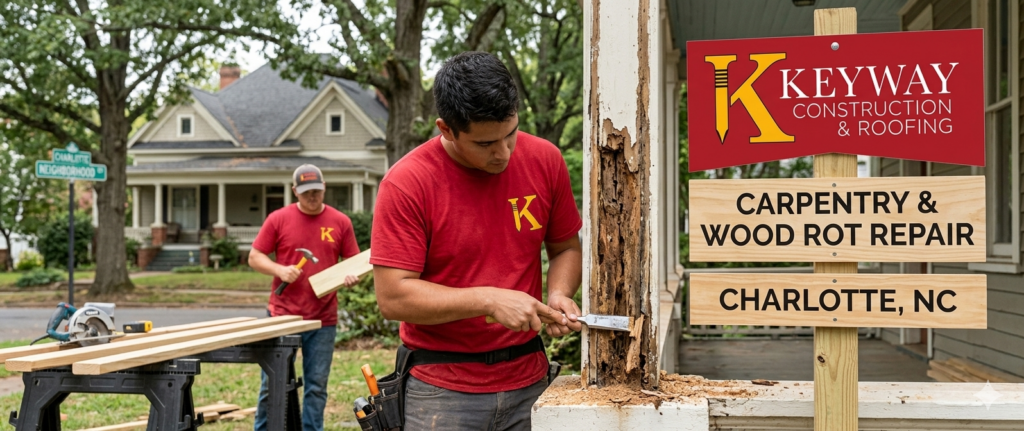 Wood rot does not announce itself before it causes real damage. By the time you notice a soft spot on your porch, a bubble in the paint around a window frame, or a section of fascia that looks slightly off from the ground, the fungal decay has usually been working for months. Charlotte’s climate is one of the most aggressive environments for exterior wood in the country. Hot summers, persistent humidity, and a long warm season mean the conditions that cause wood rot here are present for nine or ten months of every year rather than the four or five you’d see in northern states.
Keyway Construction has been handling carpentry and wood rot repair across Charlotte, NC and the greater metro for over 50 years. As a licensed general contractor headquartered in Matthews, we repair and replace every exterior wood component on a home, from fascia and soffit boards at the roofline to window sills, door frames, deck boards, and porch columns. We handle carpentry alongside roofing, siding, and gutters under one contract and one warranty. If your home has a wood rot problem, you do not need to coordinate multiple contractors to solve it.
Call 704-847-7119 or request your free estimate online. We schedule next-day inspections across Charlotte, Matthews, Ballantyne, Monroe, and surrounding communities.
Why Charlotte Homes Get Hit Hard by Wood Rot
The biology behind wood rot is straightforward. Fungal spores are always present in the environment. They become active when wood moisture content rises above roughly 20 percent and stays there. Charlotte’s humid subtropical climate keeps exterior wood cycling through wet and dry conditions repeatedly across the season, and that cycling is exactly what promotes decay. Unlike climates where a hard winter freeze slows or kills fungal activity, the Charlotte area stays warm enough that rot progresses year-round at varying rates.
The specific combination of stresses that Charlotte puts on exterior wood is worth understanding:
Summer humidity that never fully breaks. July average highs sit around 92°F, but the humidity is the real driver. Relative humidity regularly stays above 70 percent through the growing season, and wood that gets saturated by a morning thunderstorm may not fully dry before the next one arrives two days later. Fascia boards, soffit panels, and exterior trim in shaded or north-facing locations can stay at elevated moisture content for weeks at a stretch.
High annual rainfall. Charlotte averages around 44 inches of rain per year, spread fairly evenly across the calendar. There is no genuine dry season where exterior wood gets a sustained rest from moisture exposure. Every gap in caulk, every failed paint seal, and every overflowing gutter channel is an ongoing entry point for water.
Older housing stock with original wood framing. A significant portion of the Charlotte metro, particularly in established neighborhoods in Matthews, Mint Hill, Ballantyne, and areas closer to the city center, was built between the 1960s and 1990s. Those homes have exterior wood that is now 30 to 60 years old and has been absorbing and releasing moisture through hundreds of seasons. The original caulk around window and door trim has long since failed in most cases, even if it does not look it from the outside.
Tree canopy that traps moisture. Many of the most desirable neighborhoods in the Charlotte area have mature tree cover that shades the roofline, keeps surfaces damp after rain, and drops debris that collects in gutters and at the base of walls. Both the moisture retention and the gutter blockage they cause are direct contributors to the fascia and soffit rot we see most often in these areas.
Wood Rot Repair and Carpentry Services We Provide
We handle every exterior carpentry and wood rot situation on residential and commercial properties across the Charlotte metro. Here is what that scope covers:
Fascia and Soffit Board Repair and Replacement
Fascia and soffit boards are the most common location for wood rot on Charlotte homes, and the reason is almost always gutters. When gutters overflow, from clogging, improper pitch, or inadequate capacity, water runs back across the fascia board behind the gutter channel rather than draining down the downspout. That water sits against the wood and saturates it repeatedly until decay takes hold. The rotted fascia then loses the structural ability to hold the gutter, the gutter pulls away, the overflow gets worse, and the problem compounds.
We remove and replace rotted fascia sections, install properly pitched replacement boards, and can address contributing gutter issues in the same visit. For detail on gutter work that connects to fascia rot, see our gutter services page and gutter guards overview. For dedicated fascia and soffit work, see our fascia and soffit repair page and the broader soffit and fascia service overview.
Exterior Trim Carpentry
Exterior trim, corner boards, frieze boards, brick molding around windows and doors, band boards, and decorative molding, is the part of a home’s exterior that takes the most direct UV exposure, the most paint cycling, and the most moisture stress at joints and end-grain. Once caulk at a joint fails, water works into the end grain of a trim board and decay starts from the inside out. The board may look fine from ten feet away while the interior is already compromised.
We repair and replace exterior trim across every material type commonly used in Charlotte-area homes: pine, cedar, PVC composite, and fiber cement. For high-moisture locations, window corners, areas where downspouts drain close to a wall, low-clearance band boards, we often recommend PVC composite trim as a replacement material because it will not rot regardless of moisture exposure. It can be painted to match your existing exterior and holds up through Charlotte’s climate without the maintenance cycle that wood requires.
For a full breakdown of exterior trim repair specifically, see our exterior trim repair page.
Window Sill and Window Frame Rot Repair
The wood around windows is one of the most rot-prone locations on any Charlotte home. The sill sits at the bottom of the window unit and is designed to slope water away from the wall, but caulk failure at the sill-to-frame joint and at the trim-to-siding junction lets water sit against end grain repeatedly. Window frames on the interior edge of the opening, the jamb and the rough framing behind it, can absorb moisture from both outside and inside the wall cavity.
We repair window sills and frames using epoxy consolidants and fillers where the wood is still structurally intact beneath the damaged surface, and replace boards entirely when decay has penetrated the full depth. We also inspect the rough framing behind the sill whenever we open a window sill repair, because rot at the sill frequently extends into the rough sill plate and trimmer studs if it has been active for more than a season. See our dedicated window sill repair page for full detail.
Door Frame and Threshold Rot Repair
Exterior door frames fail at predictable locations: the threshold at the base of the door opening, the bottom of the door jambs on either side, and the area around the door brick molding where caulk has failed. The threshold in particular is fully exposed to foot traffic, rain splashback, and the gap that forms between the door sweep and the sill over time. On many Charlotte homes built before 2000, the original thresholds are pressure-treated pine that has long since absorbed enough moisture to support decay.
We replace door thresholds, repair and replace door jamb sections, and reframe openings where moisture has worked into the rough framing. For chronic moisture situations at door openings, covered porches where water regularly blows in, or doors on north-facing walls with limited drainage, we use pre-primed PVC or composite jamb material that removes the decay cycle from that location entirely.
Deck Wood Rot Repair
Decks take the most sustained abuse of any exterior wood structure on a Charlotte home. They are fully exposed to rain from above, humidity from the ground, and in most cases have no overhang protection from anything. The most common failure points are predictable once you know where to look: decking boards near the house wall where water runs off and pools, the ledger connection where the deck meets the house framing, post bases where they contact or come close to grade, and joist ends at the rim board.
We replace rotted deck boards, repair and sister compromised joists, replace post bases and structural posts, and address ledger flashing that has failed. When we open a deck repair, we always inspect the ledger connection before agreeing on a final scope, it is the most structurally critical part of any deck and the most commonly neglected in surface-level repairs. We also discuss composite decking as a replacement surface option for homeowners who want to eliminate the rot cycle on decking boards without replacing the underlying structure. See our full deck wood rot repair page for detail on what that scope covers.
Porch Column and Railing Repair
Porch columns fail at two predictable locations: the base where the column meets the porch floor or footing, and the capital where the top of the column meets the beam above it. Water collects at both joints during rain and has nowhere to go if the caulk seal fails. Once rot starts at a column base, it can compromise the structural bearing capacity of that column relatively quickly, a porch column is load-bearing, and a rotted base is not a cosmetic problem.
We repair and replace porch columns, column bases, railings, and the porch floor boards that connect to them. For structural column replacement, we use pressure-treated framing inside a composite or PVC casing that eliminates the base rot cycle. See our porch column repair page for full detail on how we approach column replacement.
Roof Deck and Structural Sheathing Repair
When a roof leak goes unaddressed for an extended period, the water does not stay at the shingle surface. It saturates the roof deck sheathing, runs along rafters, and eventually compromises the structural integrity of the decking material. By the time a ceiling stain appears inside the home, the decking in the leak area has typically been wet long enough to begin softening.
As a licensed general contractor, we cut out and replace damaged roof deck sections as part of a complete roofing and carpentry repair. Most roofing-only companies treat this as out of scope and either work around damaged decking or call in a separate contractor. We handle it under one contract because the roofing and the structural repair need to be addressed together to produce a repair that holds. See our roof repair services page for how roofing and carpentry work together on these jobs.
How We Approach Every Carpentry and Wood Rot Job
How to Tell Wood Rot From Surface Damage
Not every imperfection in exterior wood is rot. Before calling for an inspection, here is a quick way to assess what you are looking at:
Signs of actual wood rot (not just surface wear):
- The probe test: press a screwdriver or your thumb firmly into the suspect area, if it compresses, feels spongy, or crumbles, decay is present below the surface
- Paint that bubbles or peels repeatedly in the same spot despite being repainted, moisture is coming from within the wood
- Soft spots on decking or porch boards that give slightly underfoot, especially near the house wall or at post bases
- Visible darkening or discoloration that runs along the grain of the wood rather than sitting on the surface
- Gaps opening between trim and siding that were previously caulked and sealed, the wood has moved as it absorbed and released moisture
- Fungal growth visible on the surface, any visible mycelium or mushroom-like growth on wood indicates active decay
- A musty odor near an exterior wall, particularly in closets or rooms on the north side of the home
Surface staining, minor UV cracking, and chipped paint without softness underneath are generally surface issues rather than rot. The probe test is definitive, if the wood pushes back solidly, it is intact.
If you are not sure, call us. We inspect for free and tell you exactly what we found, whether or not it requires a repair. There is no pressure to proceed and no charge for the assessment.
Wood Rot and Carpentry Repair Across the Charlotte Metro
Keyway serves homeowners and property managers across the greater Charlotte area and Union County. Every market we work in has its own character when it comes to where and why wood rot shows up, here is what that looks like in practice:
Charlotte and Mecklenburg County
Charlotte’s older established neighborhoods, Dilworth, Plaza Midwood, NoDa, Myers Park, and Elizabeth, carry a large stock of homes built between the 1920s and 1960s where original wood trim, window frames, and porch structures have been in place for decades. These homes see rot at predictable locations: original single-pane window frames, porch columns on covered front porches, and soffit boards on the north and east elevations where moisture retention is highest. Newer builds in areas like Ballantyne and Steele Creek are entering their first major maintenance cycle as 20-year-old caulk seals fail and decks built in the early 2000s show their age. Our dedicated wood rot repair Charlotte page covers the Charlotte-specific scope in full detail.
Ballantyne
Ballantyne’s housing stock is concentrated in the 1995 to 2015 build window. Homes in this vintage are now old enough that original deck ledger connections are failing, fascia boards behind gutters have been absorbing overflow for 15 to 20 seasons, and window trim caulk has cycled through enough temperature changes to crack and pull away. The HOA-governed appearance standards that many Ballantyne communities maintain mean rot repairs here need to be finished carefully, the repaired area has to match the original exterior completely. We handle Ballantyne carpentry and rot work through our Ballantyne wood rot repair page.
Matthews and Stallings
Matthews is our home market, we are headquartered at 740 Stallings Road and respond here faster than anywhere else in the metro. The Matthews and Stallings area has a wide housing age distribution, from 1970s ranch homes with original wood siding and trim to newer subdivisions where builder-grade exterior wood is hitting its first major maintenance window. We cover the full scope of carpentry and rot work in Matthews through our Matthews wood rot repair page.
Monroe and Union County
Monroe’s downtown historic district carries some of the oldest housing stock in the metro, with original wood framing and trim on homes built as far back as the early 1900s. These properties require careful material matching and in some cases period-appropriate repair techniques. The newer subdivisions throughout Union County face different but equally real rot challenges as initial construction materials begin their first serious test against the region’s climate. We cover Monroe through our Monroe wood rot repair page. For roofing and carpentry combined in Monroe, see our Monroe roof repair page.
Mint Hill, Indian Trail, Waxhaw, and Weddington
These Union County and east Mecklenburg communities combine established neighborhoods with significant new development. Wood rot in Mint Hill tends to concentrate on older homes near the town center where tree canopy keeps surfaces damp for extended periods. Indian Trail and Waxhaw have a large stock of 2000s-era homes where decks and exterior trim are in the 15 to 25 year range, the window where the first significant rot repairs become necessary. For roofing and carpentry services in these areas, see our pages for Indian Trail, Waxhaw, and Weddington.
Cornelius and North Mecklenburg
Cornelius and the Lake Norman corridor have a mix of lakefront properties where wood rot is accelerated by the additional humidity from the water, and inland neighborhoods with conventional exposure. Lake-adjacent homes see fascia and trim rot at above-average rates and often need more aggressive material choices, composite and PVC trim rather than painted wood, to stay ahead of the problem. See our Cornelius roofing and exterior services page for how we approach this market.
When to Repair vs. Replace Wood Components
| Situation | Repair (epoxy/filler) | Replace (new material) |
|---|---|---|
| Extent of decay | Confined to one face, surrounding wood solid | Through full depth, structural integrity compromised |
| Location | Window sill, isolated trim section, fascia end | Structural post, load-bearing column, roof deck, ledger |
| Spread | Contained to defined area, clear boundaries | Has spread to adjacent boards or into framing |
| Future moisture exposure | Low to moderate after source is corrected | Chronically high, consider PVC composite replacement |
| Age of component | Original material still sound overall | Board is near end of useful life regardless of rot |
The inspection determines which approach applies. In some cases a single piece of trim needs epoxy at one end and replacement of the other half. We scope based on what we find, not a blanket policy. For an overview of how we approach the repair vs. replacement decision more broadly, see our wood rot treatment vs. repair guide.
Why a Licensed General Contractor for Carpentry Matters
Most wood rot repair and carpentry work on Charlotte homes is done by painting companies, handyman services, or roofing companies working outside their core scope. There is nothing wrong with that for surface-level cosmetic repairs. The problem arises when rot has extended into structural components, roof decking, ledger boards, load-bearing posts, or wall framing, and the contractor doing the visible repair does not have the license, the expertise, or the scope to address what is actually there.
Keyway is a licensed general contractor. That means we can legally and competently address structural repairs that fall outside what a specialty contractor is licensed to touch. It also means that when a carpentry repair reveals a compromised roof deck section, a failed ledger connection, or rot that has worked into wall framing, we handle it in the same project rather than stopping at the point where the scope gets complicated.
It also means one warranty covers the full scope. When roofing, carpentry, and siding repairs are handled by three different companies, each warranty covers only that company’s work and none of them cover the interaction between trades. We cover everything under one 1-year workmanship warranty.
Frequently Asked Questions, Carpentry and Wood Rot Repair
What is the difference between wood rot repair and carpentry replacement?
Wood rot repair addresses decay that has damaged existing wood components. If the rot is shallow and the surrounding wood is still structurally sound, epoxy consolidants and fillers can restore the surface without replacing the piece. When rot has spread into the full depth of a board or into structural framing, carpentry replacement is the right approach, we remove the compromised material entirely and install new wood or PVC composite. The correct path depends on what the inspection reveals, not a blanket policy.
How do I know if I have wood rot or just surface damage?
Press a screwdriver or your thumb firmly into the area you are concerned about. If the wood feels spongy, compresses, or crumbles rather than pushing back solidly, fungal decay is present below the surface. Paint that bubbles and peels repeatedly in the same spot, soft spots underfoot on a deck, and gaps opening between trim and siding are also reliable signs. Surface staining and minor UV cracking without softness are generally not rot, the probe test tells you definitively.
Can Keyway handle roofing and carpentry wood rot repair on the same job?
Yes. As a licensed general contractor, Keyway handles roofing, exterior carpentry, wood rot repair, siding, and gutters under one contract and one crew. This matters because roofing damage and fascia or deck rot almost always travel together. You get one estimate, one timeline, and one 1-year workmanship warranty covering everything. See our wood rot repair hub for the full scope of what falls under one contract.
What wood or material does Keyway use for rot repairs?
Material choice depends on the location and exposure level of the repair. For areas with high moisture exposure, fascia boards behind gutters, low-slope porch surfaces, door thresholds, we often recommend PVC composite trim. It will not rot, does not require painting for preservation, and outperforms pressure-treated pine in chronic moisture situations. For sections where matching the existing material is the priority, we use pressure-treated or clear-grade lumber as appropriate. We discuss the options with you during the estimate so you can make an informed decision.
How long does exterior carpentry and wood rot repair take?
Most single-area repairs, a section of fascia, a window sill, a door threshold, or isolated exterior trim, are completed in a single visit. Larger scopes involving multiple elevations, full roofline fascia replacement, or structural deck work may take two to three days. We give you a clear timeline as part of the written estimate before we start. We do not leave jobs open overnight without securing the exposed area.
Does Keyway paint or finish the repaired area?
Yes. Every repair is primed, caulked, and painted to match your existing exterior as closely as possible. On older homes where the original color has faded or been discontinued, we work with you to find the best match. If you are planning a full exterior repaint, we can coordinate the carpentry repair to align with that project so the finish work is done once.
Can painting over wood rot stop it from spreading?
No. Paint seals the surface but the fungal decay beneath continues to spread. In some cases painting over rot accelerates the problem by trapping moisture against the affected wood. Wood rot requires physical removal of the decayed material. Once rot is confirmed below the surface, the only effective fix is removing the compromised wood and replacing or restoring it with properly sealed new material. For a full explanation, see our wood rot treatment vs. repair guide.
What areas of Charlotte does Keyway serve for carpentry and wood rot repair?
We provide carpentry and wood rot repair throughout the greater Charlotte metro, including Matthews, Mint Hill, Ballantyne, Charlotte, Indian Trail, Monroe, Waxhaw, Weddington, Cornelius, and surrounding Mecklenburg and Union County communities. We are headquartered at 740 Stallings Road in Matthews and serve most of our surrounding area without a travel fee. Call 704-847-7119 if you are unsure whether we cover your specific address, the answer is almost certainly yes.
Schedule Your Free Carpentry and Wood Rot Inspection
If you have spotted signs of wood rot on your Charlotte-area home, the right move is to get it inspected before the next rain event makes it worse. Wood rot that is caught early costs a fraction of what the same damage costs after another season. Keyway Construction provides free, no-obligation carpentry and wood rot inspections across Charlotte, Matthews, Ballantyne, Monroe, and the full greater metro. We show up, tell you exactly what we found, and give you a written estimate before a single board is touched.
Call 704-847-7119 or request your free inspection online. Next-day availability in most cases across the Charlotte metro.
Keyway Construction provides exterior carpentry and wood rot repair alongside our full range of services: wood rot repair hub, roof repair, siding repair and replacement, soffit and fascia, gutters, attic insulation, and skylights. For storm damage that has affected both roofing and carpentry, see our storm damage roofing page. Call 704-847-7119 for a free estimate anywhere in the Charlotte metro.
Protect Your Gutters With Gutter Caps
Eliminate tedious maintenance tasks and unsightly clogs with time-saving gutter guards.Proudly Serving
Matthews | Stallings | Mint Hill | Indian Trail | Weddington
Waxhaw | Monroe | Ballantyne | South Park | Arboretum |
Myers Park | Pineville | Fort Mill
Matthews | Stallings | Mint Hill | Indian Trail | Weddington
Waxhaw | Monroe | Ballantyne | South Park | Arboretum |
Myers Park | Pineville | Fort Mill