

Fiber Cement Siding Repair & Replacement in Charlotte, NC
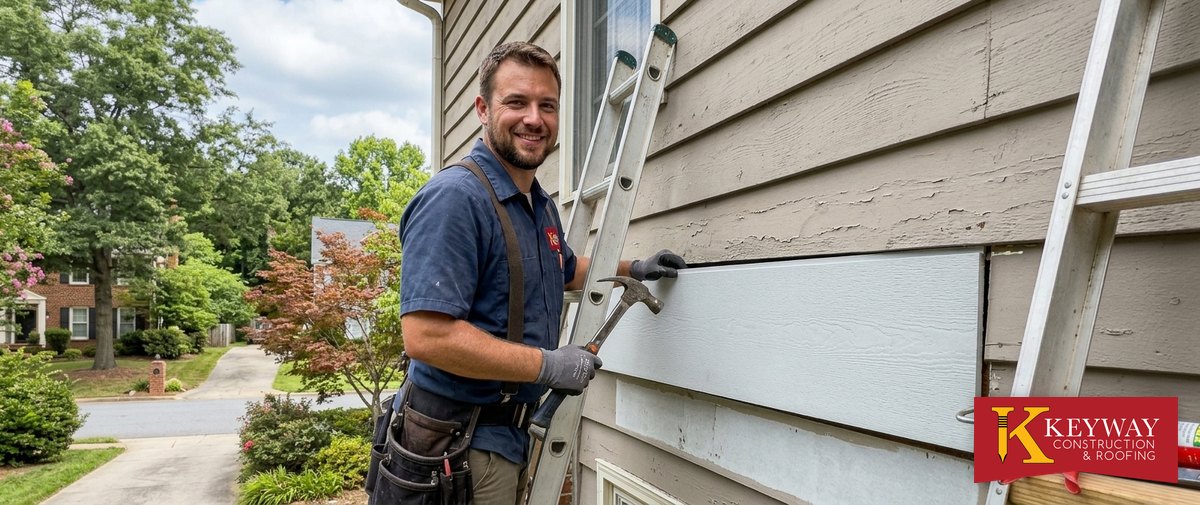
Fiber cement is one of the toughest siding materials on the market, and one of the least forgiving to repair badly. It is heavy, it is brittle at the edges, and it needs the right fasteners, the right sealant, and primed cut edges to hold up. Do a patch wrong, the wrong board match, caulk smeared over a crack, an unprimed cut edge, and moisture works in behind the surface and quietly compounds for months before you ever see it inside. Keyway Construction and Roofing repairs and replaces fiber cement siding on homes across Charlotte, Matthews, Mint Hill, Indian Trail, Stallings, and Ballantyne. We are a licensed general contractor, family-owned, and based right here in Matthews, so when we open a wall and find trouble behind the siding, we can fix that too instead of stopping at the surface.
Call 704-847-7119 or contact us online for a free next-day estimate. No hidden fees, no pressure.
Putting on a whole new exterior instead? That is a different job, and we cover it on our fiber cement and Hardie siding installation page. This page is about fixing what you already have.
Quick answer
Fiber cement siding is worth repairing when the damage is localized, a cracked board, failed caulk, or peeling paint, and the wall behind it is sound. Small cracks take a cementitious patch; a board cracked all the way through gets cut out and replaced, with the cut edges primed and the area painted to match. Replacement wins once damage is widespread or moisture has reached the sheathing behind the boards.
Signs Your Fiber Cement Siding Needs Attention
Fiber cement hides its problems well, right up until it does not. A few things are worth a closer look after a storm season or once your siding is a decade or two old:
- Hairline cracks running off a nail head or a corner, often the first sign a board was over-driven at install
- Chipped, punched, or broken boards from hail, a stray ball, or a ladder
- Gaps opening at the butt joints between boards or where siding meets window and door trim
- Paint that is peeling, blistering, or chalky over whole sections rather than one spot
- A board that rattles or sits proud of the wall, a sign the fastening has let go
- Dark streaks, staining, or a soft spot on the trim, which usually means water is already getting behind
One or two of these on an otherwise sound wall is a repair. Several of them across the house is a conversation about replacement, and we will be straight with you about which one you are looking at.
Common Fiber Cement Problems We Repair
These are the ones we see most on Charlotte-area homes:
- Cracked or broken boards. Impact from hail or debris, or a board over-nailed at install, cracks the plank. In most cases the damaged section comes out and a matched board goes in without disturbing the rest of the wall.
- Failed caulk at joints and trim. Caulk shrinks and splits through Charlotte’s summer-to-winter swings. The gaps at window frames, door frames, and butt joints are prime moisture entry points, and they are the cheapest thing on this list to stay ahead of.
- Peeling or blistering paint. Fiber cement holds paint beautifully when the surface was prepped and the cut edges were primed. When it peels in sheets, the prep was skipped or moisture is pushing from behind, and it needs more than another coat.
- Water intrusion behind the boards. Once caulk fails or a board cracks, water gets behind the siding. By the time you see a stain inside, it has usually been working back there for months.
- Rot in the wood behind it. Fiber cement does not rot. The sheathing, framing, and trim behind it absolutely will if water gets through, and that is the repair that catches most homeowners off guard.
Call 704-847-7119 or contact us online to schedule a free fiber cement siding inspection.
How We Actually Repair Fiber Cement Siding
Here is the part most homeowners never see, and the part that separates a repair that lasts from one that reopens in a year. Our process on a typical fiber cement repair looks like this:
- Find the real source first. A crack or a stain is a symptom. We trace it back to why water got in, a failed joint, a bad flashing detail, an over-driven nail, before we fix the visible part.
- Patch or replace, based on the damage. Small chips and hairline cracks get a cementitious patching compound made for fiber cement, not a smear of caulk that stays visible and reopens. A cracked or broken board gets cut out and replaced. On a real crack, replacing the board is the only permanent fix, and we will tell you that rather than sell you a patch we know will fail.
- Re-secure loose boards into framing. A board that has pulled loose gets fastened back into solid framing, not just tacked to sheathing, so it does not work loose again.
- Prime the cut edges. Every field-cut edge on fiber cement has to be sealed and primed. This is the step DIY jobs and rushed crews skip, and it is exactly where the next round of moisture damage starts.
- Seal the right joints with the right material. We caulk the joints that are meant to move with a quality exterior sealant, and leave the ones that are supposed to breathe alone. Over-caulking fiber cement traps water as surely as under-caulking lets it in.
- Prime and paint to match. The repair gets primed and painted to blend with the existing wall, so you are not left with a patch that announces itself from the curb.
That is also why fiber cement repair is a poor DIY candidate. The material is heavy and cuts up a lot of silica dust, the board match has to be right, and the edge-priming and paint-matching are easy to get wrong in ways that show up later.
Repair or Replace: How We Think About It
Fiber cement that is structurally sound but showing surface wear, peeling paint, dried-out caulk, a cracked board here and there, is worth repairing. The material underneath is still doing its job, and targeted repairs add years of life for a fraction of a re-side.
Replacement earns its place when the damage is widespread across large sections, when the sheathing behind has been compromised by moisture, or when the original install was done wrong and keeps generating the same problems in sequence. If you are weighing the two materials for a full replacement down the road, our guide on vinyl vs fiber cement siding lays out the tradeoffs. Either way, we give you the honest read. Fifty years in this area is a long time to build a reputation on straight answers instead of the biggest invoice.
Matching the Board and the Color
The hardest part of a good fiber cement repair is making it disappear. Two things have to line up: the board and the paint. The replacement plank has to match the existing profile and thickness, or the repair reads as a patch in raking light. And the color has to match, whether your siding is factory-finished like James Hardie ColorPlus or field-painted. A ColorPlus wall can sometimes be spot-matched, but often the cleanest result is repainting the full affected elevation so the finish is uniform. We assess what you have before we commit to an approach, so you know what the finished wall will look like before we start.
Storm, Hail, and Impact Damage
Charlotte gets its share of hail and wind, and fiber cement takes impact damage like anything else: cracked boards, chipped edges, punctures. If a storm did the damage, it may be a covered insurance claim. We document the damage with photos and a written assessment that supports the claim, and if the same storm hit your roof or gutters, our storm damage team can look at the whole exterior in one visit. Call us before you patch anything, so the condition is recorded first.
What We Find Underneath, and Why a Licensed GC Matters
Most siding crews stop at the surface. When they pull a damaged fiber cement board and find rotted sheathing or compromised framing behind it, they patch around it or hand you off to a carpenter. We do not. As a licensed general contractor, when we open a section and find wood rot in the sheathing, the framing, or the fascia and trim around a window, we repair it in the same project. One crew, one point of accountability, no gap where two contractors point at each other later.
On Charlotte-area homes built in the 1980s and 1990s, which make up a big share of the housing in Matthews, Mint Hill, Stallings, and Indian Trail, this comes up more than people expect. Older sheathing has had decades to take on moisture through small failures. We look at what is actually behind your siding and tell you what we find, good or bad.
Keeping Repaired Siding Sound
A fiber cement repair holds up if the wall around it is looked after. Recaulk the joints when they start to shrink, repaint before the finish fails rather than after, keep sprinklers from spraying the wall, and make sure your gutters and fascia are actually moving water away from the siding instead of down behind it. Small habits, and they are the difference between a repair that lasts a decade and one that needs company again next year. If your caulk lines are the weak point, our weatherproofing work targets exactly those joints.
Serving Matthews, Stallings, Mint Hill, Indian Trail, and Surrounding Areas
We are headquartered at 740 Stallings Road in Matthews, which puts us close to the communities where most of our fiber cement repair work happens. When you call, you reach a local contractor who gets out to you the next day, not a regional company scheduling three weeks out. Every repair carries our one-year workmanship warranty. If anything is not right within 365 days, we come back and make it right, no questions asked. We serve homeowners across Matthews, Stallings, Mint Hill, Indian Trail, Ballantyne, Monroe, Waxhaw, Weddington, Myers Park, SouthPark, Arboretum, and Pineville.
Call 704-847-7119 or contact us online for a free next-day fiber cement siding estimate.
Frequently Asked Questions About Fiber Cement Siding Repair
How do I know if my fiber cement siding needs repair or full replacement?
Localized damage, a cracked board here, failed caulk around a window, a section of peeling paint, is usually worth repairing. Widespread damage across large portions of the exterior, or moisture that has worked into the sheathing behind the boards, usually means replacement is the more cost-effective path. We offer free inspections and give you a clear answer on which situation you are in, with an honest explanation of why.
Can a crack be patched, or does the whole board need replacing?
It depends on the crack. A small chip or hairline can be filled with a cementitious patching compound made for fiber cement, then primed and painted. But a real crack that runs through the board will reopen if you just fill it, and a caulk-filled crack stays visible. In that case replacing the board is the only permanent fix, and we will tell you honestly which one your siding needs rather than selling you a patch we know will fail.
Can fiber cement boards be replaced individually without redoing the whole wall?
Yes, in most cases. Individual boards can be removed and replaced without disturbing the surrounding installation, as long as the new board matches the existing profile and thickness and the repair is sealed and primed correctly. The trick is the match, both the board profile and the paint finish. We assess the existing material before committing to an approach so you know exactly what the finished result will look like.
Do you paint the repair to match the rest of the siding?
Yes. A repair is not done until it disappears. We prime and paint the replaced or patched area to blend with the existing wall. On a factory-finished ColorPlus wall we can sometimes spot-match, but often the cleanest result is repainting the full affected elevation so the color is uniform. We talk through which approach fits your siding before we start.
What happens if there is wood rot behind my fiber cement siding?
Fiber cement does not rot, but the wood sheathing and framing behind it will if moisture gets through. When we open a damaged section and find rot in the sheathing, fascia, or framing around a window or door, we tell you what we found and what it takes to fix it properly. Because Keyway handles wood rot repair directly as a licensed general contractor, we fix it in the same project rather than sending you to a separate crew.
Is repairing fiber cement siding a DIY job?
We would steer most homeowners away from it. Fiber cement is heavy, it throws a lot of silica dust when you cut it, the board and color match has to be right, and the cut edges have to be primed or the repair fails from the edges in. It is the kind of job where the mistakes do not show up until a year later, behind the wall. A proper repair by a crew that does it every week is usually cheaper than doing it twice.
Does home insurance cover hail-damaged fiber cement siding?
Often, yes, if a storm event caused it. Sudden hail or wind damage is typically covered, while gradual wear from age is not. If a storm cracked or punctured your siding, we document the damage with photos and a written assessment to support the claim, and we can assess the roof and gutters in the same visit if the same storm hit them. Call us before patching anything so the condition is on record.
Keyway Construction provides fiber cement siding repair and replacement across greater Charlotte, alongside new fiber cement siding installation, vinyl siding, wood rot repair, and window replacement. Not sure your siding is worth keeping? Start with the signs your home needs new siding. Call 704-847-7119 for a free estimate.
Protect Your Gutters With Gutter Caps
Eliminate tedious maintenance tasks and unsightly clogs with time-saving gutter guards.Proudly Serving
Matthews | Stallings | Mint Hill | Indian Trail | Weddington
Waxhaw | Monroe | Ballantyne | South Park | Arboretum |
Myers Park | Pineville | Fort Mill
Matthews | Stallings | Mint Hill | Indian Trail | Weddington
Waxhaw | Monroe | Ballantyne | South Park | Arboretum |
Myers Park | Pineville | Fort Mill