

Siding Repair and Replacement in Matthews, NC
Quick answer
A lot of Matthews houses went up in the 1980s and 1990s, so the siding on them is often original vinyl or pressed-wood hardboard that’s now 25 to 45 years old, frequently on walls that sit under heavy tree shade. Keyway Construction and Roofing, based on Stallings Road, repairs vinyl, fiber cement, wood and aluminum siding in Matthews, re-sides in vinyl or fiber cement, and fixes rot behind the siding as part of the same job. Free next-day estimates at 704-847-7119.
Pick almost any street off Sardis Road, Weddington Road or Monroe Road and you’ll find the same picture. A house from the late ’80s or the ’90s. Pines and oaks taller than the roof. And one wall, usually the one facing the woods, that never quite dries out after a rain.
That wall is where Matthews siding fails first. Our office is on Stallings Road, so these calls are a short drive for us, and this page is about siding repair and replacement in Matthews, NC: what’s actually on your walls, why it’s failing, and how to tell whether a handful of boards will do or the house needs re-siding. Before you sign anything, see what your Matthews siding quote should list.
Want someone to look? Call 704-847-7119 or ask for a free next-day estimate.
What’s on your walls, and how does it fail here?
You can’t decide anything until you know the material. Matthews grew in waves, so you’ll see a bit of everything, and plenty of houses have one wall that was re-sided years ago and three that weren’t. Use this as a field guide.
| Material | Usually found on | How to recognize it | How it tends to fail |
| Hardboard lap | 1980s and 1990s builds | Painted pressed-wood boards, often with a stamped wood grain. Sounds dull when you knock on it. | Bottom edges swell and go soft, paint lifts off the swollen spots, nails sink in. Worst near the ground and under roof runoff. |
| Vinyl (original builder grade) | 1990s and 2000s subdivisions | Hollow panels, color runs all the way through, nailing slots along the top edge. | Turns brittle and cracks from mower-thrown rocks or hail, grows green film on shaded walls, buckles if it was nailed too tight. |
| Fiber cement | Newer homes and re-sides | Heavy and rigid. A cut edge looks like gray stone. No hollow sound. | Worn paint and split caulk joints, cracks near nails, swelling where cut ends were left unsealed or run too close to soil or a roof. |
| Wood (lap, shake, board and batten) | Older houses, plus gables and dormers on newer ones | Real grain and end grain at the joints. A screwdriver sinks into soft spots. | Rot at the bottom courses and around windows wherever paint has failed. Carpenter bees in bare wood. |
| Aluminum | 1960s and 1970s houses, sometimes installed over wood | Thin metal that dents with a thumb. Leaves chalky residue on your hand. | Dents, chalking and fading. Matching replacement pieces are hard to find. |
| Asbestos-cement shingle | Mid-century houses | Hard, brittle rectangular shingles, often with a textured face and a straight or wavy bottom edge. | Cracks and breaks. Have it tested before anyone cuts, drills or pressure washes it. |
Hardboard gets its own warning. Several brands sold through the ’80s and ’90s ended up in class-action settlements over swelling and rot, and the claim windows on those closed years ago. So if your house has it today, it’s simply a repair-or-replace call. Swollen hardboard won’t go back to flat, and no amount of paint fixes it. Isolated boards can be swapped out. When the bottom edges are mushrooming on every side of the house, though, you’ll be replacing boards faster than the next ones fail.
Not sure which one you’ve got? That’s the first thing we’ll tell you at the estimate.
Why does one side of a Matthews house go first?
It’s usually the wall facing the woods. Matthews neighborhoods kept a lot of their tree canopy, and that shade is great in July and hard on siding the rest of the year. A few local conditions do most of the damage:
- Shade that never burns off. A wall under pines can stay damp for days after a storm. That’s how vinyl turns green and paint peels off hardboard and wood.
- Sprinkler heads. A rotor that wets the house every morning keeps the bottom few courses soaked. Swollen hardboard right behind a sprinkler is about as predictable as siding failure gets.
- Mulch and pine straw. Beds get topped up every spring until they’re touching the siding. Fiber cement makers call for about 6 inches of clearance above the ground for a reason: buried board bottoms wick water.
- The brick ledge. Lots of houses here sit on a brick base with siding above. If the bottom course was run tight to the brick with no flashing, water sits on that ledge and soaks the board from below.
- Dormers and garage roofs. Wherever a lower roof runs into a sided wall, rain runs down the roof and straight behind the siding unless there’s a kick-out flashing at the bottom of that joint. Current residential code calls for one. Plenty of older houses never got it.
Easy way to confirm it: stand at the south wall, then walk round to the north one. Firm boards and tight paint on one, soft bottoms and peeling on the other? That’s your pattern.
Four things to check on a wall like the one in the photo
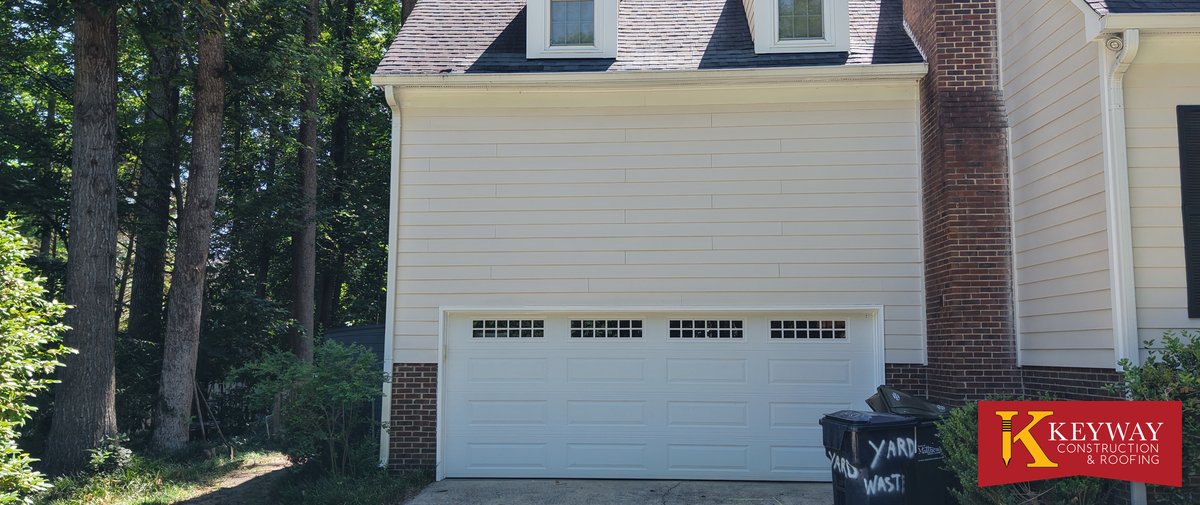
The photo at the top is a garage wing on a Matthews house, lap siding over a brick base, with a brick chimney on one side and woods on the other. It’s a good example of where a wall here gets tested.
- The dormers. Each dormer is a little roof-to-wall joint. Stains or soft siding just below a dormer usually mean the flashing above is letting water in, and that’s a roofing fix before it’s a siding fix.
- The chimney edge. Where siding butts into brick, the seal is caulk plus whatever flashing the builder bothered with. That caulk dries out and splits, and nobody notices because the trash cans live right there.
- The brick piers at the garage door. The siding stops on top of the brick. That’s the ledge problem from the list above, and it’s where we’d probe first on this house.
- The tree line. The side of a house that backs onto woods gets the least sun and the most leaf litter in the gutters. Walk that side of your own house first.
Repair or replace? A checklist you can run from the driveway
Do this from the ground. Walk each side of the house and see which list your answers land in.
Repair probably makes sense if:
- The damage is on one wall, or in one patch of a wall.
- Boards around the damage feel firm when you press them.
- Your profile and color are still made, or there’s a hidden wall to borrow from (more on that below).
- It’s storm or impact damage on otherwise healthy siding.
Re-siding probably makes sense if:
- Hardboard is swelling on more than one side of the house.
- Vinyl cracks when you gently flex a panel.
- You’ve already patched the same wall twice.
- Soft spots show up around several windows, not just one.
- The color’s discontinued and there’s nowhere to borrow matching boards from.
About that borrowing trick. Vinyl fades evenly over the years, and manufacturers retire colors, so a brand new panel rarely matches a 20-year-old wall. What works: take panels off a wall nobody looks at, like the back of the garage or a side hidden by the fence, use those to fix the front, and put the new panels on the hidden wall. The visible repair matches. The slight color difference ends up where no one sees it.
Outside Matthews, or want the long version? Read our siding replacement guide for the Charlotte area.
Vinyl or fiber cement for a Matthews re-side?
Both are good choices when they’re installed right. They just behave differently on a shaded, tree-lined lot.
| What matters | Vinyl | Fiber cement |
| Damp, shaded walls | Won’t rot, but grows mildew you’ll be washing off | Won’t rot, as long as the paint and every cut end stay sealed |
| Hail, mower rocks, kids | Thin panels crack, especially in cold weather. Thicker or insulated panels hold up better. | Takes hits far better. Can crack if struck hard near a nail. |
| Summer heat | Expands and shrinks a lot, so it has to hang loose on its nails. Can warp from sunlight reflected off a neighbor’s low-E windows. | Barely moves with temperature |
| Fire | Melts and burns | Noncombustible |
| Painting | Never. The color is in the panel. | Primed boards get painted on site and repainted over the years. Factory-finished boards go longer between coats. |
| Installation | Light and quick to hang | Heavy and slower. Cutting it makes silica dust, so it’s cut outdoors with dust control. |
| Upfront cost | Lower | Higher |
Our rule of thumb for Matthews: if the house is heavily shaded and you plan to stay a long while, fiber cement siding usually pays for itself in fewer headaches. Selling in a few years, or working to a tight budget? A thicker vinyl over a properly wrapped and flashed wall is an honest, solid job. We install both, so we don’t have a reason to push either. The full vinyl versus fiber cement comparison goes deeper on lifespan and upkeep.
What’s behind the siding on a 1980s or ’90s house?
Short version: whatever the builder had on the truck that week. On houses from that era we find OSB or plywood at the corners, sometimes black asphalt-impregnated fiberboard or thin foam board in between, and either felt paper or no wrap at all. None of that is a problem while it’s dry.
When siding comes off, we’re looking for three things. Soft sheathing along the bottom and under windows. Windows that were only ever caulked to the siding, with no flashing tape at the head or sill. And torn or missing housewrap. Re-siding over a wet wall just seals the problem in.
If there’s rot, it gets fixed before anything new goes up. We’re a licensed general contractor, so the carpentry is ours and it stays on the same job. Our page on rotted trim, sills and sheathing in Matthews covers what that repair looks like.
Permits, HOAs and older houses: the Matthews paperwork
Which county are you in? The Town of Matthews is in Mecklenburg County, where building permits go through Mecklenburg County Code Enforcement. But Matthews mailing addresses also reach into Union County, which runs its own permitting. Your property tax bill tells you which one you’re dealing with.
Does siding need a permit? Swapping a few damaged boards is ordinary maintenance. A whole-house re-side, or a job that replaces sheathing or framing, can be a different story depending on scope. Ask whoever you hire to put in writing who’s checking that.
HOA review. Many Matthews subdivisions have an architectural review step for exterior color or material changes. Get the approval in writing before material gets ordered. Like-for-like replacement is sometimes treated as maintenance, but your covenants decide that, not your contractor. We can supply product sheets and color samples for the application.
Built before 1978? Federal EPA rules require lead-safe work practices, by a certified firm, whenever more than 20 square feet of painted exterior surface is disturbed on a pre-1978 home. That covers a lot of older wood siding and trim. Ask any contractor for their firm certification before work starts.
Asbestos-cement shingles. If you’ve got the hard, brittle shingles described in the table, leave them alone until they’re tested. Don’t let anyone pressure wash, sand or nail through them first.
How a Keyway siding job runs, step by step
- Walk-around estimate. We look at every side of the house, probe the bottom courses and window corners, and identify the material and profile. It’s free, and we offer next-day appointments.
- Written scope. You get a repair list or a re-siding plan, the material we’d use and why, and what happens if we find rot once the siding’s off.
- Paperwork. Samples and spec sheets for your HOA, plus a straight answer on whether the scope needs a permit.
- Strip and inspect. Once the old siding is off, we check the sheathing, the wrap and the flashing around every window.
- Fix the wall. Rotted sheathing or framing gets replaced, housewrap and flashing tape go on, and kick-out flashings go in where roofs meet walls.
- Hang the siding. Proper clearance above soil, roofs and the brick ledge. Vinyl hung loose so it can move. Fiber cement cut ends sealed.
- Trim, seal and clean up. Corners, window surrounds and the joint at any chimney get finished and sealed, and the yard gets cleaned up. The work carries our 1-year workmanship warranty.
What drives the cost of siding work in Matthews?
- How much wall. A few boards, one elevation or the whole house.
- Material and finish. Standard or thicker insulated vinyl; primed or factory-finished fiber cement.
- Height and access. Two-story gables, sloped lots and trees tight against the walls all add setup.
- What’s behind it. Rotted sheathing or framing only shows up once the siding’s off.
- Trim and extras. Corner boards, window wraps, and soffit and fascia done at the same time.
- Tear-off. One layer, or new siding over old siding that has to come off first. Asbestos-cement adds testing and abatement.
There’s no price on this page on purpose. A shaded two-story in Sardis Forest and a ranch near downtown Matthews are different jobs, even with the same siding on them. The estimate’s free, and you get it in writing.
Siding rarely fails alone
Swollen boards right under a gutter corner usually mean the gutter’s overflowing, so check our Matthews gutter work too. Stains on the top course under the eave point to the roof edge, which is covered on our page about soffit and fascia in Matthews. Water coming off a valley into a dormer wall is a roofing job first; see roof repair and replacement for Matthews homes. Material-by-material detail is on our main siding page, and everything else we do in Matthews is on the town page.
Matthews siding questions
Can you replace just a few boards of siding on my Matthews house?
Yes. If the damage is in one area and the boards around it are firm, we replace the damaged pieces and match the profile. We’ll check the wall behind them while they’re off, because a few bad boards are sometimes the visible end of a leak.
My siding is swelling and crumbling at the bottom edges. What is it?
It’s very likely hardboard, a pressed-wood siding used on a lot of 1980s and 1990s homes. It swells when water gets into unsealed edges and won’t flatten again. A few boards can be replaced; if it’s happening on several sides of the house, re-siding is usually the better spend.
Will new vinyl match my old vinyl siding?
Not exactly, in most cases. Old vinyl fades and colors get discontinued. The best fix is often to move panels from a hidden wall to the damaged spot and put the new panels where nobody looks.
Do I need HOA approval before re-siding in Matthews?
If your subdivision has an architectural review process, plan on it for any change in color or material. Like-for-like replacement is sometimes exempt, but your covenants decide that. Get the approval in writing before materials are ordered; we can provide samples and product sheets.
Do I need a permit to replace siding in Matthews?
It depends on the scope. Replacing damaged boards is maintenance. A full re-side, or work on sheathing or framing, may need a permit from Mecklenburg County, or from Union County if your Matthews mailing address is actually on the Union side. We’ll talk it through at the estimate.
Is fiber cement worth it on a heavily shaded lot?
Often, yes. Fiber cement doesn’t rot or feed mildew the way wood and hardboard do, and it shrugs off impacts. It costs more upfront and needs paint, so if you’re selling soon a thicker vinyl over a properly flashed wall can be the smarter call.
What happens if you find rot behind my siding?
We stop and show you. Then you get a written change to the scope before we go further. Because we’re a licensed general contractor, we repair the sheathing or framing ourselves as part of the same job.
How soon can you look at my siding in Matthews?
Usually the next day. Estimates are free, and the drive from our Stallings Road office to most Matthews streets is short. Call 704-847-7119.
Got a soft wall, a cracked panel or a whole house of tired hardboard? Call 704-847-7119 or book a free next-day siding estimate.
Protect Your Gutters With Gutter Caps
Eliminate tedious maintenance tasks and unsightly clogs with time-saving gutter guards.Proudly Serving
Matthews | Stallings | Mint Hill | Indian Trail | Weddington
Waxhaw | Monroe | Ballantyne | South Park | Arboretum |
Myers Park | Pineville | Fort Mill
Matthews | Stallings | Mint Hill | Indian Trail | Weddington
Waxhaw | Monroe | Ballantyne | South Park | Arboretum |
Myers Park | Pineville | Fort Mill