

Soffit and Fascia Repair in Matthews, NC
Quick answer
Most Matthews homes were built between the 1970s and the 1990s, so their original wood fascia, soffit boxes and trim have been through 30 to 50 years of shade, humidity and gutter overflow. Keyway Construction and Roofing is based on Stallings Road, a few minutes away, and repairs or replaces soffit and fascia on Matthews homes, fixes the water source first, and checks the attic vents behind the soffit. Free next-day inspection at 704-847-7119.
If you live in Matthews, there’s a decent chance your roof edge is older than your kids. A lot of the housing here was built in the ’70s, ’80s and early ’90s, and the wood on those eaves has been getting wet and drying out for three or four decades. Some of it has held up beautifully. Some of it is a screwdriver away from falling off.
We’re a short drive from most of Matthews, which makes this the soffit and fascia work we do most. This page is about soffit and fascia repair in Matthews, NC, what we find, and how to tell where your house falls.
Want it looked at? Call 704-847-7119 or book a free next-day inspection.
Which Matthews homes have eave problems, and why?
Age and shade, mostly. The housing stock here covers a lot of ground, and what fails depends on when the house was built.
| Built | What the eave usually is | What tends to go first |
| 1970s to early 1980s | Wood fascia, plywood or wood soffit boxes, often with few or no vents | Paint failure, soft fascia under gutters, stained or sagging plywood soffit |
| Mid 1980s to 1990s | Wood fascia, often aluminum-wrapped, with aluminum or vinyl soffit added or original | Rot hidden behind the wrap, loose soffit panels, blocked vents |
| Late 1990s onward | Wrapped wood fascia with vinyl vented soffit | Gutter-related fascia rot, sagging vinyl, nests in corner gaps |
That table is a rule of thumb, not a diagnosis. Plenty of owners have already redone part of their eaves, and plenty of old houses have been repainted just often enough to survive. We start every inspection by looking at what’s actually there.
What does shade do to a Matthews roof edge?
The trees are part of the town’s appeal, and part of the problem. Mature oaks over a house keep the north and east eaves damp long after a storm, drop leaves and debris into gutters, and block the sun that would normally dry the wood out. A fascia board in constant shade stays wet far longer than one on a sunny elevation, and wet wood rots.
It also gives you a quick test. Compare the sunny side of your house with the shaded side. If the fascia on the north elevation has paint peeling, algae or soft spots and the south side looks fine, you know what’s going on. Our broader Matthews wood rot page covers porches, decks and trim in the same environment.
Older wood soffit and boxed eaves
Many of the older brick ranches and colonials have wood soffit boxes: a plywood or board panel running from the fascia back to the wall, sometimes with a small round or rectangular vent cut into it. They were built to last and many have. When they fail, it’s usually for one of three reasons.
- Water from above. A leaking gutter or roof edge soaks the panel from the top and it stains, sags, then softens.
- No airflow. Without vents, humid attic air condenses on the cool underside of the panel, and the paint bubbles and flakes.
- Animals. A soft corner is an invitation. Squirrels and birds widen it quickly.
Repair depends on what’s behind the panel. If the framing is sound, we replace the panel and add vents. If water has reached the rafter tails or the sheathing edge, we open it up and repair that first. As a licensed general contractor we can do the carpentry ourselves, so there’s no hand-off to a second company halfway through.
Gable ends, rake boards and where the roof meets the wall
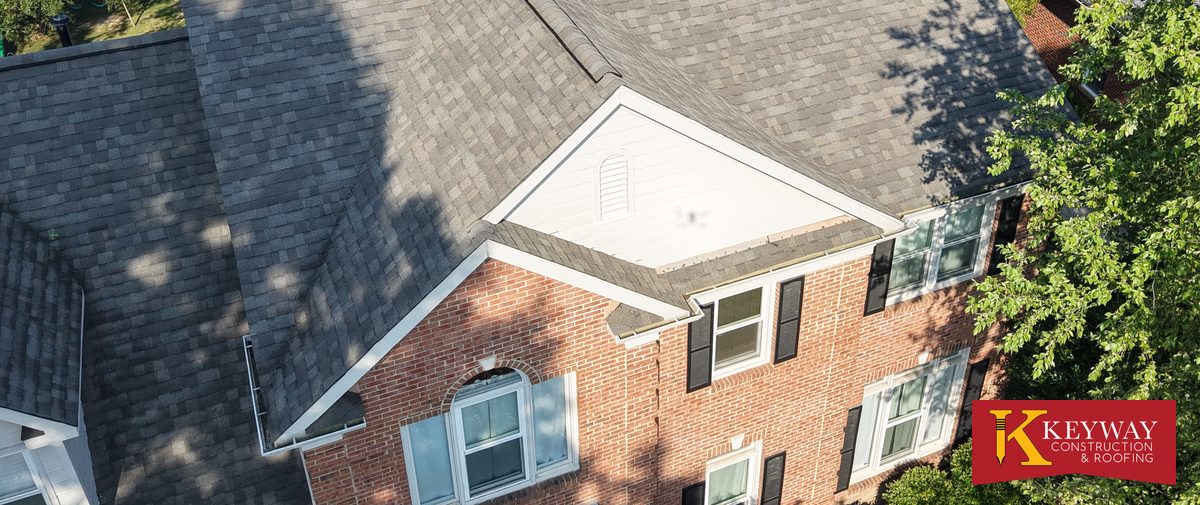
Look at the photo at the top of this page. It’s a brick home in Matthews that we re-roofed, shot from a drone. The white boards running up the slope of each gable are rake boards, the roof-edge version of fascia. The boards along the bottom edge, under the gutter, are the fascia. Both need to be sound, and both need good flashing behind them.
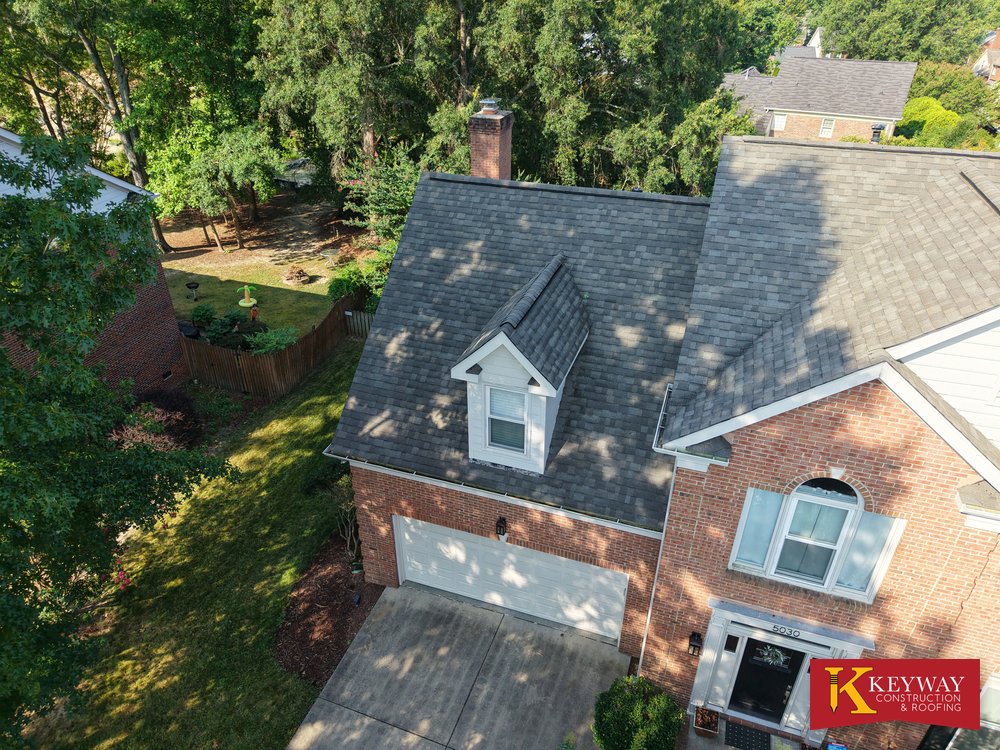
Rake boards fail differently from gutter fascia. They don’t get overflow, but they sit at the top of the wall where water running down the roof meets the siding, and where end grain sits exposed. Cracks in the paint at the corner of a gable return, or a rake board that’s bowed away from the wall, usually mean water is getting behind it. Dormers and chimney surrounds have the same issue, which is why our Matthews roof replacement case study spends so much time on flashing.
Why did my fascia rot if I just had gutters installed?
We hear this one a lot, and it’s fair. Gutter installers hang gutters. They don’t always probe the board they’re hanging them on. If the fascia was already soft, new gutters get screwed into weak wood, and the rot continues behind a shiny new gutter.
It happens the other way too. A gutter hung a little too level, or with too few hangers, can hold water at one end and soak the board behind it. The gutter looks installed correctly. The fascia pays for it over a few seasons.
Our approach on any Matthews call: probe the fascia first, replace soft sections, then hang or reset the gutter, and correct pitch, hanger spacing and downspout capacity. We’d rather charge for the fascia and have the gutter last than hang new gutters on rot. See our Matthews gutter installation page for the gutter side.
How can you check your own eaves before you call?
You don’t need a ladder, and you shouldn’t use one on a wet roof edge. Walk around the house in daylight and look at each side. Start with the shaded elevation, because that’s where trouble usually starts.
- Look at the line. Fascia should run straight. A wave or a dip means the board behind the paint has moved.
- Look under the gutters. Streaks running down from a seam or corner mean water is spilling over the back edge.
- Look at the soffit. Flat, clean, tight panels are good. Stains, bubbling paint or a droop in the middle aren’t.
- Look at the corners. Open joints, split caulk and gaps are where water and animals get in.
- Listen. Scratching in the attic in the morning or evening can mean something is already inside.
If you find one issue, it may be a quick fix. If you find a few across several sides of the house, the eave as a whole is probably due for attention.
Who moves in when the eave goes soft?
Carpenter bees love old, weathered wood and leave neat round holes about the width of your finger. Wasps nest in the void behind a loose panel. Squirrels and birds enlarge any opening they find. If you have active insects, call a pest company first. Caulking over a hole while bees are inside just sends them looking for another exit, often through your soffit.
After that, we repair the wood, seal every joint and prime and paint every cut edge. Sealed wood is much less attractive to carpenter bees than bare wood, and paint is the cheapest long-term protection a fascia board has. If the board has been bare or flaking for years, paint it as part of the repair, not someday.
Repair a section, replace the run, or start over?
Here’s how we think about it, in plain terms.
Replace a section when the damage is local and the rest of the board is solid. A single rotted corner under a gutter seam is the classic example.
Replace the run when soft spots show up every few feet. Piecing together a dozen small repairs means a dozen joints, and joints are where water gets in. One clean board lasts longer.
Replace the soffit and fascia together when the water has been running a while. If the fascia is soft and the soffit under it is stained, the two are usually linked, and doing both at once is cheaper than coming back.
Open the whole eave when rot has reached the rafter tails or you see daylight through the roof edge. That’s structural work, and we handle it before anything gets covered up again.
We’ll tell you which one it is after probing the wood. If it’s something small, we’ll say so. Not every call needs a big job.
Your attic and the vents behind your soffit
Older Matthews homes are often under-vented, and the soffit is where it shows. In July, the attic of a house with poor airflow can sit well over 130 degrees, which cooks shingles from underneath, pushes your air conditioner harder and puts moisture where you don’t want it in winter.
When we replace soffit, we check the attic side. Are the vent openings clear? Is insulation drifting over them? Is there a ridge or roof vent to complete the airflow path? The residential code baseline is about 1 square foot of vent area per 150 square feet of attic, or 1 per 300 when vents are balanced between low and high. Replacing a solid soffit with vented panels is often the cheapest ventilation upgrade a house can get. Our attic ventilation page has the full picture.
What the work looks like
- Free inspection. We look at each elevation, probe the wood, check the gutters, and look in the attic if needed.
- Plain-language scope. You get a written list of what we’d repair, what we’d replace and why.
- Fix the cause. Gutters, flashing or drainage that caused the damage get corrected first.
- Cut out the bad wood. Rotted fascia, soffit and any damaged framing come out.
- Install new material. Primed fascia, matching trim and vented soffit go in.
- Paint, seal and clean up. Joints sealed, color matched, gutters back on, site swept.
The work comes with our 1-year workmanship warranty.
What decides the cost of soffit and fascia work in Matthews?
- How many feet of eave. A porch roof and a whole house are different jobs.
- Single story or two. Height changes the setup.
- How far the rot goes. A soft board is one thing. Damaged rafter tails or sheathing add scope.
- Material. Wood, composite, aluminum, vinyl and fiber cement all price differently.
- Gutters. They come down for fascia work and go back up after.
- Vent upgrades if the attic needs more airflow.
We don’t post a number, because two Matthews houses can be a few hundred feet apart and need very different work. The inspection is free, and the estimate is in writing.
Based a few minutes away
Our office is on Stallings Road, so most Matthews calls are a short drive. That’s why next-day inspections are realistic. The rest of what we do in town is on our Matthews page, including roof repair and storm damage repair. The same work is covered in Indian Trail and Cornelius. For the full guide to materials and when to repair versus replace, see our soffit and fascia repair and replacement page and the plain-English explainer.
Soffit and fascia questions Matthews homeowners ask
How can I tell if my Matthews home's fascia is rotted?
Press a screwdriver into the board, especially along the shaded sides and under gutter seams. Sound wood pushes back and rotted wood lets the tip sink in. Peeling paint, a wavy fascia line and a gutter pulling away are other clues. We’ll probe it for you during a free inspection.
My soffit has water stains. Is that serious?
It can be. Stains usually mean water is coming from above, from a leaking gutter, a roof edge or flashing, and the panel or the framing behind it may be wet. We find the source first, then repair what the water has damaged. A stain that’s old and dry is less urgent than one that grows after rain.
Do you add vents when replacing soffit?
Yes, where the attic needs them. Many older Matthews homes have solid soffit or blocked vents. Replacing it with vented panels, and clearing any insulation that’s covering the openings, is one of the most cost-effective ventilation fixes available. We check the attic side to see what’s needed.
I just had new gutters put on and the fascia is still rotting. Why?
Likely because the fascia was already soft when the gutters were hung, or the gutters were pitched or supported in a way that holds water against the board. New gutters on bad wood don’t stop rot. We replace soft fascia first, then hang the gutter with proper pitch, spacing and downspout capacity.
Can you repair just the soffit, or do you have to replace the fascia too?
Sometimes the soffit can be done on its own, if the fascia is sound and the water source is fixed. Often they’re linked, because the same overflow that soaked the fascia reached the soffit. We’ll tell you after probing both.
Do you repair rake boards and gable trim as well?
Yes. Rake boards, gable returns, frieze boards and dormer trim fail for similar reasons, and we repair or replace them along with the eaves. If a board has bowed away from the wall, water is probably getting behind it, so we check the flashing before closing it up.
How soon can you come out in Matthews?
Our office is on Stallings Road, a few minutes from most of Matthews, and we offer free next-day inspections. Call 704-847-7119 or use the contact form.
Keyway Construction and Roofing is a family owned, licensed general contractor that has worked around Charlotte since 1975. We’re Owens Corning certified, accredited with the Better Business Bureau and listed on Angi. Read our reviews, learn about the company, or call 704-847-7119 for a free next-day inspection in Matthews.
Protect Your Gutters With Gutter Caps
Eliminate tedious maintenance tasks and unsightly clogs with time-saving gutter guards.Proudly Serving
Matthews | Stallings | Mint Hill | Indian Trail | Weddington
Waxhaw | Monroe | Ballantyne | South Park | Arboretum |
Myers Park | Pineville | Fort Mill
Matthews | Stallings | Mint Hill | Indian Trail | Weddington
Waxhaw | Monroe | Ballantyne | South Park | Arboretum |
Myers Park | Pineville | Fort Mill