

Soffit and Fascia Repair in Ballantyne, NC
Quick answer
Soffit and fascia repair in Ballantyne usually starts where water piles up on a complicated roof: valley outlets, inside gutter corners, cornice returns, and the short eaves over bays and porches. Keyway opens up any suspect aluminum wrap, fixes whatever is sending the water there, rebuilds the rotted wood and soffit, and rehangs the gutters into solid board. The estimate is free and in writing, and the work carries our 1-year workmanship warranty.
A Ballantyne house has a lot more eave than it looks like from the driveway. Take a typical two-story brick front off Ardrey Kell or Rea Road: a hip or multi-gable main roof, two or three front gables with cornice returns, a bay window with its own little roof, a covered entry, and a bonus room over the garage. Add it up and the soffit and fascia aren’t one long run around the house. They’re a stack of short runs and corners, most of them at second-story height, and almost every corner is a joint where paint and caulk are doing the waterproofing.
That’s why soffit and fascia repair in Ballantyne is rarely about one board. It’s about finding the two or three spots where your roof sends its water and fixing those properly, before the rot travels into rafter tails, the soffit, or the wall behind the brick.
Got a soft corner or a gutter that won’t stay tight? Call 704-847-7119 or ask for a free estimate online.
Where does water get into a Ballantyne roofline?
At a junction, almost every time. Long straight runs of fascia on a two-story wall usually hold up. The trouble collects where planes, materials and trim pieces meet. These are the six places we check first on houses built the way most of Ballantyne was built.
- Valley outlets. Two roof slopes meet in a valley and empty all their water at one point on the gutter, often right at an inside corner. In a hard summer downpour the gutter can’t take it in, water shoots over the front edge or backs up behind it, and the fascia under that spot gets soaked storm after storm. The fix is the board plus something that slows the water down, like a valley splash guard or a bigger downspout nearby.
- Missing kickout flashing. Think of a porch or garage roof that runs into the two-story wall. Right where its eave meets that wall, there should be a small bent flashing that kicks the water out into the gutter. When it’s missing, water runs down the wall behind the gutter end and into the fascia, the soffit and the wall itself. On brick you’ll see a stain fanning out below that corner. On siding you won’t see much until the trim is soft.
- Cornice returns. Those short boxed returns at the foot of a gable look like pure decoration, but the top of each one is nearly flat. Builders usually capped them with a scrap of shingle or a little metal. Once that cap opens up, rain sits on the top and soaks down into the wood. The blocks and brackets under many returns are wood too, and they hold water at every joint.
- Bay and porch roofs. A bay window with a small metal or shingled roof has its own mini eave and fascia, with tight angled corners where caulk carries most of the load. These are easy to forget because they’re below the main gutter line.
- Hanger lines on wrapped fascia. Aluminum coil wrap looks perfect from the lawn. But every gutter spike or hanger screw is a hole through it, and water follows the fastener straight into the wood behind. Rot here often shows up as a gutter that keeps pulling loose before you see anything wrong with the trim.
- The line where soffit meets brick. There’s usually a frieze board or trim strip where the soffit dies into the wall. When the caulk there cracks, wasps move in, moisture gets behind the trim, and on a gable end it’s often the first spot a squirrel tests.
If you’re curious which part is which before we talk, our plain-English guide to the parts of a roof edge has a labeled walk-through.
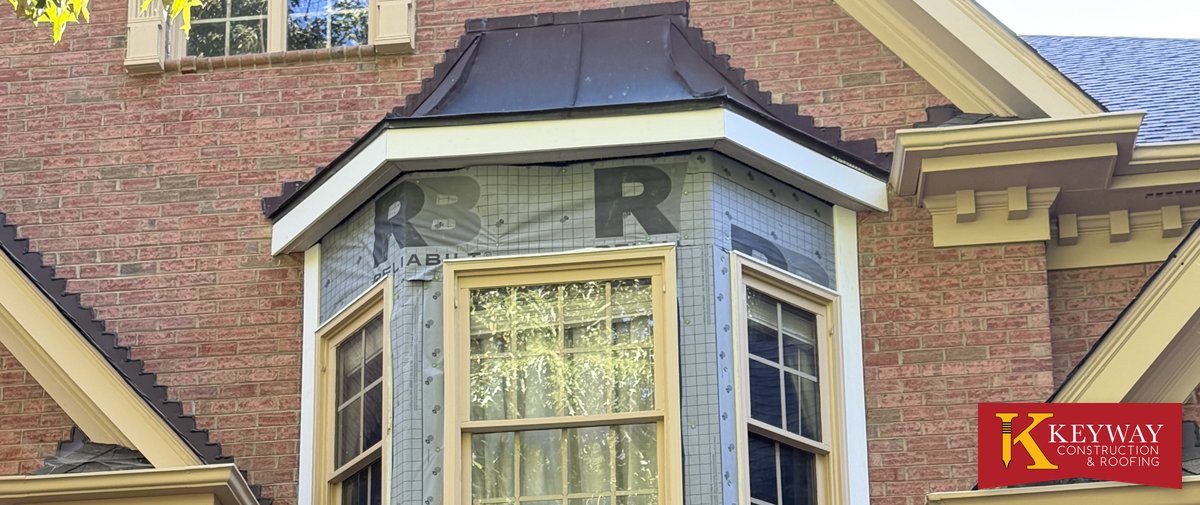
What the photo at the top of this page shows
It’s from a job our crew did on a brick home in the Providence Plantation area of Charlotte. It isn’t a Ballantyne house, but it’s built the way a lot of south Charlotte homes from the same era are, so it’s worth a closer look.
- The bay, mid-repair. The bay’s trim has been taken off down to the house wrap. You can see how much of a bay is trim rather than brick, and how many seams there are around the windows.
- The bay’s own eave. Above the windows is a short eave and fascia under a metal-capped roof. Its corners are angled, not square, which makes them harder to seal and harder to match.
- Cornice returns on both sides. Left and right, the gable eaves end in boxed returns with blocks underneath. Each block is a separate piece with its own joints.
- Soffit vents. Up close, the soffit under the right return has slotted vents in it. That’s attic intake air, and it has to stay open after any repair.
The point isn’t the bay. It’s that on a house like this, a “fascia job” is partly finish carpentry. Whoever does it needs to rebuild returns and blocks to match, not just bend a new piece of aluminum over the old board.
Which soffit and fascia materials make sense on a Ballantyne house?
Match what’s there unless there’s a reason not to. Most homes here have painted wood trim, wrapped fascia, vinyl soffit, or some mix of the three, and a repair that changes the material on one side of the house tends to stand out. Here’s how the options compare.
| Material | Where you’ll see it | How it fails | When we’d use it |
|---|---|---|---|
| Painted wood | Fascia, rake boards, cornice returns, blocks and brackets | Soft end grain at joints and corners, anywhere the paint has let go | When a trim profile has to match. We prime all six faces and seal every cut end. |
| Aluminum wrap over wood | Fascia on a lot of builder homes from the late 1990s and 2000s | Looks fine while the board behind it rots; leaks at fasteners | Over sound wood only. Wavy or stained wrap gets opened before we quote. |
| Vinyl soffit | Most soffit on homes built since the 1990s, vented or solid | Sags or ripples when fitted too tight, cracks on impact, fades unevenly | Matching an existing vinyl soffit. We use heavier-gauge panels with room to expand. |
| Aluminum soffit | Vented soffit on some homes, often paired with wrapped fascia | Dents; can corrode at fasteners over many years | A rot-proof choice where the house already uses it. |
| Composite trim board | Replacement fascia and returns on homes where owners are tired of repainting | Costs more up front than wood or wrap | High, hard-to-reach runs and returns that keep failing. |
| Fiber cement trim | Homes with fiber cement siding | Heavy; cut ends need sealing; still needs paint | Keeping trim consistent with fiber cement siding. |
Vinyl costs the least, then aluminum wrap, composite and fiber cement, roughly in that order. On a house with ornate returns, painted wood or composite is usually what lets us match the shape.
Does your HOA need to approve soffit and fascia work?
Often not for like-for-like repair, and often yes if the color or material changes. Every Ballantyne association writes its own covenants, so the only real answer is in yours. Some quick rules that help:
- Same material, same color, same profile: usually treated as maintenance. A short email to your management company still saves arguments later.
- Different color, even a slightly different white or almond: expect an architectural review application.
- Different material that changes the look, like swapping wood returns for wrapped ones: submit before work starts.
- Faded vinyl soffit: new panels in the “same” color can look brighter than 20-year-old ones. We’d rather replace back to an inside corner or a natural break than leave a patch that shows from the street.
We provide written estimates before any work, can supply product spec sheets or samples if your HOA wants them for pre-approval, and can give you a completion summary for your records once the job’s done.
Five checks that decide how big the job is
Run through these and you’ll know roughly what you’re facing: a short repair, or a full elevation.
- Is the soft wood in one spot or several? One corner under a valley is a section repair. Soft fascia at every hanger along a side means the board has been wet for years.
- What does the wrap look like? Waves, bulges, dark streaks at the bottom edge or corners pulling apart in more than one place on the same side usually mean the whole run behind it needs replacing.
- Are the rafter tails sound? We find out when the fascia comes off. If they’re soft, they get cut back and reinforced before new trim goes on. We’ll call you before doing anything outside the estimate.
- Is the cause still there? An overflowing valley, a missing kickout, a gutter with no pitch. If it isn’t fixed in the same job, the new board goes the same way as the old one.
- Can the color and profile be matched? If not, we replace to a natural break instead of patching mid-run.
Two “yes, it’s widespread” answers in that list usually point to a full run. One isolated problem usually doesn’t. If rot has spread past the roof edge into sills, door frames or porch posts, our Ballantyne wood rot repair page covers the rest of the house.
Not sure which camp you’re in? Call 704-847-7119 and we’ll take a look at every elevation, not just the one that’s bothering you.
Why do the eaves under your trees go first?
Because they stay wet and full. A lot of Ballantyne lots kept their pines and hardwoods when the neighborhoods went in, and those trees have had decades to grow over the roof.
Needles, leaves and overflowing gutters
Pine needles mat together in a gutter and hold water like a sponge. Oak leaves clog the downspout outlet. Either way the gutter fills, and the water goes over the front edge or, worse, behind the gutter and down the face of the fascia. Shaded north and east eaves stay damp for days after a storm and never get the sun that would dry them. Regular gutter cleaning is the cheapest fix there is, and on heavily wooded lots gutter guards for Ballantyne homes cut down on how often it’s needed. Guards only make sense on fascia that’s solid, though. Screwing new hardware into soft wood doesn’t hold.
Squirrels, carpenter bees and woodpeckers
Trees bring animals right up to the roof edge. Squirrels chew in at soffit corners and where vinyl soffit meets a return. Carpenter bees drill neat round holes into bare wood on rake boards and fascia ends. Woodpeckers go after trim that has insects in it, so their holes are often a sign of a bigger problem. Before any opening gets closed, make sure nothing’s still living inside. If it’s bats, a licensed wildlife control operator should handle them first, since sealing them in causes a worse problem than the hole did.
Is your soffit doing its job as an attic vent?
On most Ballantyne homes, the vented soffit is the attic’s air intake, and the ridge or roof vents are the exhaust. If the intake is blocked, the attic runs hotter in summer and holds more moisture in winter, and the vents up top can’t do much on their own.
- Bonus rooms over garages and sloped ceilings. Houses of this era often have finished rooms tucked under the roof, with insulation packed tight up to the roof deck. That can choke off the air path right above the soffit. Rafter baffles hold that channel open.
- Bath fans that end at the soffit. A bathroom exhaust duct that blows out at a perforated soffit panel can get pulled straight back into the attic through the same vents. It’s worth checking where yours goes.
- Solid panels where vents should be. Earlier repairs sometimes swap vented panels for solid ones, or paint over the vent slots.
When we replace vented soffit, we look at whether the air path behind it is actually open. Our page on attic ventilation goes deeper on intake and exhaust balance.
How we repair soffit and fascia on a two-story Ballantyne home
The order matters more than the speed. This is the sequence we follow.
- Walk every elevation. We look at each side of the house at eave level, probe suspect boards, check soffit for sag and gaps, note gutter attachment and pest entry, and photograph what we find.
- Open what’s hidden. Where wrap is wavy or stained, or a soffit panel is sagging, we look at the wood behind it so the estimate reflects real damage.
- Put it in writing. You get a written estimate with material options and trade-offs. Nothing starts until you’ve approved it, and we call before doing anything beyond it.
- Fix the water source first. That might be a valley diverter, kickout flashing, gutter pitch, or new hangers.
- Rebuild the eave. Soft rafter tails get repaired, new fascia is primed on all six faces, returns and blocks are rebuilt to match, and soffit goes back with the vent path open.
- Rehang, walk it, clean up. Gutters go back on into solid wood, pitched to the downspouts. We walk the perimeter with you, haul away the old material, and the 1-year workmanship warranty starts from completion.
Second-story eaves sitting over a lower roof, a sloped backyard or a deep planting bed take more setup than a single-story run, and that shows up in the estimate.
What changes the price of soffit and fascia work in Ballantyne?
The number of corners, more than the number of feet. Here’s what moves an estimate up or down:
- How many separate runs and corners there are. Ten short runs with returns cost more than one long straight one of the same length.
- Height and what’s below. Second-story work over a lower roof, a slope, or a landscaped bed takes more time and equipment.
- What’s under the wrap. Surface damage costs far less than rot that’s reached the rafter tails.
- Decorative trim. Returns, blocks, brackets and crown have to be built to match the existing pieces.
- Material choice. Vinyl at one end, composite and fiber cement at the other.
- Gutters. Taking them down and rehanging them is part of most fascia jobs. Replacing them at the same time adds to the cost but saves doing the work twice.
- HOA requirements. A specific color or material can limit which products work.
We don’t price over the phone, because nobody can see behind the wrap from there. You’ll get a written number after we’ve looked. For the bigger picture on materials and projects across the metro, see our main page on soffit and fascia repair and replacement.
Soffit and fascia questions from Ballantyne homeowners
How can I tell if there's rot behind my aluminum fascia wrap?
Look for wrap that’s wavy or bulging, dark streaks along its bottom edge, corners pulling apart, or gutter hangers that keep working loose for no obvious reason. Press gently on the bottom edge near a hanger. If it gives, the board behind it is soft. The only way to know for sure is to pull a section and look, and that’s what we do before we quote.
Why does the same corner of my Ballantyne house keep rotting?
Because something keeps sending water there. On Ballantyne rooflines it’s usually a valley emptying into an inside gutter corner, a missing kickout flashing where a lower roof meets a taller wall, or a cornice return whose cap has opened up. Replacing the board without fixing that just restarts the clock.
Can you match the cornice returns and brackets on my house?
Yes. Returns, blocks and brackets are rebuilt to the existing shape, usually in painted wood or composite trim, so they read the same from the street. If an original piece is still sound, we keep it and replace only what’s soft.
Will my HOA need to approve new soffit or fascia?
Like-for-like repair usually doesn’t need approval, but a change in color or material usually does. Check your association’s architectural guidelines first. We can provide a written estimate, product spec sheets or samples for the application, and a completion summary for your records afterward.
Do I need new gutters if my fascia is replaced?
Not necessarily. Most fascia jobs mean taking the gutters down and rehanging them on the new board with new fasteners into solid wood, pitched to the downspouts. If the gutters are leaking at the seams, bent or too small for the roof above them, replacing them at the same time saves doing the work twice.
Squirrels got into my soffit. What should happen first?
Make sure the animal is out before the opening is closed, or it’ll chew a new way out or get trapped inside. Bats are a job for a licensed wildlife control operator. Once the attic is clear, the damaged soffit, fascia corner or return gets rebuilt and the gaps at the corners get closed.
Does homeowners insurance cover soffit and fascia damage?
It depends on your policy and on the cause. Sudden damage, like a limb coming down through the gutter and fascia in a storm, is the kind of thing policies typically cover. Slow rot from years of overflow or peeling paint usually isn’t. If a storm did it, photograph the damage before anything gets cleaned up and talk to your insurer.
Is there a minimum job size for a small fascia repair?
No. We take on a single rotted corner the same way we take on a full exterior. If you’ve got other small items on your list, like a loose gutter or a soft window sill, it’s worth bundling them into one visit.
On a Ballantyne house, opening one fascia corner can turn up something else: a kickout that was never installed where the garage roof meets the brick, a soft rafter tail behind a return, a sill under the bay that’s gone soft too. We’re a family-owned, licensed general contractor on Stallings Road in Matthews, and roofing, gutters, carpentry and wood rot repair all sit under that one license, so whatever turns up gets fixed in the same job. Everything else we do in the neighborhood is on our Ballantyne home services page.
Call 704-847-7119 and tell us where it is: the valley corner, the garage roof, the bay, the returns. We’ll set up a free estimate and look at the rest of the roofline while we’re there.
Protect Your Gutters With Gutter Caps
Eliminate tedious maintenance tasks and unsightly clogs with time-saving gutter guards.Proudly Serving
Matthews | Stallings | Mint Hill | Indian Trail | Weddington
Waxhaw | Monroe | Ballantyne | South Park | Arboretum |
Myers Park | Pineville | Fort Mill
Matthews | Stallings | Mint Hill | Indian Trail | Weddington
Waxhaw | Monroe | Ballantyne | South Park | Arboretum |
Myers Park | Pineville | Fort Mill