

Commercial Roof Replacement in Charlotte, NC
Quick answer
A Charlotte commercial roof is ready for replacement when leaks appear in unrelated places, the insulation is broadly wet, or the membrane has reached the end of its service life. Keyway replaces flat and low-slope commercial roofs across the metro, works around occupied buildings, and gives you a written scope you can budget from. Licensed general contractor, family-owned, based in Matthews. Call 704-847-7119.
Nobody replaces a commercial roof because they want to. It happens because the repair log got too long, or because a building is changing hands, or because the insulation is soaked and the HVAC bill finally made the case.
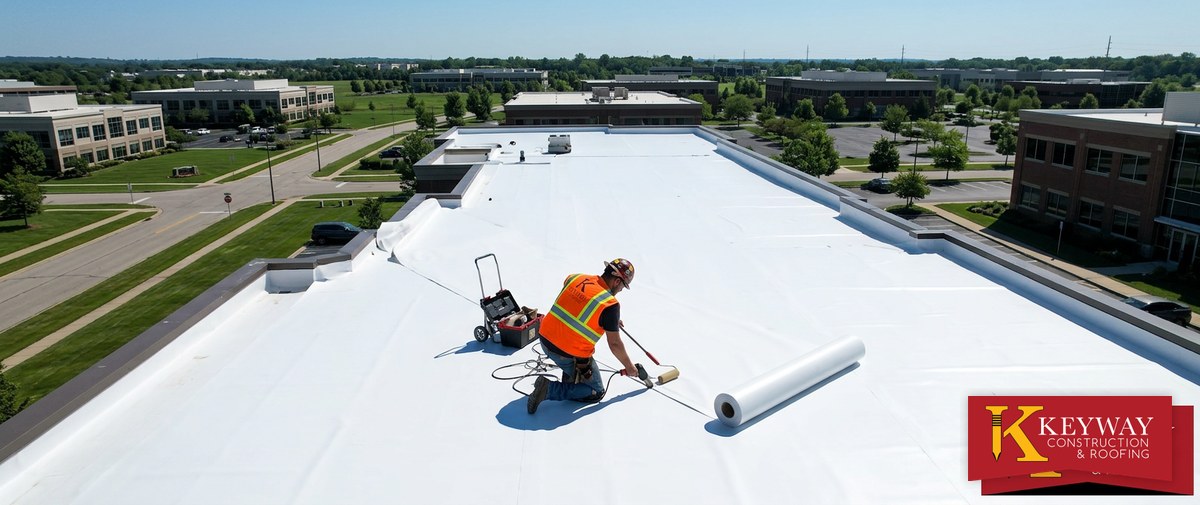
Keyway has been replacing roofs across Charlotte and Union County for more than 50 years. On the commercial side that means flat and low-slope buildings: retail centers, medical and office buildings, warehouses, churches, and multi-family. We are a licensed general contractor, so the work that comes with a re-roof, deck repair, carpentry, wall flashing, interior patching, does not need a second contractor.
When a commercial roof is worth replacing instead of repairing
Repair is usually the right answer. These are the signs it has stopped being the right answer.
- Leaks in unrelated areas. One detail failing is a repair. Four failures in four places means the system is done.
- Wet insulation across a wide area. Once saturation runs beyond a section, cutting and patching turns into a permanent habit.
- Membrane at end of service life. Seams opening on their own, shrinkage pulling at the terminations, chalked and brittle surface.
- Repair spend approaching replacement value. Pull the last three years of invoices. Owners are often surprised.
- Warranty expired and manufacturer is out of it. No coverage means every future failure is yours.
- A building sale, refinance, or tenant fit-out where a roof with remaining life is worth more than a discount at closing.
If you are not there yet, do not let anyone tell you otherwise. Most of what we get called out for is still a commercial roof leak repair, and we will say so.
Want a straight answer on repair versus replace? Call 704-847-7119 or request a commercial roof assessment.
Tear-off or recover: which one your building can have
A recover leaves the existing roof in place and installs a new system over it. It is faster, cheaper, and easier on an occupied building. It is also not always allowed.
Building code limits how many roof systems can be stacked, so a building already carrying two coverings has to go to a full tear-off. Wet insulation rules out a recover regardless of how many layers are there, because you would be sealing moisture against the deck. So does a deck that needs repair, or a membrane that has shrunk and distorted badly enough that a new system cannot lie flat on it.
We core the roof before recommending either. A core sample tells us the layers, the insulation condition, and the deck type, which is the difference between an informed recommendation and a guess. Anyone quoting a recover without opening the roof is guessing with your money.
When a coating makes more sense than either
On a structurally sound roof with a serviceable membrane and isolated problems, a fluid-applied restoration coating can add years and comes with its own warranty. It is not a fix for wet insulation and it is not a fix for a roof at the end of its life. Where it fits, we will tell you, and we cover it on our flat roofing page.
Choosing the system for the new roof
Most Charlotte commercial replacements land on single ply, usually TPO, because reflective membranes cut cooling load through our summers and they suit the flat and low-slope buildings across the metro. EPDM still makes sense on some roofs, modified bitumen on others, and metal on certain low-slope and steep-slope commercial applications.
What should drive the choice: the building use, the rooftop traffic, how much equipment sits up there, the drainage design, your warranty expectations, and how long you plan to hold the asset. Not what a contractor happens to stock.
We go through this properly in TPO vs EPDM vs modified bitumen, and the full range of systems sits on our flat roofs page.
Replacing a roof over an occupied building
This is where commercial work separates from residential, and it is usually what property managers ask about first.
- Phasing. We replace in sections so the building is never open to weather, and each section gets dried in before we leave for the day.
- Tenant notice. You get a schedule you can distribute, with the sections and dates, so nobody is surprised by noise above their ceiling.
- Noise and hours. Tear-off is loud. For medical suites, offices, and schools, we schedule the noisiest work around the hours that hurt least, including weekends where it matters.
- Odor. Some systems smell during installation. That drives system choice on medical and food service buildings, and it drives where we stage.
- Parking, loading, and craning. We plan lay-down areas, dumpster placement, and lift locations with your property manager so operations and deliveries keep running.
- Rooftop equipment. HVAC units often need lifting or temporary disconnection. We coordinate with your mechanical contractor rather than working around live equipment badly.
- Safety and protection. Walkways, entrances, and anything below the work get protected, and the site gets swept daily.
Our commercial roof replacement process
- Assessment and core sampling. We survey the roof, take cores, map wet insulation, and document the deck condition.
- Written scope and system recommendation. You get the findings, the options, and the reasoning, in a format you can take to ownership or a board.
- Schedule and phasing plan. Sections, dates, access, staging, and tenant notice agreed before mobilization.
- Tear-off or prep. Existing system removed to the deck, or the roof prepared for a recover where that is the right call.
- Deck repair. Rusted metal deck, rotted wood, and damaged blocking replaced before anything new goes down.
- Insulation and cover board. New insulation to the specified R-value, tapered where drainage needs correcting, with a cover board where the system calls for it.
- Membrane and details. Membrane installed and welded, then the details that actually decide roof life: curbs, penetrations, drains, terminations, parapets.
- Final inspection and closeout. Welds probed, drains tested, photos taken, warranty paperwork issued, site cleaned.
Warranties: what actually covers you
Two different things get called a warranty on a commercial roof.
The manufacturer warranty covers the system, and the longer NDL versions cover labor and material to fix a covered failure. They are issued only when the roof is installed to spec by an approved contractor, and most of them require documented maintenance to stay valid. Skip the maintenance and the paper stays on your shelf while the claim gets denied.
The workmanship warranty is the contractor’s own, and it covers how the roof was installed. Ours is a 1-year workmanship warranty on every job, and we are still at the same address to honor it.
Keeping the manufacturer coverage alive is the main reason to put a new roof on a maintenance plan from day one.
Ready to budget a replacement? Call 704-847-7119 or request a written scope.
Drainage decides how long the new roof lasts
Owners focus on the membrane. We focus on where the water goes, because a roof that holds water fails early no matter what is welded down.
Membrane manufacturers generally treat water still standing 48 hours after rainfall as ponding, and ponding can affect warranty coverage. It also accelerates everything: dirt collects, the surface degrades, seams sit wet, and on a metal deck the extra load in a heavy storm is not nothing.
A replacement is the one chance to fix it. Tapered insulation can build slope back into a dead flat roof and move water to the drains. Drains can be added, upgraded, or relocated. Scuppers and overflow provision get checked against the roof area. Internal drain lines get inspected, since a perfect roof draining into a blocked leader is still a wet roof.
If your current roof has a low spot that shows up in every photo, tell us. That spot is the reason to spend a little more on insulation and a lot less on repairs later.
Energy code and the reflective roof question
Two things change on a Charlotte re-roof that owners do not always expect.
First, insulation. When a roof comes off to the deck, current energy code generally requires the new insulation to meet today’s R-value rather than whatever was acceptable when the building went up. On an older building that can mean noticeably more insulation than what you are removing, which affects both the scope and the height of everything at the perimeter and the curbs.
Second, reflectivity. A white single ply reflects a large share of the solar load instead of absorbing it into the building. Through a Charlotte summer that shows up on the cooling side and it keeps the membrane itself cooler, which slows aging. It is also why most of the commercial roofs going down across the metro today are white.
We price both the code-required scope and any upgrade separately, so you can see what is required and what is optional rather than getting one number and no explanation.
What drives commercial roof replacement cost in Charlotte
- Square footage and roof geometry. A simple rectangle costs less per square than a cut-up roof with a dozen levels.
- Tear-off versus recover, and how many existing layers have to come off and go to landfill.
- Insulation. Target R-value, and whether tapered insulation is needed to fix drainage.
- Deck repairs found once the roof is open. We flag the risk up front rather than surprising you with it.
- Rooftop equipment. Curb count, unit lifts, and mechanical coordination.
- Access and logistics. Crane time, staging space, and whether work has to happen outside business hours.
- Warranty term. Longer manufacturer terms carry higher spec requirements.
Buildings we re-roof across greater Charlotte
Retail centers and standalone storefronts. Medical, dental, and professional offices. Office buildings around Ballantyne and uptown. Warehouses and light industrial along the Monroe and Indian Trail corridors. Churches, schools, and HOA amenity buildings. Apartment and multi-family properties.
We cover Matthews, Mint Hill, Stallings, Indian Trail, Monroe, Waxhaw, Weddington, Pineville, and the rest of the metro from our shop on Stallings Road.
Why owners and property managers choose Keyway
Family-owned, licensed general contractor, more than 50 years at the same address in Matthews. Not a franchise. Not a storm chaser.
On a replacement that matters in three specific ways. We core and document before recommending, so the scope is based on what is actually in your roof. We are a GC, so the deck repair, carpentry, and interior work that a re-roof uncovers stay with one company and one warranty. And we are here afterwards, which is the part you only value when something needs attention in year two.
Every job comes with free estimates, written pricing with no hidden fees, and our 1-year workmanship warranty on top of the manufacturer coverage. See all our commercial roofing services.
Commercial roof replacement FAQs
How long does a commercial roof replacement take?
It depends on square footage, system, and access. Small single-tenant buildings are often a few days, while large phased projects on occupied buildings run several weeks. You get a schedule with sections and dates before we start.
Can you replace the roof while our building stays open?
Yes. We phase the work so no section is left open to weather, coordinate noise around your operating hours, and give you a schedule you can send to tenants.
Do we need a full tear-off or can we recover?
A recover is possible when code allows the additional layer, the insulation is dry, and the deck and existing membrane are sound. We take core samples before recommending either, because that is the only way to know.
Which roofing system should we install?
Most Charlotte commercial buildings go with reflective single ply such as TPO, but the right answer depends on rooftop traffic, equipment, drainage, warranty expectations, and how long you are holding the building.
What happens if you find a damaged deck?
We stop, photograph it, and price the repair before continuing. Rusted metal deck and rotted wood get replaced before new insulation and membrane go down.
What kind of warranty comes with a new commercial roof?
A manufacturer system warranty, with NDL terms available on qualifying installations, plus our own 1-year workmanship warranty. Most manufacturer warranties require documented maintenance to stay in force.
Can a roof replacement be phased across budget years?
Often, yes. Where a property has separate roof sections, we can sequence them across budget cycles and prioritize the sections in worst condition.
What does a commercial roof replacement cost in Charlotte?
It comes down to size, tear-off versus recover, insulation, deck condition, equipment, and access. We survey and core the roof, then give you a written scope and price you can budget from.
Get a commercial roof replacement scope you can budget from
If you are weighing another repair against a replacement, let us core the roof and show you what is in it. Call 704-847-7119 or request an assessment. Storm damage involved? Start with our insurance claims guidance.
Protect Your Gutters With Gutter Caps
Eliminate tedious maintenance tasks and unsightly clogs with time-saving gutter guards.Proudly Serving
Greater Charlotte
Matthews | Stallings | Mint Hill | Indian Trail | Weddington
Waxhaw | Monroe | Ballantyne | South Park | Arboretum |
Myers Park | Pineville
Matthews | Stallings | Mint Hill | Indian Trail | Weddington
Waxhaw | Monroe | Ballantyne | South Park | Arboretum |
Myers Park | Pineville