

TPO vs EPDM vs Modified Bitumen Flat Roofs | Charlotte
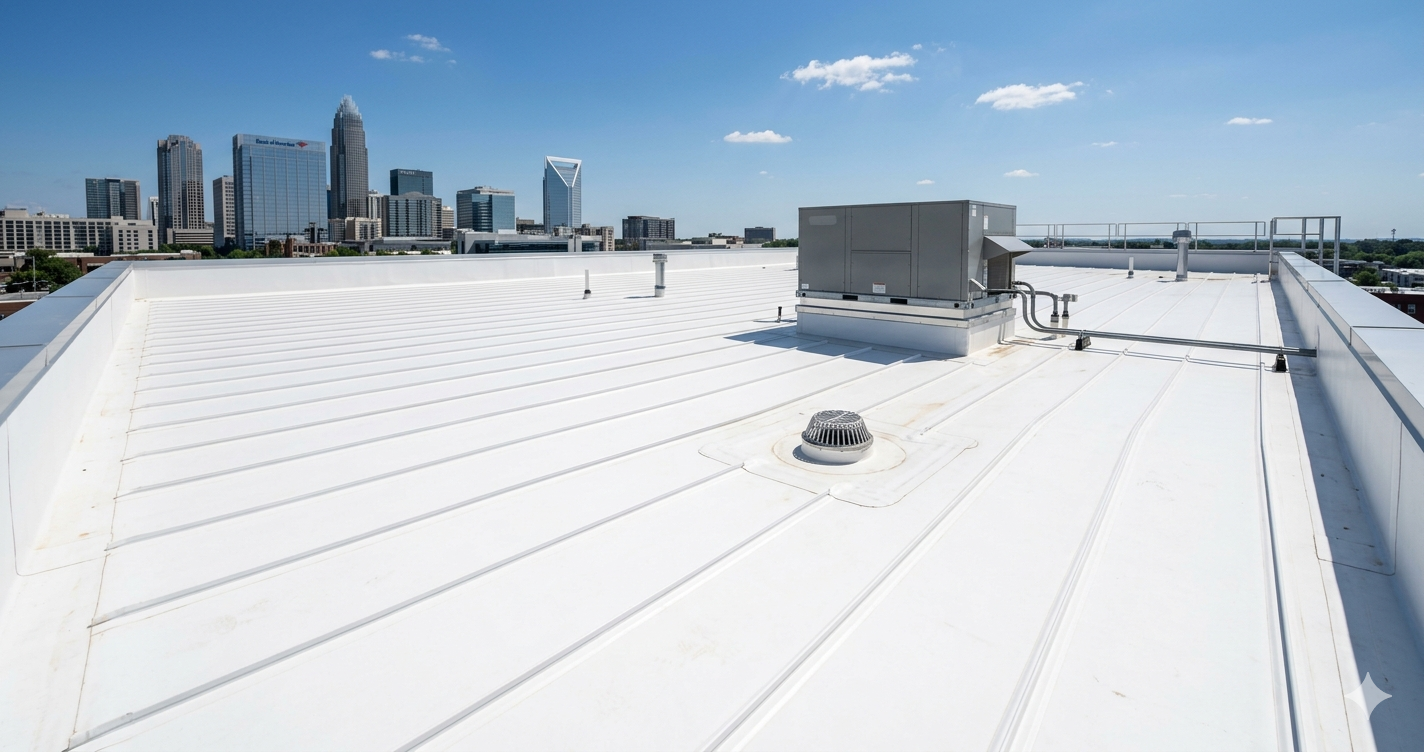
If a flat roof on your property is already leaking, our guide to flat roof repair cost in Charlotte walks through what drives the price and when to repair versus replace.
If you own a building with a flat or low-slope roof in Charlotte, the material on top of it matters more than most people realize. A pitched shingle roof sheds water fast. A flat roof does not. It holds water, bakes in the summer sun, and lives or dies by the quality of its seams and drainage. So when it is time to replace one, the system you choose shapes how long it lasts, how much heat it pushes into the building below, and how often you will be calling someone out to fix a leak.
The three systems you will hear about most are TPO, EPDM, and modified bitumen. Built-up roofing comes up too, especially on older commercial buildings. This guide breaks down what each one is, how long it tends to last in Charlotte’s climate, and which buildings each one suits best, so you can walk into a conversation with a contractor already knowing the right questions to ask.
To see modified bitumen tied into a shingled roof on a real house, look at our Monroe porch and addition roof project.
Why the flat roof you choose matters more in Charlotte
Charlotte is a hard place to be a flat roof. Summer UV is intense and runs for months. Humidity stays high through spring and fall. Then January and February bring the occasional hard freeze. That swing from baking heat to a hard freeze and back is called thermal cycling, and it works every seam and joint on the roof loose a little at a time.
On top of that, our summer storms do not arrive gently. A single afternoon thunderstorm can drop two to three inches of rain in under an hour. A flat roof is not actually flat. It is built with a slight slope to move water toward drains or scuppers, and when that drainage cannot keep up, or debris blocks it, water ponds on the surface and accelerates wear. Most flat roof failures in Charlotte show up in one of four places: the seams, the penetrations where pipes and vents come through, the drainage points, and the edge metal where the membrane meets the fascia.
Different materials handle that environment differently. That is the whole reason this choice is worth thinking through instead of just defaulting to whatever a contractor installs most often.
Signs your flat roof needs attention
- Seams that are lifting, curling, or separating along the membrane
- Water that ponds and stays on the surface for more than a day or two after rain
- Blisters or bubbles forming in the membrane
- Cracked or failed flashing around HVAC units, vents, and other penetrations
- Edge metal pulling away where the roof meets the fascia
- Interior stains or active leaks below the roof
TPO roofing: the reflective workhorse
TPO, short for thermoplastic polyolefin, is a single-ply membrane that has become the most common choice for commercial flat roofs across Charlotte. It is usually white, and that white surface is its biggest advantage in our climate. It reflects solar energy instead of soaking it up, which keeps the roof and the space below it cooler through the long Charlotte summer and takes some load off your cooling system.
TPO seams are heat-welded, meaning the sheets are fused together with hot air to form a continuous, watertight bond. A heat-welded seam, done correctly, is one of the strongest parts of the whole system and holds up well to the thermal cycling our climate dishes out. A properly installed 60-mil TPO system typically delivers 15 to 20 years of service in Charlotte, and some high-quality installations run longer with regular maintenance.
TPO is our most common recommendation for Charlotte commercial flat roof replacements, and for residential low-slope sections where energy performance is a priority. If you are cooling a building through a Carolina summer, the reflective surface earns its keep. When the system is past saving, our commercial roof replacement page covers tear-off, recover, and phasing.
EPDM roofing: the flexible veteran
EPDM is a synthetic rubber membrane, and it has been protecting flat roofs longer than TPO has. That track record counts for something. Well-maintained EPDM systems regularly reach 20 to 30 years in service, the longest typical lifespan of the common single-ply options.
Its standout quality is flexibility. EPDM stays pliable across a wide temperature range, which makes it forgiving on roofs that experience a lot of movement. Charlotte does not get the brutal freeze-thaw cycles that make EPDM the default in northern states, but its flexibility and long history still make it a strong option here. It tends to shine on residential flat sections, detached garages, and additions, where a durable, dependable system is the priority and the bright reflectivity of TPO is not essential.
The main trade-off is color and heat. EPDM is usually black, so it absorbs heat rather than reflecting it. On a residential garage or a shaded addition that is rarely a problem. On a large commercial roof over conditioned space in full sun, the reflectivity of TPO often wins out.
Modified bitumen: the asphalt evolution
Modified bitumen is the modern descendant of the old asphalt roll roofing. It is an asphalt-based membrane manufactured in rolls and applied in layers, with polymers blended in to add flexibility that traditional asphalt does not have. Depending on the product, the layers are torch-applied, hot-mopped, or self-adhered.
In Charlotte’s climate, modified bitumen systems generally fall in the 10 to 20 year range. That is shorter than TPO or EPDM, but the system has real strengths. It is tough underfoot, which matters on roofs that see regular foot traffic for HVAC service or maintenance, and it is well suited to smaller flat sections where a full single-ply installation is more than the job needs. The multiple layers also give it redundancy: more than one barrier between the weather and the building.
Built-up roofing: the traditional option
Built-up roofing, or BUR, is the classic tar-and-gravel roof you have seen on older commercial buildings. It is made of multiple alternating layers of asphalt and reinforcing felt, usually topped with a layer of gravel that protects the surface from UV. It is heavy and labor-intensive to install, but it is also proven. On well-maintained commercial roofs, built-up systems can last 15 to 30 years.
BUR is less common on new installations today than it once was, but it is still a sound choice on certain heavy-duty commercial roofs, and we repair and replace it across Charlotte alongside the single-ply systems.
TPO vs EPDM vs modified bitumen: a side-by-side look
Here is how the four systems compare on the points that matter most when you are choosing a flat roof in Charlotte. Lifespan figures reflect what these systems typically deliver in our specific climate when installed correctly and maintained.
| System | Material | Seams | Typical Charlotte Lifespan | Best Suited For |
|---|---|---|---|---|
| TPO | Single-ply thermoplastic, usually white and reflective | Heat-welded | 15 to 20 years | Commercial roofs and low-slope sections where energy performance matters |
| EPDM | Single-ply synthetic rubber, usually black | Adhesive or tape bonded | 20 to 30 years | Residential flat sections, garages, and additions |
| Modified Bitumen | Asphalt-based, applied in layers | Torch, hot-mopped, or self-adhered | 10 to 20 years | Smaller flat sections and roofs with regular foot traffic |
| Built-Up (BUR) | Layers of asphalt and felt, gravel surfaced | Hot-mopped layers | 15 to 30 years | Older and heavy-duty commercial roofs |
No single system wins every category. TPO leads on reflectivity and seam strength, EPDM on lifespan and flexibility, modified bitumen on toughness for smaller or high-traffic roofs, and BUR on proven longevity for heavy commercial use. The right answer depends on your building, not on which material is trendy.
Which flat roof system is right for your Charlotte building?
A few practical patterns hold true across the buildings we work on in Charlotte and the surrounding communities.
If you run a commercial building with conditioned space under a large flat roof, TPO is usually the strongest choice. The reflective white surface cuts cooling load through the summer, and heat-welded seams stand up to thermal cycling. This is the default for most office, retail, and warehouse roofs in our area.
If you have a flat section on a home, a detached garage, or an addition, EPDM is often the better fit. It is durable, flexible, and built to last, and reflectivity matters less on a smaller residential roof that may be partly shaded.
If you are dealing with a small flat area or a roof that sees a lot of foot traffic, modified bitumen can be the practical answer. It is tough underfoot and well matched to jobs where a full single-ply system is more than the situation calls for.
If you own an older commercial building that already has a built-up roof, replacing it in kind is sometimes the right move, though many owners switch to TPO at replacement time for the energy benefit. We will walk you through both paths honestly.
How we approach a flat roof project
| 1 | We inspect the full system, the membrane, seams, penetrations, drainage points, and the edge metal where the roof meets the fascia. |
| 2 | We check the substrate underneath for trapped moisture and rot, so a new membrane is not installed over a wet or failing deck. |
| 3 | We match the system to your building, weighing how the space is used, your energy goals, foot traffic, and budget. |
| 4 | We install with proper drainage and careful seam and flashing detail, the parts of a flat roof that actually decide whether it leaks. |
Common flat roof problems we see in Charlotte
Whatever system is on your roof, the failures tend to cluster in the same few places. Knowing what they look like helps you catch a small problem while it is still a small problem.
Seam separation and membrane lifting. Single-ply membranes like TPO and EPDM are joined at seams that are either heat-welded or adhesive-bonded. UV exposure and thermal movement cause adhesive seams to lift over time, and heat-welded seams can delaminate if the original weld was under-fused. Either way, an open seam is an active leak waiting to happen. Caught early, re-welding or re-bonding it is a routine repair rather than a major event.
Ponding water. Because a flat roof drains slowly, water that cannot get to a drain sits on the surface. Clogged drains, blocked scuppers, or insufficient slope all cause it. Ponding accelerates membrane wear, adds weight to the structure, and eventually finds any weakness in the system. Clearing the drainage paths is often the fix, though sometimes the slope itself needs correcting.
HVAC curb and penetration flashing failures. Commercial roofs, and some residential ones, carry HVAC units, pipes, and vents that all pass through the membrane. Every one of those penetrations is sealed with flashing, and flashing is one of the most common places a flat roof starts to leak. The membrane itself can be in good shape while a failed seal around a rooftop unit quietly lets water in.
Edge metal at the fascia. Where the membrane meets the edge of the roof, metal trim seals the transition to the fascia. When that edge metal loosens or lifts, water gets behind it, and on a Charlotte home that often means rot in the fascia below. This is one reason we inspect the roof edge and the fascia together rather than treating them as separate problems.
What actually determines how long your flat roof lasts
The lifespan numbers above assume one thing: the roof is installed correctly and maintained. That assumption does a lot of work. A properly installed system with functioning drainage and annual checkups will consistently reach the top of its range. The same system installed over a wet substrate, or with rushed seam work, will fall short of the bottom of it.
Charlotte’s heat, UV exposure, and storm activity accelerate wear compared to milder climates, which is exactly why installation quality and regular inspections matter more here than in places with gentler weather. The single biggest favor you can do a flat roof is to keep its drains and scuppers clear so water moves off the surface, and to have the seams and flashings checked once a year before a small lift becomes an active leak.
That is also why choosing a contractor who treats flat roofing as its own discipline matters. Flat roofs behave differently from pitched roofs, and crews that mostly install shingles often treat them the same way. At Keyway, flat and low-slope roofing is a distinct part of what we do. We repair and replace TPO, EPDM, modified bitumen, and built-up systems across the Charlotte metro, and as a licensed general contractor we handle the structural repairs underneath when an inspection turns up a wet or rotted deck.
Flat roof systems: common questions
What is the most common flat roof system in Charlotte?
For most commercial buildings in Charlotte, TPO is the strongest choice and our most common recommendation. The white reflective surface reduces heat absorption through our long summers, and the heat-welded seams hold up well to the region’s thermal cycling. EPDM and modified bitumen each have their place, but TPO is the workhorse of the local commercial market.
How long does a flat roof last in Charlotte?
It depends on the system. Installed correctly, TPO typically lasts 15 to 20 years here, EPDM runs 20 to 30 years with proper maintenance, modified bitumen generally falls in the 10 to 20 year range, and built-up roofing can reach 15 to 30 years on well-maintained commercial roofs. Charlotte’s heat and storm activity push systems toward the lower end of those ranges when drainage and seam work are neglected, and toward the top end when they are kept up.
Can a flat roof be repaired, or does it need a full replacement?
Often it can be repaired. A lifted seam, a failed flashing around an HVAC unit, or a small area of membrane damage caught early is usually a routine repair. Once a roof is approaching or past the end of its service life, has widespread ponding, or shows multiple leak points and membrane cracking, replacement typically delivers better long-term value than repeated patching. The reliable way to know where you stand is a professional inspection.
Is TPO or EPDM better for a home with a flat section?
It depends on the section. EPDM is frequently the better fit for residential flat areas, garages, and additions because it is flexible, durable, and built to last, and reflectivity matters less on a smaller or partly shaded roof. TPO is worth considering when the flat section sits over conditioned living space in full sun and you want the reflective surface to help with cooling. We walk through both during a free estimate.
Why do flat roofs leak more often than pitched roofs?
Flat roofs drain slowly by design, so water lingers on the surface and works at any weak point. Most flat roof leaks start at the seams, the penetrations where pipes and vents come through, the drainage points, or the edge metal at the fascia. Keeping drains clear and having seams and flashings inspected once a year prevents the large majority of flat roof leaks we see.
Get an honest assessment of your flat roof
Choosing between TPO, EPDM, and modified bitumen is not a decision you have to make on your own. The right system comes down to your building, how the space is used, and what an honest inspection of the existing roof and deck actually finds. Keyway Construction and Roofing has been working on Charlotte roofs since 1975, more than 50 years of family-owned, locally accountable work, and flat and low-slope roofing is a core part of what we do, not a side service.
We provide flat roof repair and replacement and full commercial roofing across Charlotte, Matthews, Mint Hill, Ballantyne, Indian Trail, Waxhaw, Weddington, Monroe, and the surrounding communities. Call 704-847-7119 or contact us online for a free next-day inspection, and we will tell you honestly what your roof needs and which system fits your building best.
Related Roofing Resources
Services: flat roof systems, commercial roofing, and roof repair in Charlotte.
More guides: roof repair vs replacement, why roof maintenance matters, and how long a Charlotte roof lasts.
Recent Posts

Protect Your Gutters With Gutter Caps
Eliminate tedious maintenance tasks and unsightly clogs with time-saving gutter guards.See For Yourself
View Our Gallery of Projects
Proudly Serving
Matthews | Stallings | Mint Hill | Indian Trail | Weddington
Waxhaw | Monroe | Ballantyne | South Park | Arboretum |
Myers Park | Pineville | Fort Mill
Matthews | Stallings | Mint Hill | Indian Trail | Weddington
Waxhaw | Monroe | Ballantyne | South Park | Arboretum |
Myers Park | Pineville | Fort Mill