

Gutter Installation and Repair in Monroe, NC
Quick answer
Gutter work on a Monroe, NC home comes down to two things: a seamless system sized for your roof and your trees, and downspouts that carry the water far enough that Union County’s slow-draining clay can’t hold it against your foundation or crawlspace. Keyway Construction and Roofing installs 5-inch and 6-inch seamless gutters formed on site, repairs and replaces existing systems, adds gutter guards, and fixes the rotted fascia it finds behind old gutters. Estimates are free and next-day. Call 704-847-7119.
Drive from the courthouse square out to the newer streets off US-74 and you’ll pass about a hundred years of Monroe houses. The gutters change the whole way. Near downtown you still see half-round gutters, a few built-in gutters tucked into the cornice, and old runs hanging on spike-and-ferrule fasteners that have been working loose for decades. Out in the subdivisions it’s almost all builder-grade 5-inch aluminum, with 2×3 downspouts that stop a foot from the slab or right next to a crawlspace vent.
Different houses. Same ending when the gutter fails: the water lands on ground that doesn’t want it.
This page is for Monroe homeowners trying to sort out what they’ve actually got on the roofline, whether it’s worth fixing, and where the water ought to go. We’re Keyway, a licensed general contractor based on Stallings Road in Matthews, and we handle gutter installation in Monroe, NC, along with repairs and full replacements across Union County.
Gutters overflowing, sagging or dumping water by the house? Call 704-847-7119 or request a free next-day estimate.
Which kind of Monroe house are you working with?
The age of the house predicts most of what’s wrong with its gutters. Here’s the short version for the three kinds of homes that make up most of Monroe.
| House | Gutters you’ll often find | What tends to fail | What usually fixes it |
|---|---|---|---|
| Older in-town homes near downtown and the courthouse, built before about 1960 | Half-round, built-in gutters in the cornice, or aluminum added in a later decade | Spikes pulling out of soft fascia, leaking lap joints, built-in liners that let water into the cornice framing | Check the cornice and fascia first, then seamless half-round or copper where the look of the house matters |
| Mid-century ranch and split-level homes, 1950s to 1980s | Sectional aluminum or vinyl, sometimes 4-inch, often with too few downspouts | Overflow on long runs, a low back porch or addition roof with no gutter at all, damp crawlspaces | 5-inch or 6-inch seamless, more outlets, and extensions routed away from the crawlspace wall |
| Subdivision homes from the late 1990s on, along US-74 and the outer edges of town | Builder-grade 5-inch K-style aluminum with 2×3 downspouts | One outlet for a long run, downspouts ending at the foundation, valley water shooting past the gutter | Bigger 3×4 downspouts, added outlets, re-pitching, and a splash guard where a valley meets the gutter |
Not sure when your house went up? Union County’s property records list the year built for most homes. That one number tells us a lot before anybody climbs a ladder.
Where should the water go after it leaves the downspout?
At least six feet from the foundation, onto ground that slopes away from the house. On Monroe soil, that last part matters more than most people expect.
Much of Union County sits on the Carolina Slate Belt. The soils there tend to be heavy with clay and, in plenty of spots, fairly thin over rock. Water doesn’t soak in fast. Dump a downspout’s worth of summer thunderstorm at the corner of the house and it sits there, or it finds its way under the house. On a slab home that can mean a wet garage floor and soil washing out at the corner. On a crawlspace home, and many of Monroe’s ranch houses sit on crawlspaces, it tends to show up as a musty smell, sweating ductwork, or a sill plate that’s gone soft by the time anyone looks.
So treat the downspout ending as a real decision. Pick it by what’s around the corner of the house:
- Open lawn that falls away from the house: a solid extension that reaches six feet or more is usually enough. A splash block on its own almost never gets water that far.
- Flat yard, or one that slopes back toward the house: a buried drain line out to a pop-up emitter on lower ground. An extension just moves the puddle.
- Driveway, walk or patio in the way: run it under or along the hardscape. Water dumped across concrete spreads out, stains, and on a cold January morning it’s ice.
- Tight lot near downtown: don’t aim it at the neighbor. Sometimes the right answer is moving the outlet to a different corner of the run.
We look at all of this during the estimate. Our downspout sizing and routing guide goes deeper on extensions, underground lines and outlet strainers.
The low back roof: the eave everybody forgets
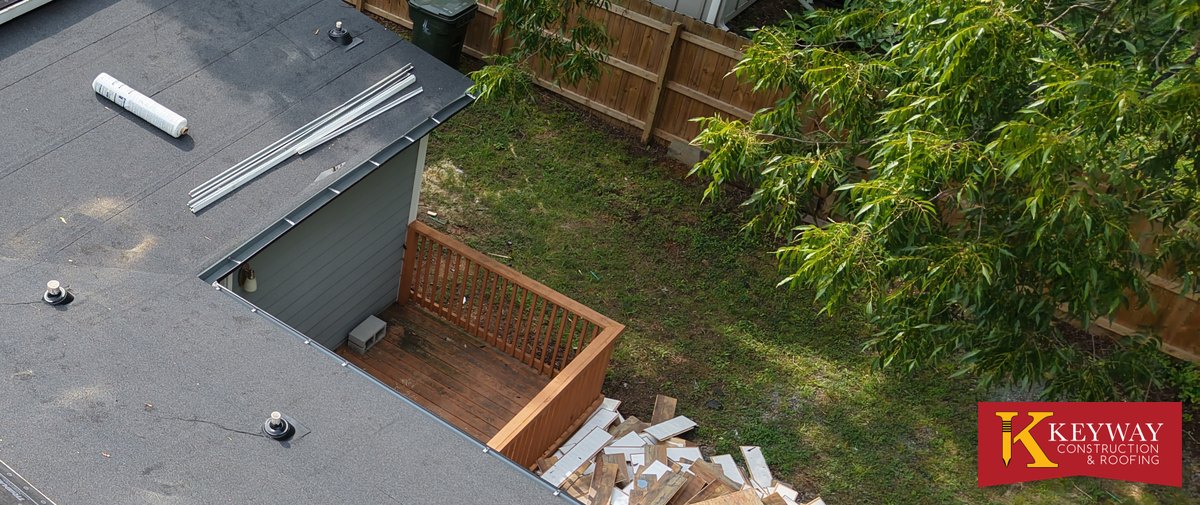
Lots of ranch and split-level homes around Monroe have a nearly flat porch or addition roof stuck on the back. Look at the photo above. That eave sits directly over the deck.
Water leaves a low slope roof differently from a steep one. It doesn’t shoot off the edge in a fast sheet. It creeps to the edge and drips along the whole length, so with no gutter you get a curtain of water right where you walk out the back door, plus splashback onto the deck boards and the bottom course of siding. Over a few years that’s how deck framing and trim rot.
A gutter on that kind of eave has its own rules. The roof membrane or drip edge has to lap down into the gutter, not stop behind it. The outlet belongs at the end of the run farthest from the steps. And because the run is short, people undersize the downspout, which is fine until the main roof dumps its valley water onto the low roof as well.
The house in that photo had other problems up top. You can see how we handled the decking and the low slope sections in our Monroe low slope re-roof project.
Repair, replace or just clean? A quick checklist
Most gutter problems are one of these. Find yours and you’ll know roughly where you stand before we show up.
- Overflows only in the hardest storms, otherwise straight and tight. Clean it and check the outlets first. You might just need one more downspout.
- One drip at a corner or end cap. Repair. Reseal the joint or swap the piece.
- A sag in one spot. Usually a repair with new hidden hangers, but we probe the fascia first. Hangers don’t hold in soft wood.
- Sags in several places, or it’s been rehung before. The fascia is probably soft. Fix the wood, then decide on the gutter.
- Leaks at seams every 10 to 12 feet. That’s a sectional system wearing out joint by joint. Replace it with seamless.
- Vinyl gutters that crack when you touch them. Sun-baked vinyl doesn’t come back. Replace.
- 4-inch gutters or 2×3 downspouts overflowing every summer. It’s a size problem. Cleaning won’t fix it.
- A new roof is coming. Do the gutters in the same project. If you’re weighing that now, start with our Monroe residential roofing page.
Green: usually a repair. Amber: depends on the wood behind it. Red: replacement is the better spend. Blue: timing.
What falls into Monroe gutters, season by season
Your trees decide how often a gutter clogs and which guard will actually work. These are the common ones in Monroe yards.
| Tree | When | What it does to a gutter | What handles it |
|---|---|---|---|
| Loblolly pine | All year | Needles slip through wide screens and knit into mats at the outlet | Fine stainless micro-mesh guard |
| Willow and water oak | Late October into January | Narrow leaves pack flat and hold water like a sponge | Micro-mesh guard; 6-inch gutter under heavy cover |
| Oaks in spring | Early spring | Tassels and yellow pollen turn to paste, then bake into a crust by summer | A rinse; no guard stops pollen completely |
| Sweetgum | Fall and winter | Spiky gumballs roll to the low point and plug the downspout | 3×4 outlets, outlet strainers or a guard |
| Red maple | Spring | Winged seeds settle in wet debris and sprout | Guard, or a spring cleaning |
If your lot has pines, skip the cheap snap-in screens. They catch oak leaves fine and let needles straight through. We go through the options, and when guards aren’t worth it, on our gutter guard installation page.
5-inch or 6-inch? How we size a Monroe gutter
Most Monroe homes are fine with 5-inch seamless aluminum. We move to 6-inch when one or more of these is true:
- A single run drains a big stretch of roof, like the long back slope on a two-story subdivision home.
- A valley pours two roof planes into one short section of gutter.
- The lot sits under heavy oak or pine, so the gutter is always partly full of debris.
- The current 5-inch overflows even right after it’s been cleaned.
Downspouts matter as much as the gutter width. Our usual pairing is 3×4 downspouts, roughly one for every 30 to 40 feet of gutter, placed at the low points. Each run is pitched about a quarter inch per 10 feet toward its outlet. Too little pitch and water sits. Too much and it looks crooked from the street.
Profiles and materials we install:
- K-style aluminum, 5-inch or 6-inch. The workhorse for most Monroe homes, with a factory finish in more than 25 colors so it won’t need painting.
- Half-round. The right look on many of the older homes near downtown, and it flushes debris a little more easily.
- Copper. For houses where the gutter is part of the architecture. Our copper vs aluminum comparison covers the trade-offs honestly.
- Box gutters for commercial buildings and big low slope roofs.
Every run is formed seamless on site from a coil, cut to the length of your roofline, so the only joints are at corners and outlets. If you’re still deciding, read seamless vs sectional gutters first.
Why we check the wood behind the gutter first
The gutter is screwed to the fascia board. When it overflows for a few seasons, water runs down the back of the gutter and soaks the top edge of that board. The paint usually fails on the hidden back face long before the front looks bad. By the time you notice peeling or a gutter pulling forward, the wood has often been wet for a while.
A gutter-only crew will hang a new system on that board and leave, and before long the hangers work loose again. As a licensed general contractor we can cut out the rotted fascia, and soffit if it’s gone that far, and rebuild it in the same job before the new gutter goes up. On the older in-town homes this often reaches into the cornice. Our wood rot repair in Monroe page shows what that work looks like.
For the full picture on soft fascia, soffit and rafter ends on Monroe houses, see rotted fascia and soffit repair in Monroe.
How a Keyway gutter installation goes, step by step
- Measure and look. We measure every run, note how much roof drains into each one, check the trees overhead, see where the water goes now, and press on the fascia.
- Put it in writing. You get a written estimate that spells out size, profile, color, downspout locations and any wood repair. No surprises halfway through.
- Take down the old system and fix the wood. Old gutters come off and any soft fascia is replaced, so the new system anchors into sound wood.
- Form the gutters on site. A roll-forming machine makes each run from a continuous coil, cut to the exact length of that stretch of roofline.
- Hang and pitch. Hidden hangers go in at 24-inch centers and each run is pitched about a quarter inch per 10 feet toward its outlet.
- Route the downspouts and test. Downspouts and extensions are set to carry water away from the foundation, then we run water through every section and walk the job with you. The work carries our 1-year workmanship warranty.
Want a Monroe gutter estimate this week? Call 704-847-7119.
What drives the cost of gutters in Monroe?
We don’t publish a per-foot price because two houses on the same street can come out very differently. These are the things that move the number:
- Total length and corners. More linear feet and more inside and outside corners mean more material and more mitering.
- Height and access. A one-story ranch is a different day from a two-story house over a walkout basement or a steep backyard.
- Size and material. 6-inch costs more than 5-inch; half-round and copper cost more than K-style aluminum.
- Downspouts and drainage. Extra outlets and larger downspouts add to the job. On a flat lot that needs a buried drain line, plan for that as its own cost.
- Guards. Adding them while the gutters are new is simpler than coming back later.
- Wood repair. Rotted fascia, soffit or cornice found behind the old gutters.
- Removal. Taking down and hauling away the old system.
For the bigger picture on all of our gutter work, from repairs to full replacements, see Keyway’s gutter services.
Monroe gutter questions
Do you install gutters in Monroe, or only around Charlotte?
We install, repair and replace gutters in Monroe and across Union County. Our office is at 740 Stallings Road in Matthews, a short drive up the road, and gutter estimates are free and next-day.
How do I know if my gutters are too small?
If water spills over the front edge in heavy rain even when the gutter is clean, it’s undersized for the roof feeding it. Other giveaways: water shooting past the gutter below a valley, 4-inch gutters, or long runs with a single 2×3 downspout. Moving to 6-inch gutters or adding larger 3×4 downspouts usually solves it.
Can I get new gutters on an older home near downtown Monroe without changing its look?
Usually, yes. Seamless half-round gutters or copper suit many older homes better than K-style. We check the cornice and fascia first, because old gutters often leave rot behind them. If the house is inside a designated historic district, check with the City of Monroe before changing the gutter profile or material.
How far should downspouts drain from my house in Monroe?
At least six feet from the foundation, onto ground that slopes away. Union County clay drains slowly, so water left near the house tends to stay there. On a flat lot or one that slopes toward the house, a buried drain line to lower ground is often the better answer than a longer extension.
Do you repair existing gutters, or only install new ones?
We repair them. That covers resealing leaking corners and end caps, rehanging sagging runs with hidden hangers, re-pitching gutters that hold water, clearing downspouts and replacing damaged sections. If the fascia behind the gutter is rotted, or a sectional system is leaking at joint after joint, we’ll tell you plainly that repair won’t last.
Will gutter guards mean I never clean my gutters again?
No. Guards cut down how often you clean, but pollen and fine grit still collect on top and need a rinse now and then. Under loblolly pines, a fine stainless micro-mesh guard is the type that keeps needles out. Cheap screens let them through.
Could my gutters be the reason my crawlspace is damp?
They’re one of the first things to check. Overflowing gutters and downspouts that empty beside the foundation put a lot of water right against the crawlspace wall, and Monroe’s clay holds it there. Fixing the gutters and the downspout endings is often the cheapest place to start, though grading and the crawlspace itself can play a part too.
Should I replace my gutters when I get a new roof?
Usually, yes. The gutters often have to come down for the roof work anyway, the fascia is exposed so any rot can be fixed, and new drip edge can lap properly into the new gutter. Remounting old gutters on a new roof and replacing them later means paying for that work twice.
Got a gutter on a Monroe house that’s spilling, sagging or pointing water at the foundation? Call 704-847-7119 or send us a photo through our contact page and we’ll set up a free next-day look.
Protect Your Gutters With Gutter Caps
Eliminate tedious maintenance tasks and unsightly clogs with time-saving gutter guards.Proudly Serving
Matthews | Stallings | Mint Hill | Indian Trail | Weddington
Waxhaw | Monroe | Ballantyne | South Park | Arboretum |
Myers Park | Pineville | Fort Mill
Matthews | Stallings | Mint Hill | Indian Trail | Weddington
Waxhaw | Monroe | Ballantyne | South Park | Arboretum |
Myers Park | Pineville | Fort Mill