

Roof Replacement in Mint Hill, NC
Quick answer
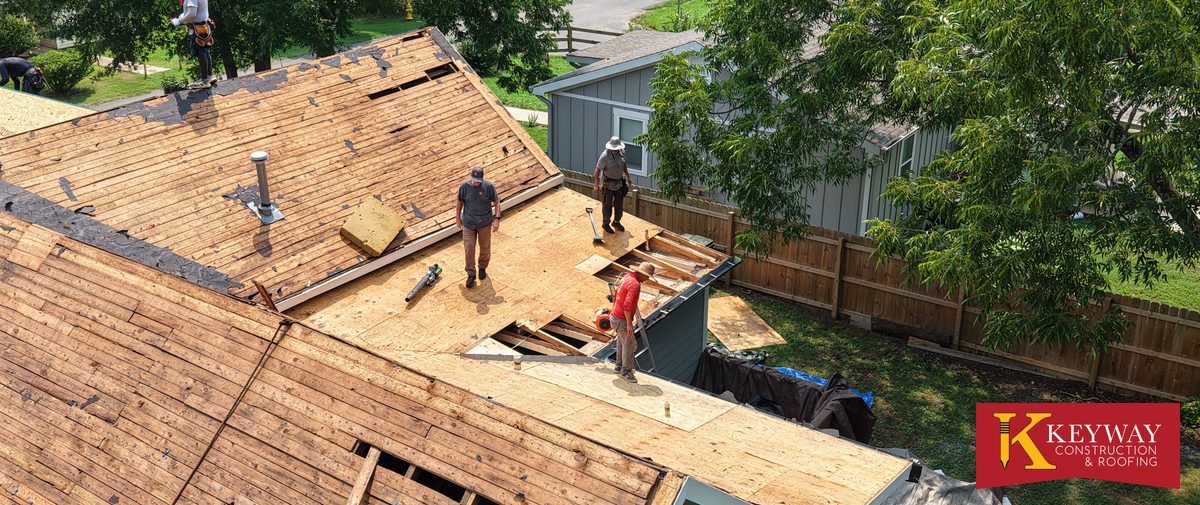
A Mint Hill roof replacement usually means one of two houses: a 1970s or 1980s ranch that may already have two layers of shingles, or a late 1990s to 2000s subdivision home still on its first, builder-grade roof. Keyway strips every layer to the deck, replaces bad decking only after showing you and itemizing it in writing, fixes the attic ventilation, re-flashes every wall and chimney, and installs new shingles backed by the shingle maker’s coverage and our 1-year workmanship warranty. Most jobs take one to two days. Building permits on the Mecklenburg side come from Mecklenburg County Code Enforcement, and we pull them when the job needs one.
Seven in ten Mint Hill houses were built between 1970 and 2009, in two big waves, and the town’s median home dates to about 1992. Those figures come from the Census Bureau. It means a lot of roofs here are hitting the end at the same time, just for different reasons. The ranches off Lawyers Road and Matthews-Mint Hill Road are often on their second or third roof by now. The subdivisions that filled in near the I-485 exits are mostly on their first. If one of those describes your house, this page walks through a full roof replacement in Mint Hill, NC: what comes off, what we usually find under it, and what goes back on.
One drip in one spot? You probably don’t need a new roof, and our Mint Hill roof repair page covers that. For a bigger picture of everything we do on houses in town, there’s the residential roofing guide for Mint Hill. This one’s for when patching has stopped adding up.
Wondering if yours is a repair or a replacement? Ring 704-847-7119; the look is free and usually the next day.
How old is the roof on a typical Mint Hill house?
Older than most owners think. The Census Bureau’s American Community Survey counts about 10,820 homes in Mint Hill, and roughly 86 percent of them are single-family detached houses. Here’s how they break down by the decade they were built, and what that tends to mean once we’re on the roof.
| When it was built | Share of Mint Hill homes | Where you’ll find them | What a replacement usually turns up |
|---|---|---|---|
| Before 1970 | About 12% | Farmhouses and older homes along the original roads, on bigger lots toward the east side | Plank board decking, more than one old layer, chimney flashing patched with tar or caulk |
| 1970s and 1980s | About 35% | Brick ranches and split-levels off Lawyers Road, Matthews-Mint Hill Road and the streets between them | Often a second layer laid over the first, no drip edge, box vents with little or no soffit intake, tired fascia boards |
| 1990s and 2000s | About 36% | Subdivisions like Olde Sycamore, where the golf course opened in 1997 and homes followed from the late 1990s on | First roof, builder-grade shingles, OSB decking that can swell at the eaves, bath fans that may vent into the attic |
| 2010 and later | About 17% | Newer phases and infill, plus mixed neighborhoods like Brighton Park with townhomes and detached homes | Usually years left, unless hail or a falling limb got it first. Check the transfer rules on the shingle warranty if you bought from the first owner |
The 2000s were Mint Hill’s busiest decade, with more homes built than in any other. So the next few years are when a big share of those original roofs come due. If your street went up in the same couple of years, your neighbors’ tear-off trucks are a decent hint about yours.
Replace now, or squeeze out a few more years?
Replace when the wear is spread across the roof. Patch when it’s in one place. You can get most of the way to an answer yourself with three stops: the driveway, the downspouts and the attic.
- From the driveway, look at the shingle edges. Curled or cupped edges, a wavy look across a slope, or tabs that look darker and smoother than the rest mean the shingles have dried out and lost granules.
- At the downspouts, check the splash blocks. A gritty, sand-like drift after every rain is granule loss. A little on a brand-new roof is normal. A steady supply on a 20-year-old roof isn’t.
- Count your patches. Two or more leaks fixed in different spots in the last few years tells you the roof is failing in general.
- In the attic, on a bright afternoon, turn the light off. Pinpoints of daylight through the deck, dark water rings on the sheathing or soft, stained spots along the eaves all point past a simple repair.
- Look at the roof edge where it meets a gable. If you can see two stacked shingle edges, you’ve got two layers, and that changes what a new roof involves. More on that below.
- Think about the last big storm. If hail or a limb hit the house and nobody checked the roof afterward, it’s probably older than its age.
One or two of these is usually a repair. Three or more, on a roof past 20 years, usually isn’t worth patching again. And if someone tells you a roof that went on in 2015 has to come off, ask them to show you why on the roof itself.
Rather have us do the checking? Call 704-847-7119 for a free inspection anywhere in Mint Hill.
Is there a second roof hiding under your shingles?
On a lot of Mint Hill’s 1970s and 1980s ranches, yes. In the 1990s and 2000s it was common to lay a new layer of shingles right over the original to skip the tear-off. Those overlays are now reaching the end too, and here’s the catch: the North Carolina Residential Code doesn’t allow a third layer. Once a roof has two layers, both come off. The code also rules out an overlay on a roof that’s water-soaked or badly deteriorated.
Even when a second layer would be legal, we rarely recommend it. Here’s why:
- You can’t see the deck. Rot, soft spots and old leak damage stay buried until they show up as a ceiling stain.
- The old flashing stays. Step flashing, chimney metal and pipe boots are where most leaks start, and an overlay keeps the tired ones in service.
- Weight adds up. A second layer of asphalt across a long ranch roof is extra load the framing carries for the life of the roof.
- Shingles lie over the bumps. Every curled tab underneath shows through the new layer and shortens its life.
Stripping two layers takes longer and fills more of the dump trailer, so it shows up in the price, and any honest quote should say how many layers it assumes. We go through the trade-offs in more detail in our tear-off versus overlay guide.
What do we usually find once the old roof is off?
Something, most of the time. Tear-off is the only moment anyone sees the whole deck, so it’s when the hidden problems get fixed. These are the ones that come up on Mint Hill houses, sorted by age.
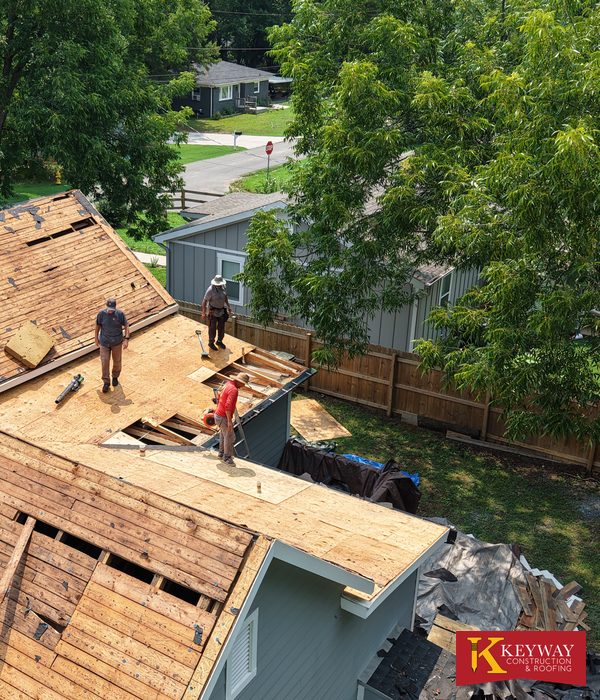
Plank boards (pre-1970 homes). Before plywood took over, roofs were sheathed with individual boards. They shrink, cup and leave gaps, and a shingle nail in a gap holds nothing. We cover them with new plywood so the shingles have a solid, flat base.
No drip edge (1970s and 1980s). Today’s code calls for metal drip edge along the eaves and rakes of a shingle roof. Lots of older roofs went on without it, and the edge of the deck and the fascia behind the gutter rot first.
Swollen OSB at the eaves (1990s and 2000s). Oriented strand board was the builder’s sheathing of choice in those subdivisions. Where it’s stayed damp, along the lower edge or under a valley, the edges puff up and go soft.
We photographed every step of that Monroe job, from the boards to the finished low-slope sections, in the Monroe low-slope roof replacement case study.
Three more that don’t depend on age:
- Bath fans blowing into the attic. Code says exhaust air goes outside, not into the attic. A fan that dumps warm, wet shower air under the deck can stain and rot the sheathing above it. If we see one, we’ll tell you, and the roof work is a good time to duct it out through a proper roof or wall cap.
- Rotted fascia and rafter tails. Gutters that overflow for years soak the board behind them. As a licensed general contractor we can replace it in the same visit; see soffit and fascia repair and wood rot repair.
- Old satellite dish mounts and abandoned vents. Every leftover hole gets decked over or properly capped.
About cost: nobody knows how much decking needs replacing until the shingles are off. Any decking we replace is itemized in writing, and we don’t replace a single sheet without showing you first and getting your OK. Our article on rotted roof decking shows what we look for.
Does your attic breathe? Getting ventilation right on a re-roof
A new roof is the cheapest moment to fix attic ventilation, because the deck is open and the crew is already up there. Skip it and a hot, damp attic will cook the new shingles from underneath, and shingle makers tie their warranties to proper ventilation.
The residential code’s baseline is 1 square foot of net free vent area for every 150 square feet of attic floor. It drops to 1 per 300 when the vents are balanced, with part of the total high near the ridge and the rest low at the soffits. In practice that comes down to three questions on a Mint Hill house:
- Is there any intake at all? Plenty of 1970s and 1980s ranches have solid soffits or vents buried under blown-in insulation. Exhaust with no intake just pulls conditioned air out of the house. Baffles at the eaves keep insulation from choking the soffit vents.
- Are two kinds of exhaust fighting each other? A ridge vent next to old box vents or gable vents can short-circuit, pulling air in through one and out the other while the rest of the attic sits still. We close off the extras.
- Is the ridge long enough? A long ranch ridge is ideal for a ridge vent. A 2000s two-story with a tall hip roof may only have a short ridge, so it might need a mix of ridge vent and low-profile roof vents to get the numbers right.
If the attic needs more insulation too, sealing it up after the roof is done is easy to schedule. More on both at attic ventilation and attic insulation.
Want the vent math done for your house? Call 704-847-7119 and we’ll measure it during the estimate.
Which new roof fits how long you plan to stay?
For most Mint Hill homes it’s architectural asphalt shingles, and the real decisions are the product line, the color and whether to step up to impact rating. Depending on the job, we install Owens Corning or GAF shingles. A few situations push the choice in a different direction:
Staying 15 years or more
A Class 4 impact-rated shingle or a standing seam metal roof costs more now and pays you back in years. Some carriers discount premiums for Class 4 roofs; call your agent before you choose.
Selling in the next few years
A clean architectural shingle in a neutral color helps the listing and the home inspection. Keep the warranty paperwork; buyers ask.
A lot under big hardwoods and pines
Pick an algae-resistant shingle. The copper in the granules slows the black streaking that shade brings. Our guide to tree canopy and roof algae explains why.
Farmhouse, barn or workshop
Metal often suits these better than shingles. See metal roofing.
Porch or addition with a shallow pitch
Shingles don’t belong on very low slopes. Those sections get a membrane instead; see flat and low-slope roofs.
Changing color or material
If you have an association, get approval first. Our article on choosing a shingle color helps narrow it down.
Product lines and colors are on the asphalt shingle roofing page.
Live in a townhome or an association neighborhood? Read this first
About 630 of Mint Hill’s homes are attached single-family units, mostly townhomes. If yours is one of them, the first question isn’t which shingle. It’s who owns the roof.
- Read the declaration and the maintenance chart. Some associations own and replace townhome roofs as a common expense, usually a whole building at a time. Others leave the roof over each unit to its owner.
- A shared roof is one roof. Replacing only your section of a building means tying new shingles into a neighbor’s old ones along the property line. It works, but the color won’t match, and the seam needs careful flashing. Coordinating with the neighbors usually gives a better result.
- Get the color approved in writing. Many architectural review committees want the manufacturer, product line and exact color name before anything visible changes.
Brighton Park is a good example of why this matters: it mixes detached homes and townhomes, and its association documents treat the two differently, with different fees for each. Larger association neighborhoods like Summerwood, off Lawyers Road and Brief Road, tend to have their own review process too. Talk to your management company before you collect bids, and we’ll supply the product details the committee asks for.
Who handles permits for a roof replacement in Mint Hill?
Not the town, in most cases. Mint Hill handles its own planning and zoning, but building permits for Charlotte and the six towns in Mecklenburg County, Mint Hill included, are issued by Mecklenburg County Code Enforcement. A small part of Mint Hill crosses into Union County, and a house on that side of the line goes through Union County’s building office instead.
Whether a re-roof needs a permit depends on what’s involved. Swapping shingles for shingles is one thing. Replacing rafters, reframing a sagging section or changing the roof covering to something heavier is another. We confirm what your job requires before it starts and, as a licensed general contractor, pull the permit when one is needed. Be careful with anyone who offers to skip a required permit to save time; it tends to come up again when you sell.
What does a Keyway roof replacement look like, day by day?
Same order every time, with the deck and the attic getting the attention. If you want the homeowner’s-eye version, read what to expect during a roof replacement.
- Inspect the roof and the attic. We walk every slope, count the layers at the roof edge, measure the roof in squares, then go into the attic to check the deck, the vents and where the bath fans exhaust.
- Settle the scope in writing. You get a written estimate naming the product and color you chose, the underlayment, the flashing and vent plan, and how any decking we replace will be itemized.
- Clear the paperwork. If an association has to approve the color or material, that approval comes back before the order goes in. We confirm whether the job needs a building permit and pull it if it does.
- Protect the property. Tarps go over shrubs, beds and the foundation line, and we ask you to move cars out of the driveway and garage before tear-off.
- Tear off and inspect the deck. Every layer comes off down to the wood. We walk the deck, show you anything soft or rotted, and replace it once you approve.
- Dry in the roof. Metal drip edge goes on first. Self-adhering membrane lines each valley and every spot where the roof meets a chimney or wall, then synthetic underlayment covers the open deck. At that point the house is sealed, even before a shingle goes down.
- Flash, shingle and vent. Fresh step and counter flashing, fresh pipe boots, then starter course, field shingles fastened the way the maker specifies, ridge cap, and whatever intake and exhaust the vent math called for.
- Final sweep and handover. We roll a magnet across the lawn and driveway for stray nails, haul every scrap away, and go over the finished roof with you before handing over the warranty documents.
Steps 4 through 8 happen on site, and the roof itself usually takes one or two days. We work Monday through Friday and don’t leave a roof open overnight when meaningful rain is in the forecast. Tear-off is loud. Pets and anyone working from home usually do better somewhere else that morning.
How do storms and insurance fit into a Mint Hill re-roof?
Sometimes they decide it. Hail in this part of the county is patchy: one street gets hammered and the next one over barely notices. On August 10, 2022, for example, one-inch hail, the size the National Weather Service uses as its severe threshold, was reported near the I-485 and Albemarle Road interchange on Mint Hill’s north side. Wind is the other half. Storm reports from February 2025 logged trees and limbs down near Wilgrove Mint Hill Road and Truelight Church Road.
If a storm is why you’re thinking about a new roof, do it in this order:
- Inspection first. Find out whether the hail or wind actually did damage before you call the carrier.
- Then the claim. Your policy sets the reporting deadline. Look it up instead of guessing.
- Read the adjuster’s estimate line by line. Upgrades the current code demands, drip edge for one, may fall under a separate code upgrade coverage in your policy. Look for it in your declarations page.
- Your deductible is yours. Be wary of any roofer who promises to absorb it.
Our Mint Hill storm damage page covers the inspection side, and the step-by-step insurance claim guide walks the claim from start to finish.
What sets the price on a Mint Hill roof replacement?
Mostly the house itself. A long single-story ranch and a two-story 2000s home can have similar square footage and very different roofs. Here’s how the main cost drivers usually compare between Mint Hill’s two most common house types:
| What moves the price | 1970s or 1980s ranch | 1990s or 2000s two-story |
|---|---|---|
| Roof size | Large footprint, simple shape, little cut waste | Smaller footprint, more slopes, more waste from hips and valleys |
| Layers to strip | Often two | Usually one |
| Pitch and access | Walkable, low to the ground | Often steeper, two stories up, roof jacks and harnesses |
| Decking | Planks or aged plywood are possible | OSB swelling at eaves and valleys |
| Flashing | One chimney, few walls | Dormers, bonus rooms and sidewalls add metal and labor |
| Ventilation | Often needs intake added | Often needs exhaust rebalanced |
Add the shingle tier you pick, any skylight work and any wood rot found along the eaves, and you have the number. There’s a longer breakdown in our new roof cost guide. Every Keyway estimate is itemized, free and written, with no hidden fees.
Why hire a Matthews roofer for a Mint Hill re-roof?
Because we’re close and we’re not going anywhere. Keyway is family-owned, and our office at 740 Stallings Road in Matthews sits roughly 10 minutes from most of Mint Hill by way of Matthews-Mint Hill Road. We’re a licensed general contractor, so rotted decking, fascia and framing get fixed by the same crew that’s doing the roof. We hold Owens Corning certification and GAF Certified status for residential roofing. On top of the shingle maker’s coverage, each new roof gets our 1-year workmanship warranty. And if your roof only needs fixing, you’ll hear that from us first. For the wider service area, see our roof replacement service across Charlotte.
Contractors enrolled in GAF certification programs are not employees or agents of GAF, and GAF does not control or otherwise supervise these independent businesses. GAF and GAF Certified are trademarks of BMIC LLC.
Mint Hill roof replacement FAQ
How long does a roof last on a Mint Hill home?
Architectural shingles commonly give 25 to 30 years around Charlotte, and older 3-tab roofs less. Heavy shade, a poorly vented attic or a hail hit can take years off that. Since the typical Mint Hill house was built around 1992, plenty of homes are on their second roof already, and a lot of late 1990s and 2000s homes are still wearing the builder’s first one. Condition decides it, so we look at the shingles and the attic before we say replace.
Can you put new shingles over my old roof?
Only in narrow cases, and we usually advise against it. The residential code doesn’t allow a new layer over a roof that already has two layers, or over one that’s water-soaked or falling apart. Even with a single layer, an overlay hides the deck, keeps old flashing in place and adds weight. On most Mint Hill re-roofs a full tear-off is the right call.
Do I need a permit to replace my roof in Mint Hill?
It depends on the scope. Building permits for the Mecklenburg County side of Mint Hill are issued by Mecklenburg County Code Enforcement, and homes in the small slice of Mint Hill that sits in Union County go through Union County instead. We check what your job requires and, as a licensed general contractor, pull the permit when one is needed.
Who replaces the roof on a Mint Hill townhome?
Check your association documents first. In many townhome communities the association owns or maintains the roofs and replaces a whole building at once, while in others each owner handles the roof over their own unit. Brighton Park, for example, mixes detached homes and townhomes under association documents with different fees for each. Call your management company before you get bids.
What happens if you find bad decking during tear-off?
We stop and show you. Soft, rotted or delaminated sheets get photographed and explained before any extra work, and any decking we replace is itemized in writing so there’s no surprise on the invoice. Nothing beyond the original scope goes ahead without your approval.
How long will my Mint Hill roof replacement take?
Most single-story ranches and average two-story homes take one to two days on site. Big roofs, steep pitches, a second layer to strip or a lot of decking replacement can stretch it to three. We don’t leave a roof open overnight when meaningful rain is in the forecast.
Will my homeowners insurance pay for a new roof?
Only if a covered event, usually hail or wind, damaged the roof badly enough that a repair won’t fix it. Normal aging isn’t covered. The deductible stays with you. Get the roof inspected first, so you know the damage is real before you open a claim.
Should I switch to metal when I replace my roof?
Metal makes sense if you plan to stay a long time, or for a farmhouse, porch or outbuilding where it already fits the look. It costs more up front than architectural shingles, and some neighborhood associations restrict it, so check your covenants. We install both and will lay out the trade-offs for your house.
Ranch with two layers, a first roof from the 2000s, or a townhome roof your association hasn’t decided on yet? Ring 704-847-7119 and book a free estimate, usually for the next day.
See everything Keyway does around Mint Hill, including commercial roofing in Mint Hill. Neighbors in nearby towns can check roof replacement in Matthews and Indian Trail.
Protect Your Gutters With Gutter Caps
Eliminate tedious maintenance tasks and unsightly clogs with time-saving gutter guards.Proudly Serving
Matthews | Stallings | Mint Hill | Indian Trail | Weddington
Waxhaw | Monroe | Ballantyne | South Park | Arboretum |
Myers Park | Pineville | Fort Mill
Matthews | Stallings | Mint Hill | Indian Trail | Weddington
Waxhaw | Monroe | Ballantyne | South Park | Arboretum |
Myers Park | Pineville | Fort Mill