

How Long Does a Roof Last in North Carolina?
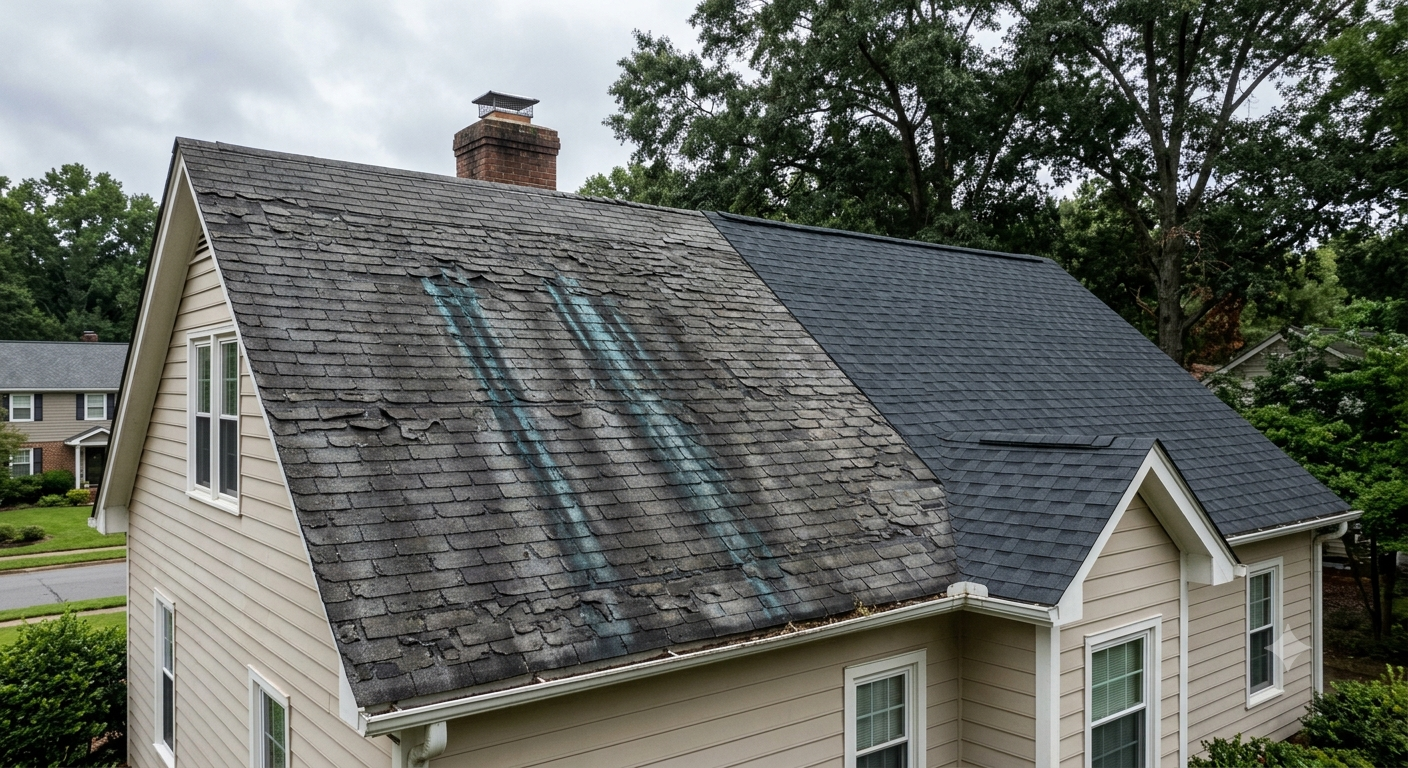
Here is the honest version most homeowners do not hear. The lifespan printed on the shingle wrapper assumes ideal conditions: a moderate climate, flawless installation, perfect attic ventilation, and steady maintenance. That is not Charlotte. Between the summer heat, the humidity, the algae, the thermal cycling, and the storms that roll through the metro every year, a roof rated for 30 years often delivers closer to the low twenties here, sometimes less if it was installed poorly or never inspected. After over 50 years tearing off and replacing roofs across the Charlotte metro, we have a clear, unromantic picture of what actually lasts here and what does not. This guide gives you the real numbers and, more usefully, how to read where your specific roof stands.
The Honest Answer: Real Lifespan Ranges in North Carolina
Roofing materials carry advertised lifespans, and those numbers are useful as a benchmark. But the advertised figure and the real-world figure in Charlotte’s climate are rarely the same. The table below pairs the marketed range with what we typically see across the greater Charlotte metro, where heat and humidity push most materials toward the lower end of their advertised range rather than the upper end.
| Roofing material | Commonly advertised range | What we typically see in the Charlotte metro |
|---|---|---|
| 3-tab asphalt shingles | 20 to 25 years | 15 to 20 years, often less on exposed slopes |
| Architectural asphalt shingles | 30 years | 20 to 28 years with proper ventilation |
| Impact-resistant (Class 4) shingles | 30 years and up | 25 to 35 years, with better storm survivability |
| Standing seam metal | 40 to 70 years | 45 to 60+ years with quality installation |
| Metal shingles | 40 to 50 years | 40 to 50 years |
| Wood shake | 30 to 40 years | 20 to 30 years, high maintenance in NC humidity |
| Composite / synthetic slate | 40 to 50 years | 40 to 50 years |
| Natural slate | 50 to 100+ years | 50+ years; storm and structural factors apply |
| Flat membrane (TPO, EPDM, PVC) | 20 to 30 years | 20 to 30 years depending on membrane and slope |
The pattern is consistent. Asphalt, the most common roofing across the metro, takes the biggest hit from Charlotte’s climate relative to its advertised number. The premium and metal materials hold their advertised ranges better because they are inherently more resistant to the specific stresses our climate applies. None of these numbers are a guarantee. They are starting points, and the factors in the next two sections are what actually move your roof up or down within them.
Why Charlotte’s Climate Ages Roofs Faster
The reason a roof in Charlotte often underperforms its rating comes down to a specific combination of stresses that mild climates do not apply all at once. Understanding them tells you why maintenance and material choice matter so much here.
Heat and UV exposure are the first. Charlotte summers are long and intense, and roof surface temperatures on sun-facing slopes climb dramatically through the day. That prolonged UV and heat exposure dries out asphalt shingles, breaks down the binders that hold them together, and accelerates granule loss. The granules are the shingle’s sunscreen, and once they thin out, the asphalt mat underneath degrades quickly.
Humidity and algae are the second. Charlotte’s humidity feeds the dark algae streaking you see on roofs throughout the metro, particularly on north-facing slopes that stay shaded and damp. Beyond the cosmetic issue, persistent moisture against the roof surface and in the valleys is exactly how slow rot starts in the decking and trim beneath.
Thermal cycling is the third and most underrated. Charlotte does not have the brutal winters of the Northeast, but it has frequent swings: hot days, cooler nights, occasional ice events, and rapid temperature changes that make roofing materials expand and contract over and over. That constant movement fatigues materials, loosens fasteners, and works sealant loose at the seams and flashing. A roof here ages differently than the same roof would in a stable climate, even at the same age on paper.
Storms are the fourth. The metro sits in an active severe weather corridor, and hail and high wind events occur regularly, with the eastern suburbs toward Monroe and Indian Trail seeing elevated hail frequency. Even when a storm does not cause obvious damage, repeated impacts and wind stress chip away at a roof’s remaining life. A roof that has weathered several storm seasons is not the same roof it was when it was installed, regardless of what the calendar says.
Why Two Identical Roofs on the Same Street Last Different Lengths of Time
This is the part the lifespan tables never explain, and it is the most important thing to understand. We have inspected two houses built by the same builder, in the same year, on the same street, with roofs installed at the same time, where one roof was failing and the other had years of life left. Same material, same age, completely different condition. Here is what drives that gap.
What makes one roof outlast an identical one:
- Attic ventilation. A roof that cannot breathe bakes its own shingles from below. Poor ventilation is the single most common reason we see roofs fail early in Charlotte. Proper ridge and soffit airflow can add years.
- Sun exposure and orientation. South and west-facing slopes take far more UV than shaded north slopes. The same roof often wears out on one side years before the other.
- Tree cover. Mature canopy drops debris into valleys and gutters, holds moisture against the roof, and encourages algae and rot. Beautiful for the neighborhood, hard on the roof.
- Installation quality. Proper nailing, underlayment, flashing, and ventilation at install time determine whether a roof reaches its rated life or falls short of it. This is not recoverable later.
- Maintenance history. Roofs that get periodic inspection and small timely repairs reliably outlast roofs that are ignored until a leak appears.
- Color of the shingle. Darker roofs absorb more heat, which can shorten asphalt shingle life compared to lighter shades on the same exposure.
The takeaway is that the material and the age tell you only part of the story. The rest is about how the roof was installed and how it has been cared for. That is also why a professional inspection gives you a far more accurate answer than any chart, because it accounts for your roof’s actual condition rather than its theoretical age.
What Your Charlotte Neighborhood’s Housing Stock Tells You About Roof Timing
One factor that almost never appears in a generic lifespan article is when the homes in your area were built, and it is genuinely useful for anticipating roof timing. The Charlotte metro grew in distinct waves, and the housing stock from each era is reaching its roof replacement window on a predictable schedule.
The large subdivisions across Matthews, Stallings, and Indian Trail were built heavily through the 1980s, 1990s, and early 2000s. A great many of those original roofs, or their first replacements, are now reaching the late stage of an asphalt shingle’s realistic life in this climate. If your home is in one of these communities and still wears an older roof, the math says you are at or near the decision point even if the roof looks acceptable from the street. This is exactly the housing type and timing we inspect most often across the eastern metro.
The older central neighborhoods, including the historic areas toward Myers Park and the surrounding established communities, present a different timeline and a different consideration. Roofs on homes that are 80 or more years old have usually been replaced multiple times, and the more important issue is what lies underneath. On a home of that age, a reroof routinely uncovers decking and structural conditions that a roofing-only inspection misses. The roof’s surface life is only part of the question; the condition of the structure beneath it matters just as much.
The newer custom builds in communities like Weddington and Waxhaw are mostly still within the early or middle stage of their roof life, especially where higher-grade or metal materials were used at construction. For these homeowners, the practical move is establishing a maintenance and inspection rhythm now, while the roof is healthy, so it reaches the upper end of its range rather than falling short through neglect.
None of this replaces an actual inspection of your specific roof. But knowing your neighborhood’s general era gives you a useful starting expectation for whether you should be planning ahead, watching closely, or simply maintaining what you have.
How to Read Where Your Roof Is in Its Lifespan
You do not need to climb onto your roof to get a rough sense of where it stands. A combination of its known age and a few visible indicators will tell you whether you are likely in the early, middle, or late stage of its life.
A simple read on your roof’s remaining life:
|
1
|
Start with the known age. If you know when the roof was installed, place it against the real-world range for its material above. An architectural shingle roof past 18 years in Charlotte is in its late stage, even if it looks acceptable from the ground. |
|
2
|
Check your gutters for granules. A buildup of sand-like granules in the gutters means the shingles are shedding their protective surface. That is a late-stage signal, not an early one. |
|
3
|
Look at the shingles from the ground. Curling edges, cupping, bald patches, or shingles that look uneven across a slope all indicate advanced wear. Dark streaks alone are usually algae, not failure, but they are worth cleaning. |
|
4
|
Note any interior signs. Water stains on ceilings, daylight visible in the attic, or a sagging roofline are not early warnings. They mean the roof is already failing somewhere and needs professional attention promptly. |
|
5
|
Get a professional inspection to confirm. The ground-level read gives you a rough stage. A proper inspection tells you the actual remaining life, what is driving the wear, and whether targeted repair can extend it. |
If several of these signals are pointing the same direction, your roof is likely later in its life than its age alone suggests. The fuller list of warning signs is worth reviewing in our guide to the signs you need a new roof in Charlotte.
When the Lifespan Math Points to Replacement vs. Repair
Knowing your roof’s stage is useful mainly because it informs the repair-or-replace decision. A roof in the early or middle of its life with isolated damage is almost always a repair. A roof in its late stage that needs frequent patching is usually telling you that repair is throwing money at a problem that replacement would solve. The general rule of thumb in the industry is that when a repair would cost more than roughly half the cost of replacement, replacement is the better value, but that rule can mislead if applied without context.
A young roof with storm damage to one section should be repaired, full stop, because it has many years of life remaining. An aging roof that has been patched by three different contractors over four years is bad math no matter how modest the next repair looks, because you are spending repeatedly to delay an outcome that is already arriving. We walk through that decision in detail, with the actual framework we use on every job, in our guide to roof repair vs. replacement for Charlotte homeowners.
The most reliable way to make this call is not a chart and not a guess. It is an honest inspection from a contractor who is willing to tell you the roof has years left when it does, rather than selling you a replacement you do not need yet. That is the standard we hold ourselves to on every inspection.
Want to know how much life your roof actually has left? Call us at 704-847-7119 or request a free inspection online. We serve Charlotte, Matthews, Ballantyne, Indian Trail, Mint Hill, Waxhaw, Weddington, Monroe, and the surrounding metro.
Frequently Asked Questions: Roof Lifespan in North Carolina
Why does my roof seem to be wearing out faster than the 30 years on the warranty?
Because the advertised lifespan assumes ideal conditions that Charlotte does not provide. The number on the wrapper is based on moderate climate, flawless installation, perfect ventilation, and consistent maintenance. In the real Charlotte metro, heat, UV, humidity, thermal cycling, and storm exposure all push asphalt shingles toward the lower end of their range. A 30-year architectural shingle commonly delivers closer to 20 to 28 years here, and less if ventilation is poor or the roof was installed badly. The warranty number is a benchmark, not a promise of how your specific roof will perform in this climate.
Does a metal roof really last twice as long as asphalt in North Carolina?
In most cases, yes. A properly installed standing seam metal roof in Charlotte is realistically a 45 to 60-year-plus system, while architectural asphalt commonly delivers 20 to 28 years here. Metal handles the specific stresses of our climate, the heat, the hail, the thermal movement, better than asphalt does. The major caveats are installation quality and roof geometry. Metal installed by a crew without genuine standing seam experience will not reach that lifespan, and complex rooflines add cost and difficulty. But for the right roof installed correctly, the longevity difference is real and significant.
How often should I have my roof inspected in Charlotte?
A professional inspection every two to three years is a reasonable baseline for a roof in good condition, and you should add an inspection after any significant storm regardless of timing. Charlotte’s storm activity means a roof can pick up damage that is invisible from the ground but real at the shingle surface. Catching small issues early, a few damaged shingles, loose flashing, a cracked vent boot, prevents them from becoming the kind of leak that damages decking and structure. Regular inspection is one of the most reliable ways to get the full rated life out of a roof in this climate.
Can I make my roof last longer than its expected lifespan?
Often, yes, within limits. The factors most within your control are ventilation, maintenance, and prompt repairs. Ensuring your attic is properly ventilated takes heat stress off the shingles from below. Keeping gutters and valleys clear of debris prevents moisture damage. Addressing small problems before they spread, and cleaning algae rather than letting it sit, all add time. None of this defeats the underlying aging of the material, but a well-maintained roof reliably reaches the upper end of its range while a neglected one falls short. The reverse is also true: neglect can shave years off even a quality roof.
My roof is 20 years old but looks fine. Do I need to replace it?
Not necessarily, but it is the right time for a professional inspection rather than a wait-and-see approach. At 20 years, an asphalt roof in Charlotte is in the later part of its realistic life, and looking acceptable from the ground does not tell you about granule loss, brittleness, underlayment condition, or hidden wear that only shows up on the roof itself. An inspection at this stage lets you plan rather than react. Sometimes we find a 20-year roof has a few good years left and recommend waiting. Sometimes we find it is closer to the end than it appears. Either way, knowing beats guessing.
Related reading: Roof repair vs. replacement: making the right call | Signs you need a new roof in Charlotte | Metal roofing services in Charlotte | Residential roofing services | All roofing services
Related Roofing Resources
Services: roof replacement, roof repair in Charlotte, and metal roofing.
More guides: signs you need a new roof, how attic ventilation affects roof lifespan, and roof repair vs replacement.
Once you know how long your roof has left, the next question is budget. See what a new roof costs in Charlotte and the factors that move the number.
A single storm can cut those years short. Here is how we handle storm damage roof repair.
Recent Posts

Protect Your Gutters With Gutter Caps
Eliminate tedious maintenance tasks and unsightly clogs with time-saving gutter guards.See For Yourself
View Our Gallery of Projects
Proudly Serving
Matthews | Stallings | Mint Hill | Indian Trail | Weddington
Waxhaw | Monroe | Ballantyne | South Park | Arboretum |
Myers Park | Pineville | Fort Mill
Matthews | Stallings | Mint Hill | Indian Trail | Weddington
Waxhaw | Monroe | Ballantyne | South Park | Arboretum |
Myers Park | Pineville | Fort Mill