
Asphalt Shingles vs. Metal Roofing: Which Is Better for Charlotte Homes?
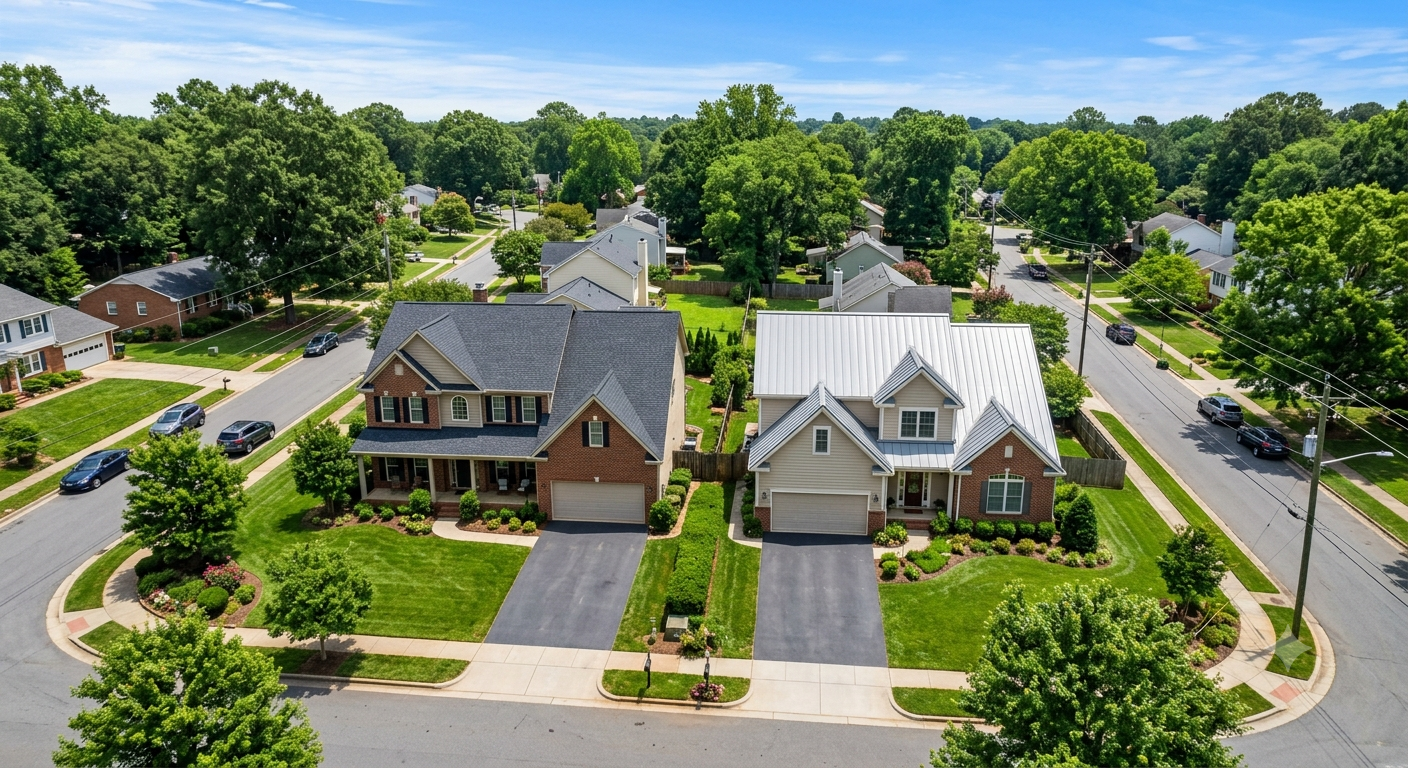
This question comes up in nearly every estimate we run for a full replacement. And our honest answer is: it depends on three things your roof salesperson probably skipped. How long you plan to stay in your home. What your roof’s pitch and sun exposure look like. And whether your neighborhood’s storm history makes impact resistance a real priority or mostly a marketing angle. After over 50 years replacing roofs across Charlotte, Matthews, Ballantyne, Monroe, Waxhaw, and the surrounding metro, we have seen both materials perform well and both fail early. The difference is almost always whether the right material was matched to the right situation.
What Charlotte’s Climate Actually Does to Your Roof
Charlotte sits in a climate zone that punishes roofs in specific ways. Summers run hot and humid with surface temperatures on south-facing slopes reaching levels that accelerate shingle aging. The metro sees regular severe weather from May through September, including hail events that affect Union County and the eastern suburbs more frequently than most homeowners realize. Winter ice events are occasional but real, particularly in the more elevated neighborhoods toward Waxhaw and Weddington.
None of this makes one roofing material automatically better than the other. It does mean that both asphalt shingles and metal roofing have specific strengths that matter more in this climate than they would in, say, coastal South Carolina or the NC mountains. Understanding those strengths is the only way to make a decision you will not second-guess in year fifteen.
One pattern we see repeatedly: homeowners who focus only on upfront cost when choosing roofing material and end up replacing their roof on an accelerated timeline because the material or the installation was not suited to their specific roof and location. The material choice matters. So does who installs it.
Asphalt Shingles: What They Do Well and Where They Struggle
Asphalt shingles are the dominant roofing material across the Charlotte metro. Drive through any established neighborhood, from Dilworth and Eastover to the 1990s subdivisions in Matthews and Stallings, and the vast majority of roofs are architectural asphalt shingles. There are real reasons for that.
Architectural shingles, also called dimensional shingles, offer a layered look that holds up well aesthetically on traditional and craftsman-style homes. They are available in a wide range of colors that coordinate with brick, vinyl, and fiber cement siding. Individual damaged shingles can be replaced without touching the rest of the roof, which keeps repair costs manageable. And for homeowners who plan to sell within the next ten to fifteen years, asphalt shingles offer a replacement cost that does not require an extended payback period to make financial sense.
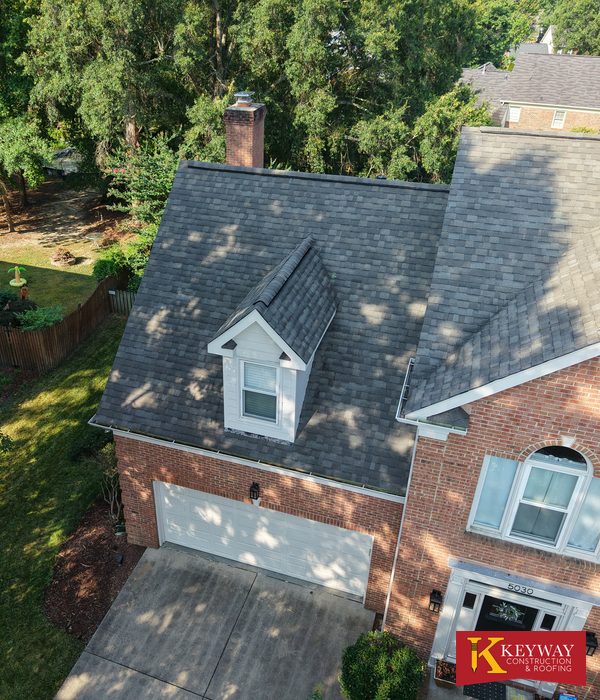
Where asphalt shingles struggle in Charlotte’s environment comes down to two things. First, the heat. South-facing roof slopes with limited shade see accelerated granule loss and mat degradation. We have inspected roofs in the Ballantyne and Blakeney corridors where the south pitch had aged noticeably faster than the north pitch on the same house. Second, hail. Standard architectural shingles absorb hail impacts by losing granules at the strike point. That granule loss exposes the underlying asphalt mat to UV radiation, which degrades it faster. The damage is often invisible from the ground but shows up clearly in an inspection.
If you are choosing asphalt shingles for a Charlotte home, the decision worth having with your contractor is whether Class 4 impact-resistant shingles make sense for your situation. They are not the right call for every roof, but for homes in the eastern metro where Union County hail frequency is higher, they close the gap significantly. We cover that question in detail in our impact-resistant shingles guide.
Asphalt shingles tend to be the right call when:
- You plan to sell the home within 10 to 15 years
- Budget is a primary constraint and you want maximum quality at a controlled cost
- Your roof has a complex pitch or multiple valleys where metal panel installation becomes significantly more complex
- Your neighborhood has HOA design standards that require a traditional shingle appearance
- You want the ability to replace individual damaged sections without full-roof work
Metal Roofing: What It Delivers and What It Costs You
Metal roofing has changed significantly in how Charlotte homeowners think about it. Ten years ago, it was mostly associated with agricultural buildings and lake houses. Today, standing seam metal is showing up in Weddington, Ballantyne Estates, Myers Park, and the custom-build communities along the SouthPark corridor. The shift is driven by homeowners who have gone through one or two asphalt replacements and are ready for a material they will not have to replace again.
The core case for metal roofing in Charlotte is longevity combined with low maintenance. A properly installed standing seam metal roof on a Charlotte home is realistically a 45 to 60-year system. It does not lose granules in hail events. It does not develop the algae streaking that asphalt shingles show after several years in Charlotte’s humidity. It reflects rather than absorbs summer heat, which reduces attic temperatures and takes pressure off your HVAC system. And for homeowners in areas with active storm history, the resistance to wind and hail damage is not a small consideration.
Metal roofing also performs well in terms of homeowner insurance. Charlotte sits in one of the Southeast’s more active severe weather corridors, and insurers recognize that. A standing seam metal roof can earn meaningful premium discounts from many NC carriers, worth verifying directly with your agent before your next replacement decision.
The honest trade-off is upfront cost and complexity. Metal roofing requires more specialized installation knowledge than asphalt shingles. A contractor who primarily installs shingles and occasionally takes on a metal job is not the same as one with genuine standing seam experience. The seaming, the flashing integration, the thermal expansion allowances: these are not details where cutting corners is recoverable. We install both materials, and we are direct with homeowners about when a roof’s geometry or budget makes one a stronger recommendation than the other.
Metal roofing tends to be the right call when:
- You plan to stay in the home for 20 or more years and want to avoid a second replacement entirely
- Your home is a custom build or high-end renovation where material longevity justifies the premium
- You have an aging asphalt roof and have already replaced it once or twice
- Your roof has simpler geometry with long straight runs that suit standing seam panels
- You want to maximize energy efficiency and reduce summer cooling costs
- Storm and hail resistance is a genuine priority based on your location and home’s exposure
How Charlotte Neighborhoods Affect This Decision
One thing that does not show up in most roofing comparison articles: where you live in the Charlotte metro genuinely changes which material makes more sense. This is not a subtle distinction.
Homes in Matthews, Stallings, and Indian Trail were built heavily during the 1980s and 1990s. Most of those roofs are hitting their first or second replacement cycle now. The housing stock is predominantly traditional in style, with complex rooflines and multiple valleys. For this housing type, architectural asphalt shingles remain the practical default. They work with the design, they perform well when properly installed, and Class 4 options add storm protection without the complexity of a full metal conversion on a roof with seven or eight pitch changes.
Homes in Weddington, Waxhaw, and the Ballantyne Estates corridor tend to be newer custom builds or higher-end renovations. These are exactly the situations where metal roofing makes the clearest financial sense: longer intended occupancy, roof geometries that often suit metal better, and buyers who recognize the value in a long-term material choice.
The Monroe and Union County area, including the communities southeast of Charlotte, sees higher hail frequency than most of the metro. Homeowners in this corridor benefit the most from impact-resistant materials, whether that is Class 4 shingles or metal. It is worth factoring that directly into the material decision rather than treating storm resistance as a bonus feature.
How We Walk Through This Decision With Homeowners
|
1
|
How long do you plan to stay? This is the first question. If the answer is under 12 years, asphalt almost always makes more financial sense. Over 20 years, metal starts to look like the better long-term investment for the right roof. |
|
2
|
What does your roof’s geometry look like? Simple rooflines with long straight runs suit metal well. Complex hip roofs with multiple valleys and dormers add significant cost and difficulty to a metal installation, which changes the value calculation. |
|
3
|
What is your storm exposure? We check what Union County Doppler and the Charlotte NWS office show for your specific area. If your neighborhood has a confirmed hail history, that factors directly into whether impact-resistant materials are worth the premium. |
|
4
|
What does your HOA allow? Some Charlotte-area HOAs have covenants specifying shingle material or color palettes. Metal is not always an option regardless of what makes structural or financial sense. Worth confirming before the estimate. |
A Direct Comparison: What Each Material Delivers
| Factor | Architectural Asphalt Shingles | Standing Seam Metal |
|---|---|---|
| Typical lifespan in Charlotte | 20 to 30 years (Class 4 can reach 30 to 35) | 45 to 60+ years with proper installation |
| Upfront cost | Lower initial investment | Significantly higher upfront |
| Hail resistance | Standard shingles vulnerable; Class 4 significantly better | Excellent at Charlotte-typical hail sizes |
| Heat performance | Absorbs heat; reflective options available | Reflects solar heat; measurable HVAC benefit |
| Maintenance | Algae treatment, occasional shingle replacement | Very low; periodic inspection sufficient |
| Repairability | Easy to replace individual sections | Repairs require matching panels; more specialized |
| Insurance premium impact | Class 4 may earn discounts; standard typically neutral | Often earns meaningful premium reduction; verify with your carrier |
| Style fit | Traditional, craftsman, colonial, most suburban styles | Modern, contemporary, custom builds; increasingly accepted in traditional neighborhoods |
| Installation complexity on complex rooflines | Handles valleys, dormers, multiple pitches well | Cost and complexity increase significantly with roofline complexity |
What We Actually Recommend and Why
We install both materials. We do not have a financial incentive to push one over the other. What we do have is over 50 years of watching both perform across Charlotte’s specific climate, housing stock, and storm history. That gives us a clearer picture than a simple pros-and-cons list.
For most Charlotte homeowners replacing a roof on a traditional 1980s to 2000s home with a plan to sell or refinance within 15 years: quality architectural shingles, and seriously consider Class 4 if you are in the Monroe, Indian Trail, or Union County corridor where hail frequency is documented and measurable.
For homeowners in a custom or newer home, planning to stay long-term, with a roof geometry that suits metal installation: standing seam metal is worth the conversation. The lifetime cost difference narrows significantly when you factor in avoided second replacement, lower maintenance, and potential insurance savings. We walk through those numbers honestly during the estimate because they should be part of the decision, not an afterthought.
The one recommendation that applies regardless of which material you choose: do not let installation quality become the second priority after material selection. A well-installed asphalt roof outperforms a poorly installed metal roof. Every time. The crew, the flashing details, the ventilation strategy, and the underlayment selection matter as much as the material on top of them.
If you are ready to talk through which material makes sense for your specific home, call us at 704-847-7119 or schedule a free estimate online. We cover Charlotte, Matthews, Ballantyne, Monroe, Waxhaw, Indian Trail, and the full greater metro.
Frequently Asked Questions: Asphalt vs. Metal Roofing in Charlotte
Does metal roofing actually last longer than asphalt shingles in Charlotte's climate?
Yes, reliably. A properly installed standing seam metal roof in Charlotte is a 45 to 60-year system under normal conditions. Quality architectural asphalt shingles in the same climate run 20 to 30 years, with Class 4 impact-resistant options potentially reaching 30 to 35. The gap is real and consistent. The caveat is installation quality: a metal roof installed by a crew without genuine standing seam experience will not deliver on that lifespan promise. Ask any contractor about their specific metal roofing installation history before committing.
Will a metal roof make my home significantly louder during rain or hail?
Not if it is installed correctly. Metal roofing installed over solid decking with proper underlayment performs similarly to asphalt shingles in terms of interior noise. The agricultural-building noise association comes from metal installed over open framing without insulation or underlayment beneath it. Residential standing seam installations include solid decking and a quality underlayment by default. We have had homeowners call us a week after a metal installation to say they could not tell the difference in rain noise from inside the house.
Can I put metal roofing over my existing asphalt shingles?
In some cases, yes. Some metal roofing systems can be installed over existing asphalt shingles if the decking beneath is in solid condition and local code allows it. We inspect the decking before recommending this approach because trapping moisture between old shingles and new metal panels creates problems that cost more to fix than a full tear-off would have. We give an honest recommendation on tear-off vs. over-installation during the estimate based on what the decking inspection shows, not on what is faster or cheaper to schedule.
Does my Charlotte neighborhood's HOA affect which roofing material I can choose?
Potentially, yes. Some Charlotte-area HOAs have architectural guidelines that specify roofing material type, color range, or appearance. Metal roofing is increasingly common enough that most HOA guidelines do not explicitly prohibit it, but some do require shingle-look materials or limit color options in ways that affect standing seam panels. If your home is in an HOA-governed community, pull the architectural standards document before getting estimates. We can review it with you during the consultation if you bring it to the appointment.
How does the choice between asphalt and metal affect my homeowner's insurance in NC?
It can make a meaningful difference. NC insurers recognize Charlotte’s position in an active severe weather corridor, and impact-resistant materials carry real premium benefits with many carriers. A standing seam metal roof often qualifies for the largest discounts because of its demonstrated hail and wind resistance. Class 4 asphalt shingles also earn discounts from many insurers, though the amount varies by carrier and policy. Before finalizing your material choice, call your insurance agent and ask directly what discount each material qualifies for. That number should be part of your total cost calculation, not something you find out after installation.
Related reading: Metal roofing services by Keyway Construction | Impact-resistant shingles: are they worth it in Charlotte? | 10 signs you need a new roof in Charlotte | Roofing services in Charlotte and the greater metro | What to do after storm damage to your Charlotte roof
Related Roofing Resources
Services: metal roofing, roof replacement, and residential roofing.
More guides: architectural vs 3-tab shingles, what a new roof costs in Charlotte, and how long a roof lasts in North Carolina.
Ready to move forward? See our asphalt shingle roof installation and replacement in Charlotte.
Staying with shingles? See the best shingle brands compared.
Recent Posts
Protect Your Gutters With Gutter Caps
Eliminate tedious maintenance tasks and unsightly clogs with time-saving gutter guards.See For Yourself
View Our Gallery of Projects
Proudly Serving
Matthews | Stallings | Mint Hill | Indian Trail | Weddington
Waxhaw | Monroe | Ballantyne | South Park | Arboretum |
Myers Park | Pineville | Fort Mill
Matthews | Stallings | Mint Hill | Indian Trail | Weddington
Waxhaw | Monroe | Ballantyne | South Park | Arboretum |
Myers Park | Pineville | Fort Mill