

Storm Damage Roof Checklist: What Charlotte Homeowners Should Do in the First 48 Hours
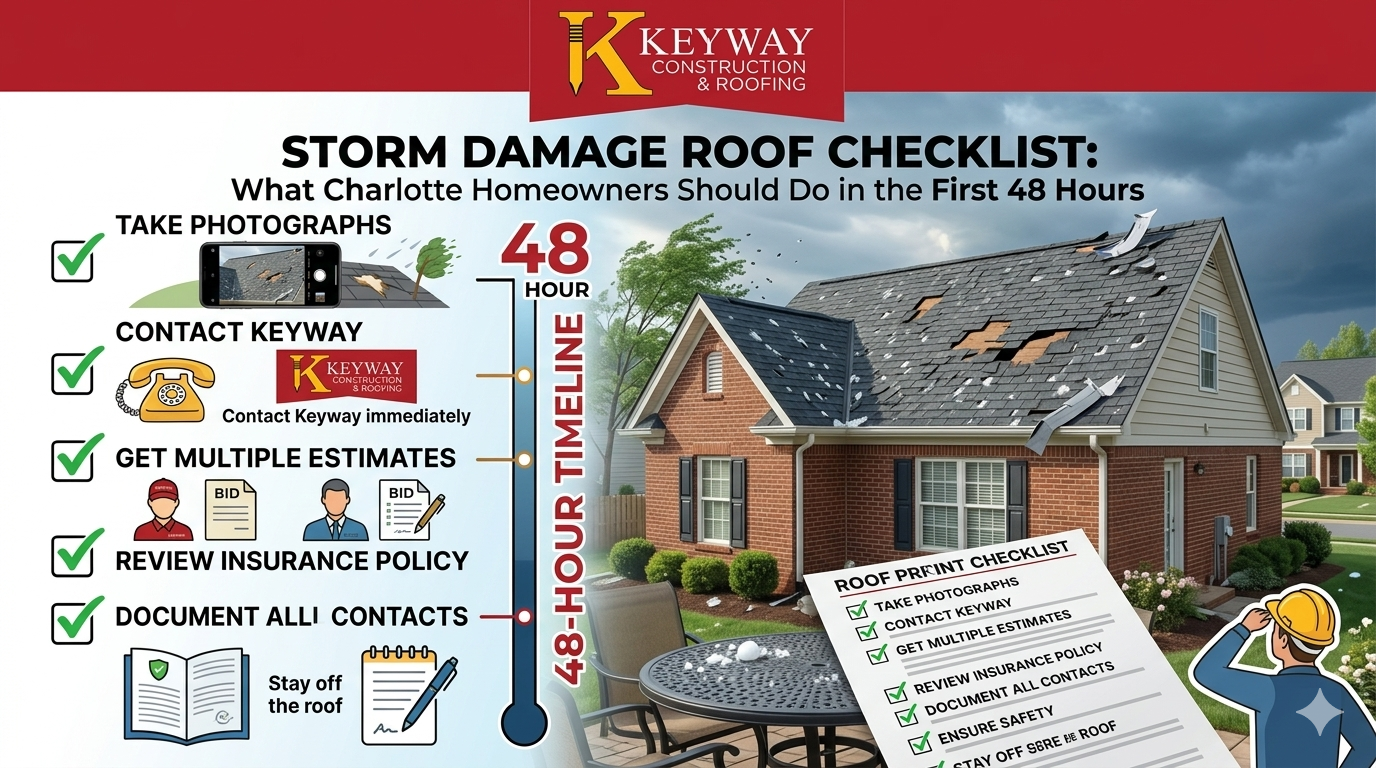
A storm just moved through your Charlotte neighborhood. The wind has died down, the rain has stopped, and you are standing in your yard trying to figure out what just happened to your roof. You might have heard something hit. You might see branches down. You might see nothing at all from the ground – which does not mean your roof is fine.
The decisions you make in the next 48 hours matter more than most homeowners realize. Document wrong, and you may leave insurance money on the table. Wait too long, and secondary water damage from an unaddressed entry point can cost far more than the original storm damage. Call the wrong contractor first, and a storm chaser may pressure you into signing before you have thought it through.
Keyway Construction has been responding to storm damage across Charlotte, Matthews, Ballantyne, Monroe, Indian Trail, and Union County for over 50 years. This checklist covers exactly what to do, in the right order, to protect your home and your claim.
If you have an active leak right now, call us at 704-847-7119 – we handle emergency roof tarping across the Charlotte metro.
Step 1 – Do Not Go on the Roof
This comes first because it is the most important instruction to give before anything else. After a storm, your roof may have structural damage, saturated decking, or debris that makes it dangerous to walk on without proper equipment and training. Wet shingles are slippery. Hail damage cannot be safely assessed from a standing position on the surface anyway – it requires close inspection at each shingle, including looking at the granule pattern and the underlying mat. After a storm, start with a free roof inspection.
Your job in the first 30 minutes is ground-level observation only. Everything else is for professionals with proper equipment.
Step 2 – Walk the Perimeter From the Ground
From the safety of your yard or driveway, do a slow walk around the full perimeter of your home. You are looking for visible signs that something has changed on the roof. Note and photograph everything you see, even if it seems minor.
What to look for from the ground:
- Missing shingles – bare patches where you can see the darker underlayment below
- Shingles that are lifted, folded back, or visibly displaced from their position
- Debris on the roof – branches, limbs, or objects that may have punctured or displaced material
- Dented or damaged gutters and downspouts – gutter dents are a reliable indicator that hail reached the property
- Granules from asphalt shingles collected in gutters or on the ground below downspouts
- Damaged or bent ridge cap at the peak of the roof
- Any visible damage to flashing around chimney or vents
- Damage to siding, window screens, or AC unit fins – these are softer surfaces that show hail impact clearly when the roof may not show visible marks from the ground
Photograph everything you find. Timestamp and location context matters – if you file an insurance claim, documentation of the condition immediately post-storm is much stronger evidence than photos taken a week later.
Step 3 – Check the Interior of Your Home
Go into every room of your home and look up. Pay particular attention to top-floor ceilings and the attic if you have access to it. Water entry from a storm often does not show up on the ceiling directly below the entry point – it travels along rafters, runs horizontally on attic insulation, and may drip through the ceiling several feet away from where it entered the roof.
What to look for inside:
- New water stains on ceilings – fresh stains appear as a darkened ring or wet patch
- Dripping or active water entry through ceiling fixtures, light covers, or fans
- Wet spots on attic insulation or along attic rafters
- Daylight visible through the attic boards – the same gaps that let light in let water in
- Wet or damp drywall on top-floor walls adjacent to the roofline
If you find any active water entry, move belongings out of the affected area and place buckets or towels to manage the drip. Then call us. Active leaks need emergency tarping before the next rain event compounds the damage.
Step 4 – If You Have an Active Leak, Call for Emergency Tarping Now
Emergency tarping is not optional when you have active water entry. Untreated roof leaks cause damage that compounds faster than most homeowners expect: insulation gets saturated and loses its R-value, drywall softens and begins to fail, and the conditions for mold growth become favorable within 24 to 48 hours in Charlotte’s warm, humid environment.
A tarp installed incorrectly can also make things worse. Improperly anchored tarps blow off in the next weather event, and a tarp nailed directly through shingles can create new penetration points. Emergency tarping by a professional involves properly securing the tarp without creating additional damage, covering a sufficient area beyond the visible entry point, and documenting the condition before and after for your insurance claim.
Keyway handles emergency storm damage response across the Charlotte metro. Call 704-847-7119 for same-day response on active leak situations. See also our blog post on why DIY tarping often causes more damage than it prevents.
Step 5 – Document Everything Before Anyone Touches Anything
Before any contractor arrives and before any work is done, your documentation needs to be complete. This is the step that determines how strong your insurance claim is.
Step 6 – Contact Your Insurance Company (Within 30 Days)
Most standard homeowner’s policies require you to report storm damage within 30 days of the event. Some policies have shorter windows for certain claim types. Do not wait a week assuming nothing is wrong – if your inspection later reveals damage, a delayed report can complicate the claim.
When you call your insurer to report the storm, you are not committing to a claim – you are opening a file and noting the event. Your insurer will typically ask for:
- The date and time of the storm event
- A general description of the visible damage
- Whether you have made any temporary repairs (tarping, boarding)
- Whether there is ongoing water entry
Your insurer will then either send an adjuster or ask you to provide a contractor’s damage assessment. Either way, having your own professional inspection documentation – from a licensed contractor, not a storm chaser – before the adjuster visits puts you in a much stronger position. Our roof insurance claim guide covers the full process of working with adjusters and what to do if the initial assessment misses damage.
Step 7 – Get a Professional Inspection From a Licensed Contractor
Here is the reality of storm damage in Charlotte: most hail damage is invisible from the ground. The circular impact marks that indicate granule loss on asphalt shingles – the ones that accelerate UV degradation and shorten remaining roof life – cannot be seen from the yard. You need someone on the roof, at each shingle, documenting what is there.
A professional inspection from a licensed contractor before any insurance adjuster visits gives you independent documentation of damage that you control. If the adjuster’s assessment differs significantly from the contractor’s, you have a basis for discussion and, if necessary, a supplemental claim. Without your own inspection report, you are entirely dependent on the adjuster’s assessment – and adjusters working high-volume post-storm situations do not always catch everything.
We provide free storm damage inspections across the Charlotte metro. We photograph every area of damage, organize the documentation by roof section, and provide you with a written assessment of what we found. You receive a copy regardless of whether you proceed with any repair work. See our Charlotte storm damage roofing page for what our post-storm inspection covers.
Step 8 – Watch Out for Storm Chasers
After every significant storm in the Charlotte metro, contractors from outside the area flood residential neighborhoods. They knock on doors, promise fast insurance claim processing, and in many cases pressure homeowners to sign Assignment of Benefits (AOB) agreements before any inspection has been done.
An AOB signs over your right to negotiate the insurance claim directly to the contractor. Once signed, you lose control of the claim process. If the contractor and insurer disagree, you are caught in the middle with your claim tied up. This is how storm chasers operate – fast signature, big claim submission, and they are onto the next neighborhood before any work is done.
The warning signs are specific. Our full guide to spotting and avoiding storm chaser scams in Charlotte covers what to look for and how to verify that any contractor you hire is legitimately licensed in NC. The short version: do not sign anything at the door, verify the NC contractor license number before any agreement, and never sign an AOB without speaking to your insurer first.
What Happens if You Wait Too Long
The 48-hour window is not an arbitrary number. Here is what happens when storm damage goes unaddressed past this point in Charlotte’s climate:
| Timeframe | What Can Happen |
|---|---|
| 0–48 hours | Best window for documentation; temporary tarping prevents additional water entry; claim filing window begins |
| 2–5 days | Saturated insulation begins to lose R-value; drywall starts to soften; mold conditions become favorable in attic spaces above 70°F |
| 1–2 weeks | Visible mold growth in attic possible; insurer may question whether delay caused secondary damage; contractor schedule backlog grows post-storm |
| 30+ days | Policy reporting window may close; secondary water damage may be excluded as separate from storm damage; full decking replacement may be needed where tarping would have prevented it |
The cost of acting early is a phone call. The cost of waiting is potentially thousands of dollars in secondary damage and a more complicated claim.
Keyway’s Storm Response Process Across Charlotte
When you call Keyway after a storm, here is what happens:
- For active leaks: same-day emergency tarping response, documentation before and after
- For no-active-leak inspections: next-day scheduling in most cases, free inspection with written assessment and photos
- We can be present when your insurance adjuster visits to walk through the damage documentation together
- We provide the complete damage documentation package – organized photos, written scope, and supporting materials – that you need for a well-supported claim
- All repair and replacement work is backed by a 1-year workmanship warranty
We serve Charlotte, Matthews, Ballantyne, Mint Hill, Monroe, Indian Trail, Waxhaw, Weddington, and the full greater metro. Storm damage pages for your specific area: Charlotte | Matthews | Mint Hill | Waxhaw | Indian Trail | Weddington
Storm Damage Checklist – Quick Reference
- Stay off the roof – ground observation only
- Walk the full perimeter and photograph all visible exterior damage
- Check all interior ceilings and the attic for water entry
- If active leak: call 704-847-7119 immediately for emergency tarping
- Document everything before any contractor arrives – photos with timestamps
- Note the storm date, time, and save any NWS alerts or news coverage
- Contact your insurer within 30 days to open a file (do not wait)
- Schedule a professional inspection from a licensed NC contractor
- Do not sign any contractor agreement at the door – verify license first
- Never sign an Assignment of Benefits without speaking to your insurer
Frequently Asked Questions – Storm Damage Roofing Charlotte
How do I know if my Charlotte roof has hail damage if I can't see anything from the ground?
Hail damage on asphalt shingles is almost always invisible from the ground. The damage shows as dark circular impact marks at the granule surface where granules have been knocked loose, exposing the asphalt mat beneath. You may also see dented gutters, damaged downspouts, or dings in aluminum window screens – these are reliable indicators that hail reached your property with enough force to damage roofing material. The only way to confirm and document hail damage properly is a professional inspection on the roof surface. We provide free inspections across the Charlotte metro – call 704-847-7119.
Does my Charlotte homeowner's insurance cover hail and wind damage?
Standard homeowner’s policies typically cover sudden storm events including hail, wind, and falling debris. They do not cover damage from normal wear, age, or deferred maintenance. Charlotte and Union County have seen significant storm activity in recent years – if your property has been through a major event and you have not had a professional inspection, there is a real chance of valid damage that qualifies for coverage. Open a file with your insurer within 30 days of a storm event even if you are not sure damage occurred. Our roof insurance claim guide walks through the full process.
How do I avoid storm chaser scams after a Charlotte storm?
The primary warning signs: contractors knocking on your door immediately after a storm, pressure to sign on the spot, requests to sign an Assignment of Benefits before any inspection has been done, and contractors from out-of-state who cannot provide an NC contractor license number. Verify any contractor’s license through the NC Licensing Board for General Contractors before signing anything. For a full breakdown of the tactics and red flags specific to the Charlotte area, see our post on storm chaser scams in Charlotte.
What is the difference between emergency tarping and permanent repair?
Emergency tarping is a temporary protective measure to stop active water entry and prevent secondary damage while the full damage scope is assessed and a repair or replacement is planned and scheduled. Tarping is not a repair – it is damage mitigation. A tarp should be professionally installed over a sufficient area with proper anchoring that does not create additional penetration points. Most insurers require documentation of tarping as evidence that the homeowner took reasonable steps to prevent further damage. Permanent repair or replacement addresses the actual damage according to the scope determined during the full inspection.
Related reading: Storm chaser scams in Charlotte – how to spot them | DIY vs. pro tarping after a storm | Roof insurance claim guide | Charlotte hail history 2020-2026 | Signs your roof survived a storm but won’t survive the next one
Related Roofing Resources
Services: storm damage roof repair, roof repair in Charlotte, and gutter services.
More guides: filing a roof insurance claim, impact-resistant shingles, and roof repair vs replacement.
Widespread damage on the checklist? Learn about storm damage roof replacement and how we work with your adjuster.
Recent Posts

Protect Your Gutters With Gutter Caps
Eliminate tedious maintenance tasks and unsightly clogs with time-saving gutter guards.See For Yourself
View Our Gallery of Projects
Proudly Serving
Matthews | Stallings | Mint Hill | Indian Trail | Weddington
Waxhaw | Monroe | Ballantyne | South Park | Arboretum |
Myers Park | Pineville | Fort Mill
Matthews | Stallings | Mint Hill | Indian Trail | Weddington
Waxhaw | Monroe | Ballantyne | South Park | Arboretum |
Myers Park | Pineville | Fort Mill