

New Roof Cost in Charlotte, NC: What Actually Drives the Price (2026)
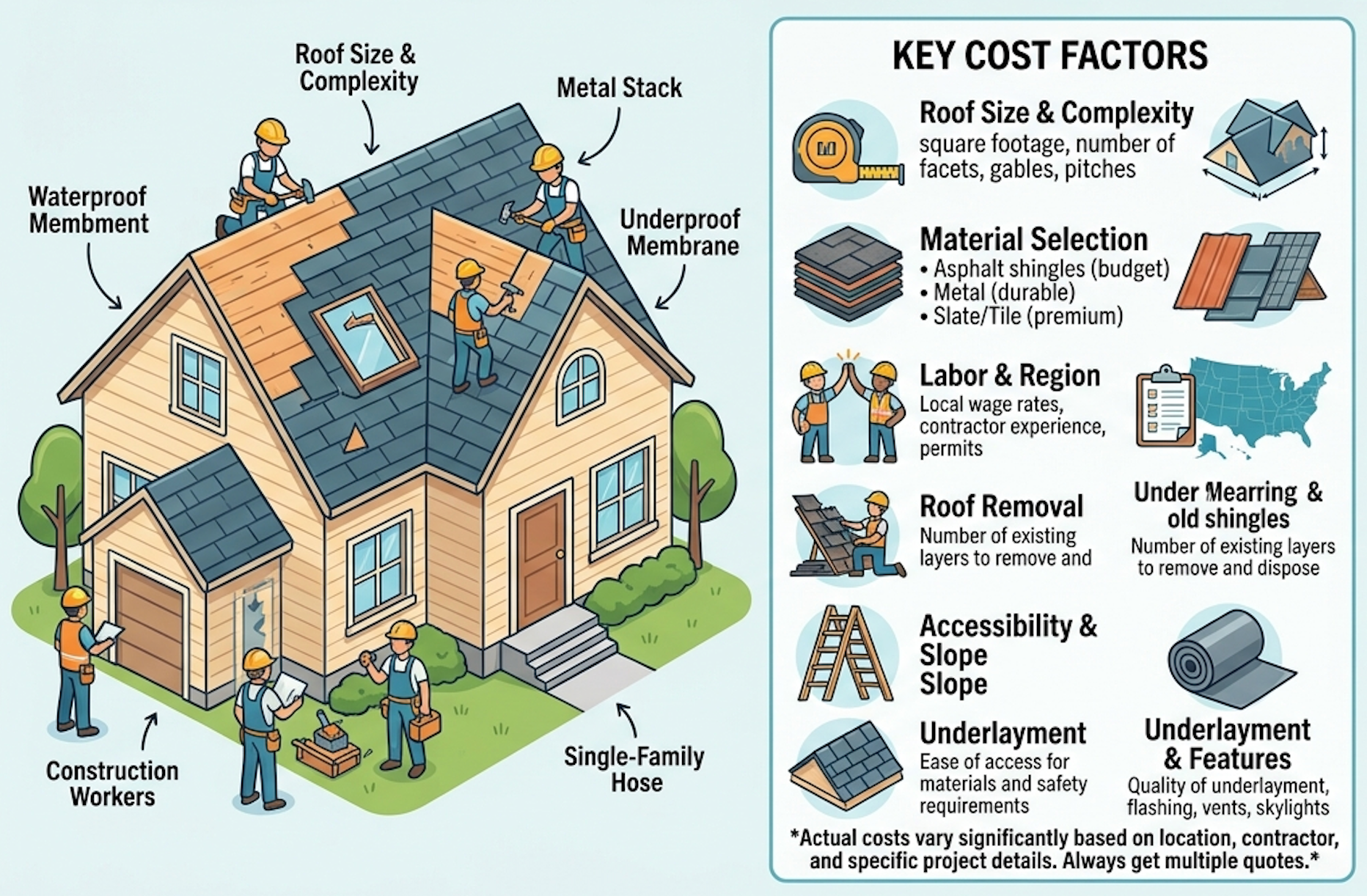
The most common question we hear from Charlotte homeowners is some version of the same thing: “Just give me a ballpark – what is this going to cost?” It is a fair question, and the honest answer is that a new roof in Charlotte can vary by thousands of dollars between two homes on the same street. Not because contractors are pulling numbers out of thin air, but because roofing costs are built from a specific set of factors that are different on every property.
This guide breaks down every factor that affects what you will pay for a new roof in Charlotte, NC. We are Keyway Construction, a licensed general contractor headquartered in Matthews with over 50 years of roofing work across Charlotte, Ballantyne, Monroe, Indian Trail, Waxhaw, and the surrounding metro. We do not throw out numbers without seeing a roof first – but we can tell you exactly what drives those numbers so you know what to expect before anyone arrives on your property.
Call 704-847-7119 or schedule your free next-day estimate online.
Why Charlotte Roof Replacement Costs More Than the National Average
Before getting into the factors, it helps to understand why Charlotte sits on the higher end of national roofing cost ranges. Three things drive this.
Labor market. Charlotte is a fast-growing metro with high construction demand across residential and commercial sectors. Qualified licensed contractors here earn more than in rural NC markets, and that flows into installed roofing costs. The labor component of a roof replacement typically accounts for 60 to 65 percent of the total cost, so labor rates matter more than most homeowners realize.
Climate demands. Charlotte’s combination of high summer heat indexes, humidity, heavy annual rainfall, and storm activity means roofing materials here need to perform harder than in milder climates. Contractors working in this market use higher-grade underlayments, proper ice and water barrier installation at eaves and valleys, and ridge ventilation systems that meet the demands of a humid subtropical climate. Cutting corners on these components is how cheap roofs fail early in Charlotte.
Storm history. The Charlotte metro including Union County has logged significant hail events over the past several years. When storm activity drives a surge in demand for roofing work, pricing tightens. Scheduling your replacement outside the immediate post-storm window – when every contractor in the market is booked – gives you better access to quality contractors and more competitive estimates.
Factor 1: Roofing Material – The Single Biggest Price Variable
Your material choice drives more of the final cost than anything else on this list. Here is how the main options compare for Charlotte homes:
| Material | Expected Lifespan (Charlotte climate) | Best For | Relative Cost |
|---|---|---|---|
| 3-Tab Asphalt Shingles | 15–20 years | Budget replacements, rentals, short-term ownership | Lowest |
| Architectural (Dimensional) Asphalt | 22–28 years | Most Charlotte homes – best balance of cost and performance | Moderate |
| Class 4 Impact-Resistant Shingles | 28–35 years | Storm-prone areas, homeowners seeking insurance discounts | Moderate-High |
| Standing Seam Metal | 40–60 years | Long-term ownership, energy efficiency priority, premium homes | High |
| Cedar Shake | 20–30 years with maintenance | Historic homes, aesthetic priority, established neighborhoods | High |
| Slate / Tile | 50+ years | Forever homes, historic properties, premium custom builds | Highest |
For the majority of Charlotte-area homeowners replacing an aging asphalt shingle roof, architectural shingles are the standard recommendation. They perform better in Charlotte’s heat and storm cycles than 3-tab shingles and represent a meaningful upgrade in longevity without the significant cost jump of metal or premium materials. As an Owens Corning contractor, Keyway installs their Duration and TruDefinition lines – both carry strong wind resistance ratings and manufacturer warranties appropriate for this climate.
If your home has experienced multiple hail events and you want to reduce future damage risk and potentially qualify for an insurance premium discount, Class 4 impact-resistant shingles are worth a serious look. Many NC insurers offer 10 to 28 percent premium discounts for Class 4 installations. Over a decade-plus roof lifespan, those annual savings can offset the higher upfront material cost. See our dedicated post on impact-resistant shingles in Charlotte for the full breakdown.
Factor 2: Roof Size and Complexity
Roofers measure surface area in “squares” – one square is 100 square feet of roof surface. A 2,000 square foot home does not have a 2,000 square foot roof. The actual roof surface is always larger than the home’s footprint because of the slope (pitch) of the roof. On a typical residential pitch of 5/12 to 7/12, the roof surface runs 20 to 35 percent larger than the floor area.
Complexity is the second dimension here and it matters as much as raw size. A simple two-slope (gable) roof on a ranch home is fast to measure, fast to tear off, and fast to install. Every additional element – dormers, valleys, multiple ridges, chimneys, skylights, turrets, or steep hip sections – adds labor time, material waste, and technical difficulty. Each valley on a Charlotte home needs proper flashing that is measured, cut, and sealed to last. Each chimney penetration needs step flashing and counter flashing that is properly integrated with the roofing system. These are not add-ons – they are necessary work that takes real time.
Charlotte homes in established neighborhoods like Myers Park, Dilworth, and the older corridors of Matthews and Monroe frequently have architectural complexity that adds meaningfully to installation time compared to the more straightforward ranch and contemporary designs common in newer Union County subdivisions.
Factor 3: Roof Pitch (Steepness)
Pitch is measured as rise over run – a 4/12 pitch means the roof rises 4 inches for every 12 inches of horizontal run. Anything above 7/12 is considered steep and requires additional safety equipment, slower production, and in some cases staging or scaffolding.
Steep roofs cost more to replace for two reasons: safety equipment adds real cost to every crew visit, and production rates drop significantly on steep surfaces. Steeper also means more actual roof surface area for the same footprint. For a Charlotte homeowner with a steeply-pitched Victorian or craftsman-style home, this factor alone can add substantially to the total project cost compared to a lower-pitch contemporary home of the same size.
Factor 4: Tear-Off vs. Overlay
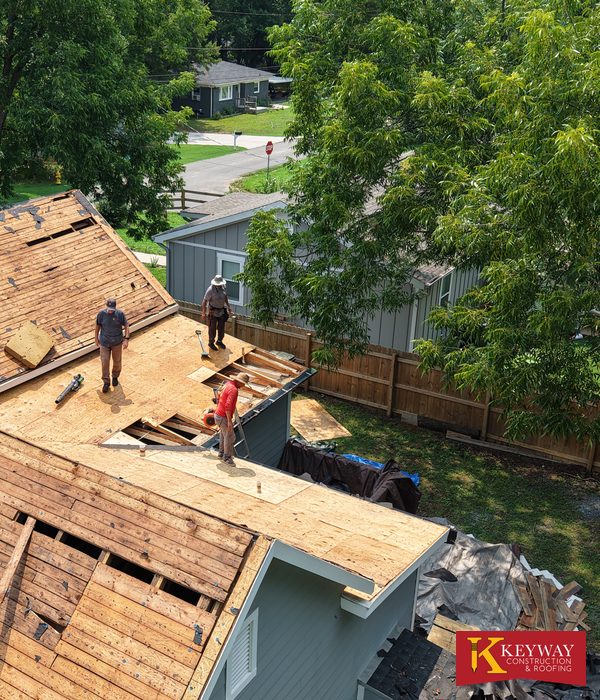
A tear-off means the existing roofing is removed down to the decking before new material is installed. An overlay means new shingles are installed directly over the existing layer.
North Carolina allows up to two layers of asphalt shingles on a structure. If your home already has two layers, tear-off is required by code – there is no option. If you have one layer, an overlay is technically permissible, but we rarely recommend it. Here is why:
- An overlay traps heat between the layers, accelerating the aging of the new shingles from below
- Overlays prevent proper inspection of the decking – if there is any rot or damage underneath, it stays hidden and continues to spread
- Most manufacturer warranties require proper installation over clean decking – an overlay can void the warranty
- When it eventually needs replacement, a double-layer tear-off costs more than a single-layer one
The up-front savings of an overlay are real. But for a roof that is meant to last 25 or more years in Charlotte’s climate, starting on a clean deck with a proper warranty is almost always the better investment. We explain our recommendation either way during the estimate so you can make an informed decision.
Factor 5: Decking Condition
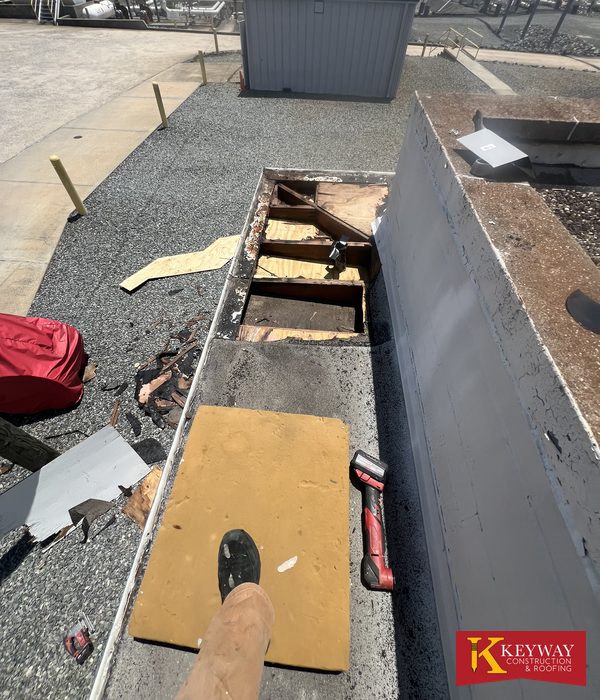
The roof deck – the plywood or OSB sheathing below the shingles – is not always visible until tear-off is complete. On most Charlotte homes, the decking is fine. But on homes where a roof leak has been present for any length of time, or where moisture has been entering through failed flashing or poor ventilation, sections of the decking will be soft and compromised.
Decking replacement is measured and priced per sheet. When we encounter damaged decking during a tear-off, we stop and show you before proceeding. You see exactly what was found, how much needs to be replaced, and the impact on the total cost before we continue. This is never a surprise charge at the end of the job.
As a licensed general contractor, Keyway handles decking replacement as part of the roofing scope – not as a separate subcontract. See our roof repair services page for detail on structural repairs that fall within our scope.
Factor 6: Ventilation
Proper attic ventilation is one of the most overlooked factors in Charlotte roof longevity, and it directly affects your replacement cost if the existing system is inadequate. A balanced ventilation system needs both intake (typically at the soffits) and exhaust (at the ridge). When intake and exhaust are mismatched, hot attic air creates a heat buildup that cooks the shingles from below – cutting their rated lifespan significantly and voiding most manufacturer warranties.
During every replacement estimate, we assess the existing ventilation and let you know whether adjustments are needed. Adding or repositioning ridge vents, installing baffles, or correcting blocked soffit intake are all within scope for a full replacement project. Our attic insulation page covers how insulation and ventilation work together for long-term roof performance.
Factor 7: Additional Components
A proper roof replacement includes components beyond shingles that are necessary for long-term performance but contribute to the total cost:
- Underlayment – the secondary water barrier between shingles and decking. Synthetic underlayment outperforms traditional felt in Charlotte’s heat and UV exposure.
- Ice and water barrier – a self-adhering membrane installed at eaves, valleys, and around penetrations. Required in this climate for proper leak protection at the most vulnerable locations.
- Drip edge – metal trim at the roof’s edges that directs water off the fascia and into the gutter. A critical component that is frequently omitted on lower-cost installations.
- Flashing – step flashing at chimneys and dormers, counter flashing at masonry, valley flashing, and pipe boot replacement. Every penetration and transition needs properly installed flashing.
- Ridge cap shingles – the capping layer at the ridge line. Hip and ridge caps are exposed to the most wind stress on any roof and need to be properly nailed and sealed.
- Permits – Charlotte requires permits for roof replacement. Permit fees are typically included in contractor estimates but verify that explicitly before signing anything.
- Disposal and cleanup – debris removal and dumpster fees are a real cost. Verify whether your estimate includes full cleanup and haul-off.
A low estimate that omits any of these components is not a better deal – it is a different scope of work that will cost more to correct later. When you review any estimate for a Charlotte roof replacement, check that all of these are itemized.
Factor 8: Timing and Demand
Charlotte’s roofing market peaks in spring and fall – the most pleasant weather for installation crews and the period following peak storm seasons. After a major hail or wind event, every quality contractor in the market gets backlogged. Homeowners who call two days after a storm are getting in line behind others who called the day before.
If your roof is approaching end of life but has not yet failed, scheduling a replacement during late winter or mid-summer – the lower-demand windows – can sometimes improve scheduling access and estimate competitiveness. This does not apply when you have active damage that needs immediate attention.
What Separates a Fair Estimate from a Low-Ball Quote
The single most important thing to understand about roofing estimates in Charlotte is that a lower number on paper is not always a better deal. Here is what a quality written estimate from a licensed contractor should include:
- Specific material: manufacturer, product line, color – not just “architectural shingles”
- Underlayment type specified – synthetic vs. felt, weight or brand
- Ice and water barrier locations called out
- Flashing scope – what is being replaced vs. reused
- Tear-off included with disposal fees
- Permit included or homeowner responsibility clearly stated
- Decking: either a per-sheet unit price for any found damage, or a statement that it is included
- Warranty: both manufacturer product warranty and contractor workmanship warranty terms clearly stated
- NC contractor license number on the document
Keyway provides written estimates with all of these elements. We are a licensed general contractor with over 50 years in the Charlotte market. We do not subcontract work to unlicensed crews, and our 1-year workmanship warranty covers all labor and installation for 365 days after completion. If anything related to our installation develops a problem, we return and fix it at no charge.
Storm Damage and Insurance – A Factor That Changes the Math
A significant portion of roof replacements in Charlotte each year are insurance-covered events – hail, wind, and storm damage that qualifies under standard homeowner’s policies. If your roof has been through significant storm activity in the past two years and you haven’t had a professional inspection, there is a real chance your replacement cost may be substantially or fully covered by insurance, minus your deductible.
We inspect, photograph, and document storm damage before any work begins. We can meet with your insurance adjuster on-site to walk through what we found. Our guidance on navigating this process is covered in detail on our roof insurance claim guide. If a claim turns out to be warranted, it can change the financial picture of a replacement significantly.
Getting Your Charlotte Roof Estimate Right
The right number for your roof is the number that comes from an inspector standing on your property, measuring your actual surface, assessing your decking condition, evaluating your ventilation, and understanding what your specific home needs. There is no substitute for that inspection, and any contractor who gives you a firm price without seeing your roof is quoting something they cannot stand behind.
Keyway Construction provides free next-day roof replacement estimates across Charlotte, Matthews, Ballantyne, Mint Hill, Monroe, Indian Trail, Waxhaw, and the full greater metro. We show up, tell you what we found, explain every line of the estimate, and let you make the decision on your own timeline. No pressure, no obligation.
Call 704-847-7119 or schedule your free estimate online.
Related reading: Roof repair vs. replacement – how to decide | How long does a roof last in Charlotte, NC? | Residential roofing services | Roof repair services | Roof insurance claim guide
Frequently Asked Questions – New Roof Cost in Charlotte, NC
Does Keyway give free estimates for roof replacement in Charlotte?
Yes. We provide free next-day roof replacement estimates across the entire Charlotte metro – Charlotte, Matthews, Ballantyne, Mint Hill, Monroe, Waxhaw, Indian Trail, Weddington, and surrounding communities. The estimate is written, itemized, and covers every component of the scope. There is no obligation and no pressure to proceed. Call 704-847-7119 or request yours online.
What is the difference between architectural shingles and 3-tab shingles for Charlotte homes?
Three-tab shingles are flat, single-layer shingles with a uniform appearance and a 15 to 20 year lifespan in Charlotte’s climate. Architectural shingles (also called dimensional shingles) are thicker, have a layered appearance that adds visual texture, carry stronger wind resistance ratings, and typically last 22 to 28 years. For most Charlotte homes being replaced today, architectural is the standard – the additional cost over 3-tab is modest relative to the lifespan and performance difference. As an Owens Corning contractor, we install their Duration and TruDefinition lines which are well-suited to this climate.
Can my roof replacement be covered by insurance?
Possibly, yes. Homeowner’s insurance typically covers roof damage from sudden events – hail, wind, falling trees. It does not cover normal wear and age. Charlotte and Union County have experienced significant storm activity in recent years, and many homeowners have valid damage they haven’t had inspected. We photograph and document all storm-related damage before any work begins and can meet with your insurance adjuster on-site. See our roof insurance claim guide for the full process.
Should I get an overlay or a full tear-off for my Charlotte roof replacement?
In almost all cases, we recommend a full tear-off. An overlay saves money up-front but traps heat between layers, accelerates shingle aging, prevents proper decking inspection, and can void manufacturer warranties. If your home already has two shingle layers, tear-off is required by NC code regardless. A tear-off also gives us the chance to inspect and repair any decking damage before the new roof goes on – which is the only time that work can be done properly.
How long does a roof replacement take on a Charlotte home?
Most residential roof replacements in the Charlotte metro are completed in one to two days for standard homes. Larger homes, complex roof geometry, or projects requiring significant decking repair may take two to three days. We arrive with all materials on day one and do not leave a job open overnight without securing the exposed area properly. Weather delays do occur – we communicate proactively if the schedule needs to shift.
Related Roofing Resources
Services: roof replacement, roof repair in Charlotte, and metal roofing.
More guides: signs you need a new roof, roof repair vs replacement, and does a new roof increase home value.
Recent Posts

Protect Your Gutters With Gutter Caps
Eliminate tedious maintenance tasks and unsightly clogs with time-saving gutter guards.See For Yourself
View Our Gallery of Projects
Proudly Serving
Matthews | Stallings | Mint Hill | Indian Trail | Weddington
Waxhaw | Monroe | Ballantyne | South Park | Arboretum |
Myers Park | Pineville | Fort Mill
Matthews | Stallings | Mint Hill | Indian Trail | Weddington
Waxhaw | Monroe | Ballantyne | South Park | Arboretum |
Myers Park | Pineville | Fort Mill