

Commercial Roof Maintenance and Leak Plan for Charlotte Property Managers
Quick answer
Put your commercial roof on a fixed rhythm: a walk in spring, a walk in fall, and a check within a day or two of every serious storm. Log photos, drain condition and ponding every time, because that file drives your repair-or-replace call and your reserve budget. When a leak gets reported, protect the space first, photograph it, then get a roofer up there before the next rain. Repair when the failure is local, restore when the membrane is sound but tired, replace when wet insulation or repeat failures keep spreading.
Most commercial roof problems in Charlotte don’t start as emergencies. They start as a clogged scupper in October, a seam that lifted after a July thunderstorm, a bead of sealant somebody smeared on a flashing three summers ago. Then a tenant calls about a wet ceiling tile and suddenly it’s a Thursday afternoon problem.
This is the playbook we’d hand a property manager or an owner-occupant who wants to stay ahead of that call. It covers when to inspect, what to write down, how to choose between a repair, a coating and a replacement, and exactly what to do the day a leak gets reported. If you want the full service side, our commercial roofing services page lays out what we do across the metro.
How often should a commercial roof be inspected in Charlotte?
Twice a year, plus after any storm that could have moved or punctured something. That’s the minimum most roof consultants, insurers and manufacturers point to, and it fits our weather. Spring and fall bracket the seasons that do the damage.
Here’s how the three triggers differ in practice.
| Trigger | What you’re really looking for | Charlotte reason |
|---|---|---|
| Spring walk | Seams, flashing and sealant that moved over winter; drains and scuppers choked with pollen and old leaves | Thunderstorm season is coming and you want drains open before the first big downpour |
| Fall walk | What summer heat did to membrane and coping; leaf load in every drain and gutter | Tree canopy drops fast in October and November, and a blocked drain going into winter is an easy way to get ponding |
| After a storm | Punctures, lifted edges, displaced coping, debris, hail marks, anything an equipment tech might have dragged across the roof | Hail and straight line wind can come through on a spring or summer afternoon and leave no sign from the parking lot |
Add a fourth trigger: any time a trade has been on the roof. HVAC techs, cell and solar crews, satellite installers. They’re the most common source of punctures we hear about, and nobody reports them. If your lease lets tenants send vendors up there, put a sign-in log at the roof hatch.
A written plan makes all of this routine. Our maintenance plan page explains how a scheduled spring and fall visit with photo reporting works. Whether you hire it out or run it in-house, the cadence above is the part that matters.
What should you check within 48 hours of a hard storm?
Start from the inside. Walk the top floor and the spaces under any known weak spots before you send anyone up a ladder. Fresh staining, a damp tile, a musty corner, anything a tenant mentions in the first day.
Then the roof, as soon as it’s dry and safe. Two rules. Don’t send staff up in wind or lightning, and don’t let anyone near the edge without proper fall protection. OSHA’s fall protection rule starts at 6 feet above a lower level, and a flat roof edge counts. If you don’t have anchors and a trained person, hire it out.
Once someone’s up there, this is the short list:
- Standing water in places it wasn’t before, or water still sitting 48 hours after the rain stopped.
- Drains, scuppers and overflows: open, or packed with debris that washed in.
- Perimeter edge metal and coping: lifted, bent, or missing fasteners. Wind gets under edges first.
- Membrane surface: punctures, scuffs, split seams, bubbles, torn flashing at walls and curbs.
- Rooftop units and curbs: loose panels, dislodged conduit, fresh scrape marks.
Hail is the one that fools people. Bruising and fractures in the membrane can sit over wet insulation without a visible hole. After a significant hail event, ask your roofer whether test cuts or moisture scanning make sense before you decide nothing happened. Photograph everything with a date, a location note and something for scale. You want that record before the claim conversation, not after it.
What belongs in a roof log for reserve planning?
One file per building, kept the same way every time. Reserve studies and capital requests fall apart when the roof history lives in three people’s inboxes. Here’s what we’d want in the folder if we were handed your building tomorrow.
- Roof ID sheet. System type (TPO, EPDM, modified bitumen, built-up, metal), install year, rough square footage, deck type, and whether there’s a manufacturer warranty and when it ends.
- A simple roof map. A sketch with drains, scuppers, units, penetrations and every area that’s ever leaked, numbered so photos can reference them.
- Every inspection, dated. Who walked it, what they found, what they photographed. Same angle, same spot, season to season.
- Drain and ponding notes. Which drains were clogged, which puddles lingered and for how long after rain.
- Repair history. Where, what was done, who did it, what material they used. Compatible materials matter, since mixing the wrong sealants on a single-ply roof can cause trouble later.
- Leak reports. Date, room, ceiling tile location, weather at the time, and what the fix was. Three reports in one area is a pattern. You’ll only see the pattern if someone wrote it down.
- Roof access log. Who went up, when, why. Manufacturer warranties commonly require approved contractors and documented maintenance, and unrecorded access is a common way to lose that coverage.
Do this for two or three years and your reserve number stops being a guess. You’ll know how many repairs per year the roof is eating, whether those are creeping up, and how many years of service you can reasonably budget for. That’s the information a board or an owner actually needs to approve money.
How do you decide between repair, coating and replacement?
Ask three questions in order: how much of the roof has failed, is the insulation underneath dry, and how many years do you need out of it. Price comes later. Roofers disagree on neat percentage cutoffs (you’ll see 25% and 30% quoted as rules of thumb), so treat those as conversation starters, not verdicts.
Repair fits a local failure
One open seam, a failed pipe boot, a drain sump that never sealed right, a section of coping. The membrane around it is sound and the insulation is dry. Repair, log it, move on. Repeat leaks in the same spot are the warning sign. If you’ve patched that spot twice, the problem is probably somewhere else.
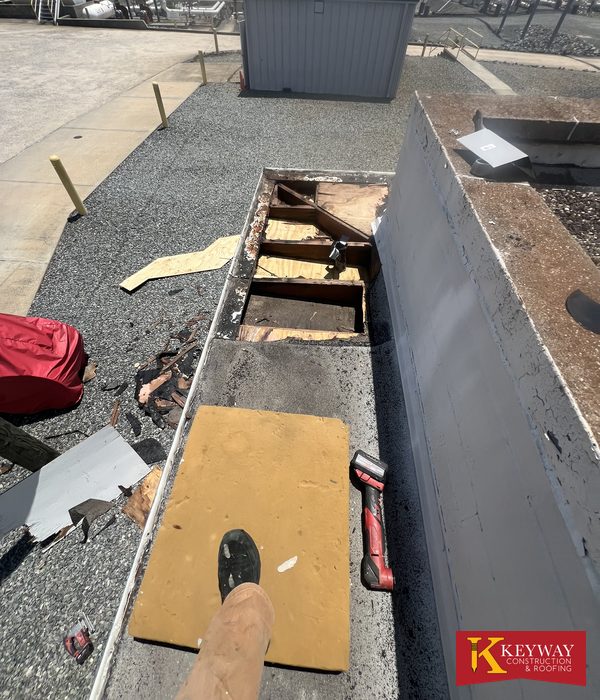
That “somewhere else” is common on flat roofs, because water travels. Our commercial parapet wall repair write-up is a good example. A Charlotte area building had water getting into the parapet wall, not through the roof field, and surface patching wasn’t going to stop it. The crew cut the wall open, took out the rotted wood, rebuilt it with new sheathing and rewrapped the parapet in new membrane. The page says that if it had been caught early it might have been a coping and flashing repair. That’s the cost of waiting, in one job.
A coating (restoration) fits a tired but sound roof
If the membrane is intact, the insulation tests dry, and you’re after more years instead of a new roof, a restoration coating can make sense on some roof types. It depends on the system, how clean it can be made, and how well seams and flashing can be repaired first. A coating over wet insulation just hides the problem. It also doesn’t rebuild thickness on a badly worn bitumen roof, so ask whoever proposes it how they’ll verify what’s underneath.
Replacement fits widespread or wet failure
- Insulation is saturated across more than a patch.
- Leaks have turned up in several areas, not one.
- The deck is damaged or corroded.
- The roof is past its designed life and repair bills are climbing year over year.
Your log is what makes the call defensible. Our page on commercial roof replacement covers how a full replacement runs, and the TPO, EPDM and modified bitumen comparison helps you think about what to put back. For buildings with active leaks right now, commercial roof leak repair is where to start.
Low slope doesn’t only mean commercial. Our Monroe low slope re-roof was a house, but it shows a detail that applies to your building as well: the spot where a low slope section meets a steeper roof is where leaks usually start, so the membrane has to be tied in correctly there.
What do you do the day a tenant reports a leak?
Work the problem in this order, and write as you go. The first hour sets up everything that follows.
- Make the space safe. Move people, inventory and electronics out from under the leak. Put a bucket or a tarp where water is dripping, and ask facilities to shut off or cover any equipment in the wet area. If water is near electrical panels or lights, call an electrician and stay clear.
- Photograph and time-stamp it. Take wide and close photos of the ceiling, the floor and any wet equipment. Note the room, the ceiling tile location, the time you first noticed it, and what the weather was doing. That’s the start of your leak log entry.
- Check the roof only if it’s safe. If it’s still raining or the wind’s up, stay off the roof. Look from the ground for open hatches, missing panels or downed branches. Never send anyone to the edge without fall protection.
- Call your roofer and say it’s an active leak. Give them the building address, the room where it shows up, roof type if you know it, and any recent repairs. An active leak above occupied space should get a same-day temporary dry-in conversation.
- Check drains and the obvious from inside and out. Have a trained person clear clogged drains and scuppers if it’s safe. Open any ceiling tile next to the stain to look for water sitting on the insulation or running along a pipe.
- Walk the roof with the contractor and mark the source. Water often enters nowhere near the stain. Ask for photos of the entry point, the condition of the insulation around it, and whether the repair is temporary or permanent.
- Log it, notify, and set the follow-up. Finish the log entry with the cause, the fix and the materials used. Tell your insurer or warranty holder if the damage may be covered, and schedule a re-check after the next significant rain.
Two mistakes we see a lot. One: waiting for a “good day” to call because the leak stopped when the rain stopped. It’ll be back. Two: asking a handyman to caulk the stain’s high point on the roof. Sealant doesn’t move with a flat roof, and it can hide the real entry point.
Who do you call, and in what order?
Keep this list taped inside the facilities binder, not in someone’s head.
- Your on-site or facilities lead. They protect people and equipment and start the log.
- Your roofer. Active leak, temporary dry-in, source tracing. If your roof is under a manufacturer warranty, check whether repairs must go through an approved contractor before you call.
- Electrician or HVAC vendor if water reached equipment or lighting.
- Insurer if the event looks storm related or the damage reaches the building interior. Ask what documentation they want before the repair, since you may need to preserve evidence.
- Warranty holder if there’s one in force. Many have notice windows, so read yours before you need it.
- Tenants (briefly, with a clear time frame for when the area will be reopened).
We’re based at 740 Stallings Road in Matthews, and we do free next day estimates. We also stand behind our work with a 1 year workmanship warranty.
Does the plan change by town or building type?
The cadence doesn’t, but the debris and exposure do. A flat-roof retail strip with mature oaks nearby will clog drains faster than a new office pad in an open lot. Older low slope additions and mixed roofs (pitched sections meeting flat ones) leak at the joins.
If your properties are in the southeast and south of the metro, we have pages on commercial roofing in Monroe and Weddington. For buildings closer to the city, see Pineville or SouthPark.
Commercial roof maintenance and leak questions
How often should a commercial roof be inspected?
At least twice a year, in spring and fall, plus after any major storm or after contractors work on the roof. Some manufacturer warranties require the twice-yearly visits and written records, so check yours.
What should a property manager log about a commercial roof?
Keep the roof type and install year, a roof map, dated inspection photos, drain and ponding notes, repair history with materials used, every leak report, and a roof access log. That file supports reserve planning, insurance claims and warranty claims.
What do I do first when a tenant reports a roof leak?
Make the space safe, photograph the damage, and call a roofer as soon as you can. Move people and equipment away from the water, put a bucket or tarp under the drip, and don’t send anyone to the roof edge without fall protection.
When is a coating better than a replacement?
A coating can make sense when the membrane is intact, the insulation is dry, and you want more years from the roof without a full tear-off. It’s the wrong choice over wet insulation or widespread damage, and it can affect your warranty, so confirm that first.
How much of a roof has to be damaged before replacement makes sense?
There’s no single number. Industry sources float figures like 25% to 30% as rules of thumb, but wet insulation, damaged decking, repeat leaks and the roof’s age matter just as much. A roofer who has seen your roof can give you a better answer than a percentage.
Why does my commercial roof leak in the same spot after repairs?
Because the water usually enters somewhere else and travels. On flat roofs, the entry point can be a parapet, a seam or a flashing some distance from the stain. If a patch hasn’t held, ask for the source to be traced and documented.
Should we walk the roof ourselves after a storm?
Only if conditions are safe and you have proper fall protection. Check inside the building first, and look at the roof from the ground. If you can’t do it safely, hire a roofer to walk it and send photos.
Does a commercial roof inspection with Keyway cost anything?
We do free next day estimates. Call 704-847-7119 and tell us the building address, the roof type if you know it, and whether you’re dealing with an active leak.
Want a second set of eyes on your roof? Call 704-847-7119 and we’ll set up a free next day estimate.
Recent Posts

Protect Your Gutters With Gutter Caps
Eliminate tedious maintenance tasks and unsightly clogs with time-saving gutter guards.See For Yourself
View Our Gallery of Projects
Proudly Serving
Matthews | Stallings | Mint Hill | Indian Trail | Weddington
Waxhaw | Monroe | Ballantyne | South Park | Arboretum |
Myers Park | Pineville | Fort Mill
Matthews | Stallings | Mint Hill | Indian Trail | Weddington
Waxhaw | Monroe | Ballantyne | South Park | Arboretum |
Myers Park | Pineville | Fort Mill