

10 Signs You Need a New Roof in Charlotte, NC (Not Just Repairs) – 2026
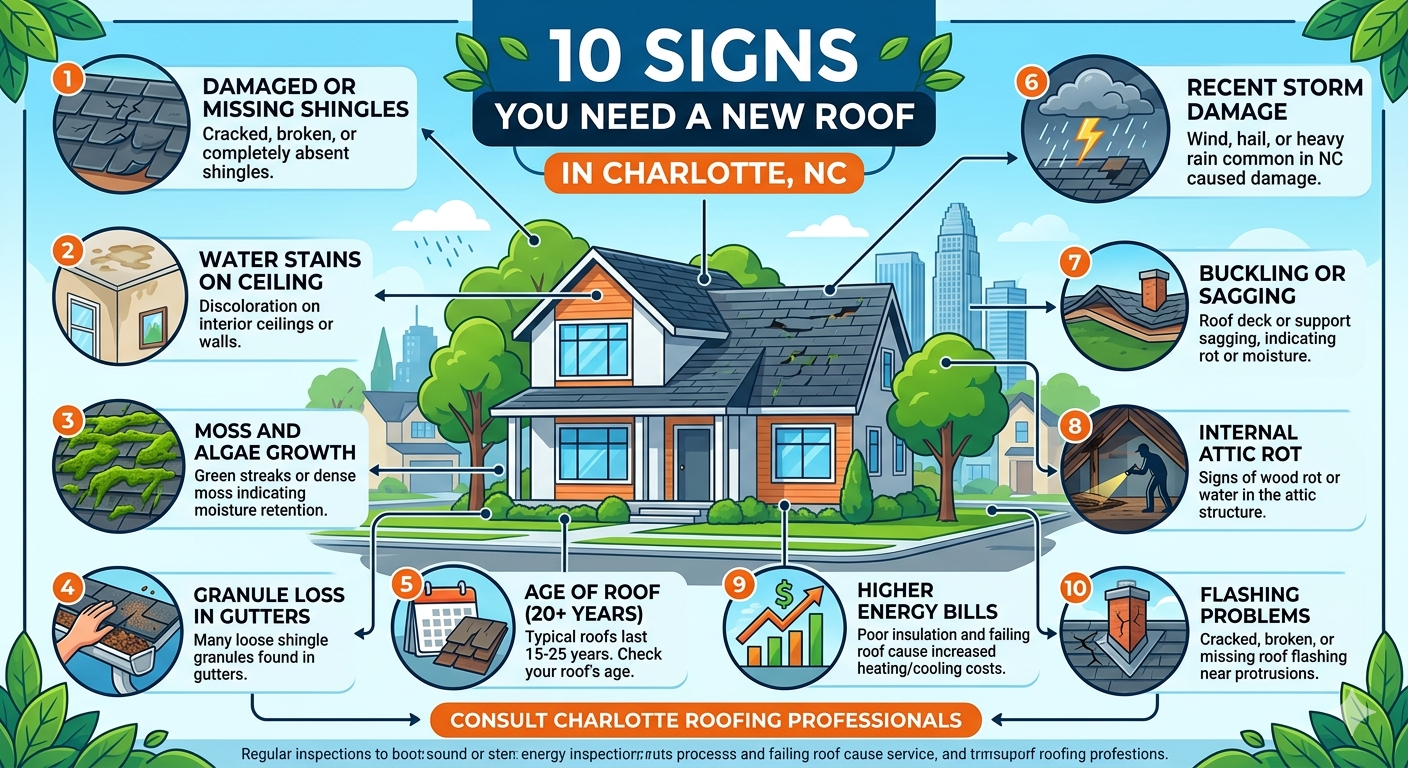
Not sure where your roof stands? Get a free roof inspection.
A drip from the ceiling is not the first sign your roof is failing. By the time water appears inside your Charlotte home, the roof has usually been giving signals for months – signals that are easy to miss if you do not know what to look for. The homeowners who catch the problem early pay for a controlled replacement on their own timeline. The ones who miss the signals pay for emergency work, water damage remediation, and a replacement under pressure.
Keyway Construction has been inspecting and replacing roofs across Charlotte, Matthews, Ballantyne, Monroe, Waxhaw, and the full greater metro for over 50 years. This guide covers the 10 specific signs that tell you a roof has moved past the repair window and into replacement territory – and what each one means for your timeline and next step.
Call 704-847-7119 or schedule a free roof inspection online.
Why “Repair vs. Replace” Is the Real Question
Not every roof problem means replacement. A failed pipe boot seal on a 10-year-old roof in otherwise good condition is a repair. A few missing shingles after a wind event on a sound system is a repair. Our full breakdown on roof repair vs. replacement in Charlotte covers the decision framework in detail.
The signs in this guide are specifically the ones that indicate a roof has moved past the point where repair is the right answer. Each one on its own might still lead to a repair conversation – but when you see two or three together, the math shifts toward replacement every time.
Sign 1: Your Roof Is 20 Years Old or Older
This is the most reliable single indicator, and it is also the one most homeowners underestimate. Standard three-tab asphalt shingles in Charlotte’s climate last 15 to 20 years. Architectural shingles last 22 to 28 years. After these windows, you are not managing a roof – you are managing a countdown.
Charlotte’s combination of summer heat, sustained humidity, annual storm activity, and UV exposure means shingles here age faster than rated lifespans that were developed for more temperate climates. A 20-year-old architectural shingle roof in Charlotte has used approximately 80 percent of its useful life, and the remaining 20 percent is the period when failures become unpredictable rather than projected.
If you do not know your roof’s age, your home’s closing documents or the seller’s disclosure from your purchase should have the installation date. If not, a professional inspection can estimate the age from the shingle condition, granule density, and flexibility of the mat.
Sign 2: Granules Filling Your Gutters
Asphalt shingles are coated with granules – small mineral particles that protect the asphalt mat from UV radiation and give the shingle its color and fire resistance. As shingles age, the adhesive bond that holds granules to the mat weakens. Granules shed first in high-stress areas: south-facing slopes with maximum UV exposure, areas hit by hail, and edges where water concentrates during heavy rain.
The diagnostic tool is your gutters. Pull the downspout strainer or check the gutter channel after a moderate rain. A small amount of granule deposit is normal throughout a roof’s life. Heavy granule accumulation – enough to visibly fill a section of gutter channel – indicates the shingles are in active granule loss phase. Once the mat is exposed, UV degradation accelerates dramatically. The remaining service life compresses quickly from this point.
After significant hail events across Charlotte and Union County, granule loss accelerates sharply. Hail knocks granules loose from impact points across the entire shingle field. The damage may not be visible from the ground, but the accelerated aging is real. Our post on Charlotte hail events 2020-2026 covers the storm history that has affected local roofing systems over the past several years.
Sign 3: Shingles That Are Curling, Cupping, or Cracking
Healthy asphalt shingles lie flat against the roof surface. When they begin to fail, the edges lift (curling), the center sags and the edges rise (cupping), or the mat surface develops visible cracks. Any of these is a physical sign that the asphalt has dried out and lost its flexibility.
In Charlotte’s climate, thermal cycling – the daily and seasonal expansion and contraction of the roof surface – is particularly aggressive. Summer attic temperatures regularly exceed 130°F, and the temperature differential between a hot summer day and a winter night can exceed 100°F over the course of a season. Asphalt that has lost its oil content from years of this cycling cannot flex through these changes without cracking.
Curling and cracking shingles on a significant portion of the roof surface indicate system-wide failure of the asphalt. Replacing shingles in isolated areas while the rest of the field continues to fail is the definition of the “repair trap” – you spend on multiple repair visits and end up replacing the roof anyway within a few years, having paid both the repairs and the replacement.
Sign 4: Multiple Leaks in Different Locations
A single roof leak usually has a specific, identifiable source – a failed pipe boot, lifted flashing, a missing shingle over a valley. That is a repair. Multiple leaks appearing in different areas of the home – especially over a period of months or years – indicate that the roof system is failing across multiple points simultaneously. Each new leak is a new failure in a system that is no longer holding.
The pattern here matters. One leak repaired, then two more appearing within a year, then another – that is not bad luck. That is a roof telling you that targeted repair is no longer addressing the underlying problem, which is a system that has reached the end of its effective service life.
Sign 5: Daylight Through the Attic Boards
This is one of the clearest indicators that a roof has serious structural issues. On a clear day, go into your attic and give your eyes a minute to adjust. Look up at the sheathing and rafters. You should see consistent darkness. If you can see pinpoints or streaks of daylight coming through, the gaps that let that light in will let water in during the next rain event.
Daylight in an attic can indicate missing or cracked shingles, failed underlayment, gaps at roof penetrations, or compromised decking. Regardless of the specific cause, it is a condition that needs immediate professional inspection. Any of these underlying causes at the point where daylight is visible means the repair scope is significant.
Sign 6: Sagging Sections of the Roof
A healthy roof surface follows consistent lines – ridges are straight, slopes are flat, valleys are even. Visible sagging or depression in any section of the roof indicates compromised structural support: damaged or rotted rafters, deteriorated decking, or structural failure from long-term moisture damage.
Sagging is always a serious finding that warrants immediate inspection. It is not a cosmetic issue – a sagging roof section is a structural section that has lost load-bearing capacity. Depending on the extent and cause, the repair may range from targeted rafter sister work to full structural replacement of the affected section.
As a licensed general contractor, Keyway handles the structural carpentry work alongside the roofing in these situations. Most roofing-only companies are not licensed to perform the structural repair component. Our carpentry and wood rot repair page covers the structural scope that often underlies roof sagging.
Sign 7: Moss, Algae, or Lichen on the Roof Surface
Dark streaking from algae (Gloeocapsa magma) is common on Charlotte roofs – it is largely cosmetic and can often be addressed with proper cleaning and algae-resistant shingle upgrades. Moss and lichen are more serious concerns.
Moss grows in the granule layer and works its way under shingle edges with its root system. As moss dries and then rehydrates, it physically lifts shingles from the surface – creating entry points for water and breaking the seal bond between adjacent shingles. In Charlotte’s shaded neighborhoods with mature tree cover, moss can become established within a few years on north-facing slopes and advance quickly.
Lichen is harder to remove than moss and more damaging. Its root system bonds directly to the asphalt mat and removing it aggressively can pull the granule layer with it. On a roof that is already age-appropriate for replacement, moss or lichen coverage is one more sign that pushing through another cycle of repair and treatment is the wrong economic decision.
Sign 8: The Flashing Has Failed Repeatedly
Flashing is the metal system that seals the transitions between the roof surface and vertical surfaces – chimneys, dormers, skylights, walls. On Charlotte homes built between 1970 and 2000, original step flashing is now well past its typical service life. Aluminum and galvanized steel flashing corrodes in this climate, sealant at joints fails, and the metal itself can develop pinholes and cracks.
When flashing has been repaired or resealed multiple times and continues to leak, the issue is often not the sealant application but the flashing material itself. Aged flashing metal that is corroded or cracked cannot hold a sealant bond permanently – each repair lasts one or two seasons before the same entry point reopens. If your roof has had the same flashing location repaired more than twice, the flashing needs replacement, and if the roof itself is in the 20+ year range, the full replacement conversation is warranted.
Our roof repair services page covers flashing scope in detail for situations where the roof itself is still worth keeping.
Sign 9: Your Energy Bills Have Increased Without an Obvious Cause
A roof that has lost its thermal performance makes your HVAC system work harder. Several failure modes contribute to this: significant granule loss reduces the shingle’s solar reflectivity, causing more heat absorption through the roof surface; compromised attic ventilation from failed ridge vents or blocked soffit intake lets heat build up in the attic; and gaps in the roof system allow conditioned air to escape through the attic.
This sign is harder to identify precisely because energy bill increases have many possible causes. But if you have noticed meaningfully higher summer cooling costs that coincide with a roof that is aging, a professional inspection of the roof and attic ventilation together is worth having. Poor attic ventilation alone can cut shingle life significantly in Charlotte’s summer heat, and the interaction between a failing roof and an overheated attic is a cycle that accelerates both problems.
Our attic insulation page covers how insulation and ventilation work together with your roof system for thermal performance.
Sign 10: You Are Approaching or Past the Manufacturer’s Warranty Period
Manufacturer warranties on asphalt shingles are often misunderstood. A “30-year shingle” carries a prorated warranty – the full coverage applies only in the first years, and the coverage amount decreases each year after that on a sliding scale. By year 20, the prorated warranty value is typically a fraction of replacement cost. By year 25 to 30, it may be nominal.
The practical implication: if your architectural shingle roof is approaching year 25, the warranty protection you have remaining is minimal regardless of what the product label says. You are essentially self-insuring the roof. In that context, a controlled replacement now – on your schedule, with your choice of contractor, before any failure event drives urgency – is almost always more economical than a reactive replacement in year 27 after an active leak has caused interior damage.
What to Do When You See These Signs
The right first step is always a professional inspection by a licensed NC contractor – not a door-knock estimate from a contractor working a neighborhood after a storm, and not a ground-level self-assessment. A proper inspection involves a trained technician on the roof surface, documenting condition at every section, and providing you with a written assessment that includes photos.
Keyway provides free, no-obligation roof inspections across the Charlotte metro. We tell you what we found, whether repair or replacement is the right call, and exactly why – with documentation you can use for an insurance claim if storm damage is a factor. We have been doing this work since 1975 and we are not going anywhere. Our recommendation is based on what your roof actually needs, not what generates the largest job.
Call 704-847-7119 or schedule your free Charlotte roof inspection online.
Frequently Asked Questions – Signs You Need a New Roof in Charlotte
How old is too old for a roof in Charlotte, NC?
Standard three-tab asphalt shingles typically reach end of life at 15 to 20 years in Charlotte’s climate. Quality architectural shingles generally last 22 to 28 years when properly installed and ventilated. Beyond these windows, you are in the period where failures become unpredictable rather than projected. If your roof is over 20 years old and has not been professionally inspected recently, schedule one – it will tell you definitively where your roof stands and how much runway you have before replacement becomes urgent. We provide free inspections with no obligation. Call 704-847-7119.
Can I repair sections of my Charlotte roof instead of replacing the whole thing?
Sometimes, yes. If your roof is under 15 years old, the damage is limited to a specific section, and the surrounding shingles are in solid condition, targeted repair is often the right call. The decision shifts toward replacement when the roof is 20-plus years old, when multiple areas are showing signs of failure simultaneously, when repair costs are approaching 40 percent of replacement cost, or when the underlying shingle field is granule-depleted or brittle across most of its surface. Our repair vs. replacement guide covers the full decision framework.
How long does a roof inspection take and what does it cover?
A thorough residential roof inspection typically takes 45 minutes to an hour and a half depending on the size and complexity of the home. Our inspections cover the full shingle field on all slopes, ridge and hip caps, all flashing locations (chimneys, skylights, vents, wall transitions), gutters and fascia, and an attic check from below for moisture, ventilation, and daylight gaps. You receive a written summary with photos of every finding – whether or not we find anything that needs attention. The inspection is free and there is no obligation.
What neighborhoods and areas does Keyway serve for roof inspection in Charlotte?
We provide free roof inspections across the full greater Charlotte metro, including Charlotte, Matthews, Ballantyne, Mint Hill, Monroe, Indian Trail, Waxhaw, Weddington, Cornelius, and surrounding Mecklenburg and Union County communities. We are headquartered in Matthews and serve most of our surrounding service area without a travel fee. Call 704-847-7119 or schedule online – we schedule inspections next-day in most cases.
Related reading: Roof repair vs. replacement – how to decide | How long does a roof last in Charlotte, NC? | New roof cost in Charlotte, NC | Roof insurance claim guide | Residential roofing services
Related Roofing Resources
Services: roof replacement, roof repair in Charlotte, and storm damage roof repair.
More guides: signs you need a new roof, what a new roof costs in Charlotte, and roof repair vs replacement.
Recent Posts

Protect Your Gutters With Gutter Caps
Eliminate tedious maintenance tasks and unsightly clogs with time-saving gutter guards.See For Yourself
View Our Gallery of Projects
Proudly Serving
Matthews | Stallings | Mint Hill | Indian Trail | Weddington
Waxhaw | Monroe | Ballantyne | South Park | Arboretum |
Myers Park | Pineville | Fort Mill
Matthews | Stallings | Mint Hill | Indian Trail | Weddington
Waxhaw | Monroe | Ballantyne | South Park | Arboretum |
Myers Park | Pineville | Fort Mill