

Parts of a Roof Explained | Charlotte NC Homeowner’s Guide | Keyway
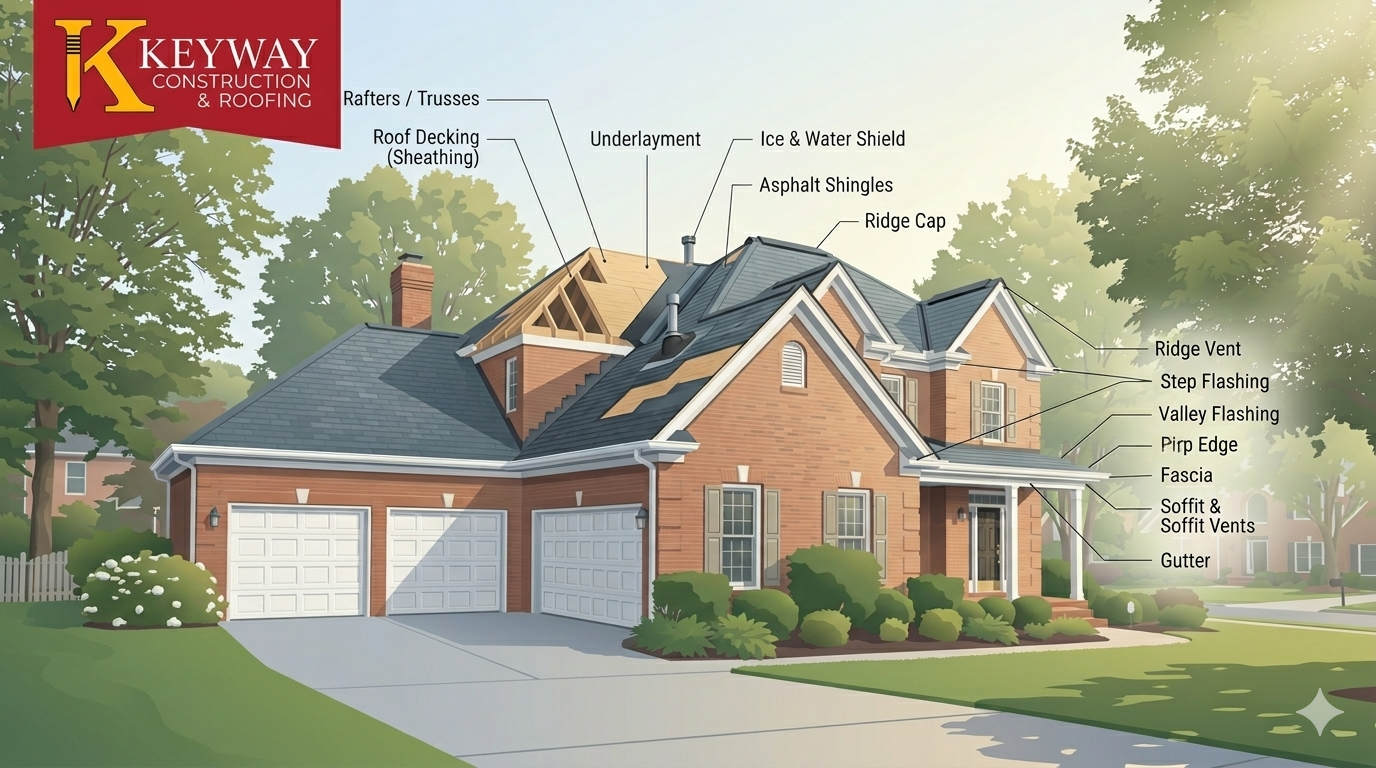
When a roofer tells you your step flashing has failed, your pipe boot is cracked, or your decking has taken on moisture, it helps to know what they are talking about. Not because you will be doing the repairs yourself, but because homeowners who understand basic roof anatomy make better decisions, ask better questions, and are far less likely to be misled by contractors who are counting on their clients not knowing the difference between underlayment and a vapor barrier. Keyway handles chimney flashing repair.
This guide covers every major part of a residential roof, what each component does, and how Charlotte’s specific climate affects its performance and lifespan. For each part, we have noted the most common failure pattern we see on Charlotte homes and what that failure means in practical terms. Where relevant, we have linked directly to the Keyway service pages that cover that specific repair or replacement scope.
The Four Layers of a Residential Roof
A residential roof is not a single surface. It is a layered system where each component performs a specific function, and where the failure of one component accelerates the deterioration of the others. Understanding it as a system rather than a single material is the first step to understanding why roofing estimates sometimes look the way they do.
The four main layers from the inside out are: the structural layer (rafters and decking), the protective layer (underlayment and ice-and-water shield), the weathering surface (shingles, metal panels, or membrane), and the trim and drainage system (flashing, fascia, soffit, gutters, and downspouts). Ventilation runs through all four layers and is often treated separately because its function affects every other component simultaneously.
Structural Parts of a Roof
Rafters and Roof Trusses
Rafters are the diagonal framing members that run from the ridge board at the peak of the roof down to the top plate of the exterior wall at the eaves. They define the slope and shape of the roof and carry the dead load of the roofing materials plus the live load of snow, wind, and occasionally workers. On homes built before the 1980s in Charlotte’s established neighborhoods, rafters were typically site-cut from solid dimensional lumber. On homes built after that era, prefabricated trusses replaced site-cut rafters on most residential construction because they are faster to install and require no structural engineering on-site.
Rafter tails are the section of the rafter that extends beyond the exterior wall to form the overhang. They are one of the most vulnerable structural components on Charlotte homes because they sit directly above the fascia and gutter, directly in the path of any water that the gutter fails to capture. When gutters overflow repeatedly, the water that runs down behind the gutter eventually saturates the end of the rafter tail. Once the wood is wet, decay follows. See our roof repair page for what rafter tail damage looks like and how it is addressed.
Roof Decking (Sheathing)
The roof deck is the structural platform attached to the rafters or trusses on which every other roofing component is installed. On most Charlotte homes built after 1980, the deck is oriented strand board (OSB). On older homes in neighborhoods like Myers Park, Dilworth, and Cotswold, it is often plywood, or in some cases, skip sheathing boards laid with gaps between them from the original construction era.
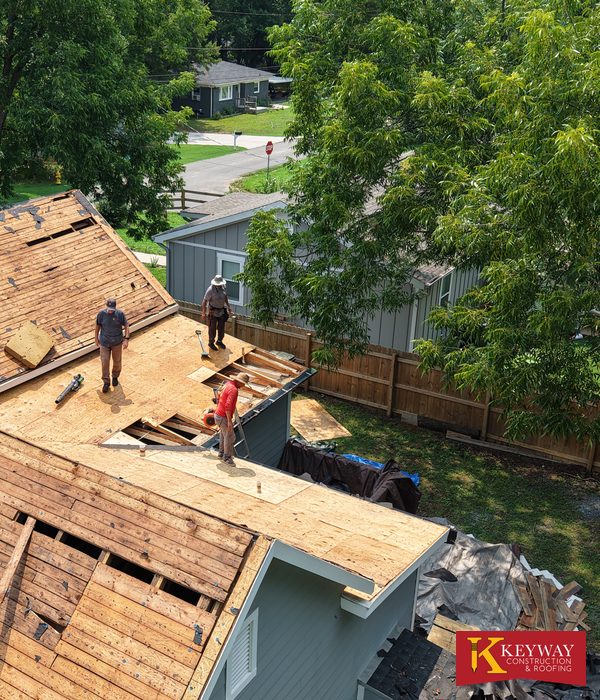
Decking condition is the most important variable in any roof replacement estimate, and it cannot be fully assessed until the existing shingles are removed. When Keyway tears off a roof, we inspect every deck board before new underlayment goes down. Soft spots, dark staining, and delamination are all signs of moisture infiltration. Any compromised section is replaced before the new roof system goes over it, because new shingles over wet or deteriorated decking will fail prematurely regardless of shingle quality.
Signs of decking problems on a Charlotte home:
- Roof surface feels spongy or flexible when walked on , sound decking is rigid
- Visible sagging or waves in the roofline when viewed from the street
- Interior ceiling stains that appeared gradually rather than immediately after a storm
- Attic inspection reveals dark staining, soft spots, or visible mold on the underside of the deck boards
- Age: Charlotte roofs from 1990-2005 with original OSB decking may have moisture infiltration from repeated hail or storm events
For a full explanation of what happens during a tear-off and why decking inspection matters, see our roof replacement page.
Protective Layer: Underlayment and Ice-and-Water Shield
Roofing Underlayment
Underlayment is the water-resistant membrane installed directly over the roof deck, beneath the shingles. It is the secondary line of defense if water finds a way past the shingle surface , through a cracked shingle, a lifted tab, or a failed flashing joint. On Charlotte homes, synthetic underlayment has largely replaced the felt paper (tar paper) that was standard through the 1990s. Synthetic underlayment is lighter, more tear-resistant, and more water-repellent than felt. It also holds up better in Charlotte’s UV environment during the period between deck installation and shingle installation when it is temporarily exposed.
A point worth understanding: underlayment is not a waterproof membrane. It is water-resistant. If water reaches the underlayment repeatedly , as it does when flashing fails , the underlayment will eventually fail too. This is why finding and fixing the water entry point is always the priority over simply replacing the visible surface material above it.
Ice and Water Shield
Ice and water shield is a self-adhering, fully waterproof membrane applied at the eaves, in valleys, and around all penetrations before the general underlayment goes down. In Charlotte’s climate, ice damming is less common than in northern markets, but the membrane serves an equally important function here: it provides a completely watertight seal at the most vulnerable points of the roof where conventional underlayment lapping is not sufficient. North Carolina building code requires ice and water shield at the eaves and in valleys on all residential roof replacements. When Keyway completes a full replacement, it goes in at every required location. When a budget contractor skips it to lower the estimate, the homeowner discovers the gap at the first heavy rain.
The Weathering Surface
Asphalt Shingles
Asphalt shingles are the most common roofing material across Charlotte’s residential market, and the variety most Charlotte homeowners encounter comes in two forms: three-tab shingles (flat, single-layer, common on pre-2000 homes) and architectural shingles (laminated, multi-layer, the current standard). Three-tab shingles have a lower wind rating and shorter service life than architectural products. We do not recommend replacing a failing three-tab system with another three-tab installation.
Architectural shingles deliver 22 to 28 years of reliable service in Charlotte’s climate when installed correctly over a well-ventilated attic. The same shingle installed over a poorly ventilated attic on the same street may show cracking and granule loss at 15 years. Charlotte’s attic temperature problem , where inadequate ventilation allows attics to reach 150-160 degrees in July , is the single biggest variable within the shingle lifespan range. See our residential roofing page for the full breakdown of shingle types, including Class 4 impact-resistant options that are increasingly popular in Union County’s documented hail corridor. See also our impact-resistant shingles guide for the cost-benefit analysis specific to Charlotte.
Ridge Cap Shingles
Ridge cap shingles are the specially formed shingles that cover the ridge line at the peak of the roof, where two slopes meet. They are thicker and more flexible than field shingles, designed to bend over the ridge without cracking. Ridge cap is one of the first places Charlotte homeowners see storm damage , high winds lift the caps and expose the ridge board beneath. A missing or damaged ridge cap is an active leak path every time it rains. It is also one of the least expensive repairs on a residential roof when caught quickly.
Metal Roofing
Standing seam metal roofing is increasingly common in Weddington, Ballantyne, and lake-front properties in Cornelius. A properly installed metal roof delivers 40 to 70 years in Charlotte’s climate, handles hail significantly better than any asphalt product, and sheds water and debris more effectively than shingles on steep-pitch rooflines. The tradeoffs are upfront cost and thermal expansion , metal expands and contracts more significantly than asphalt with Charlotte’s temperature swings, which requires specific fastening methods and joint design to handle correctly. See our metal roofing page for detail on standing seam, metal shingle, and corrugated panel systems.
Drainage Parts of a Roof
Roof Flashing
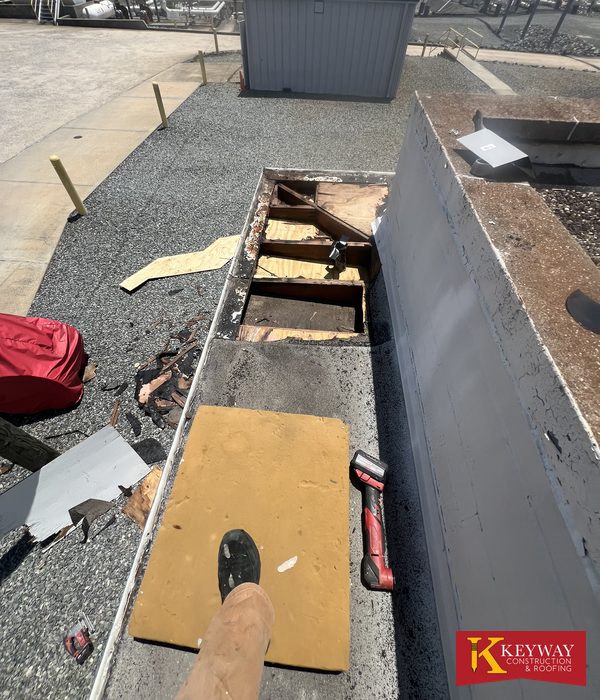
Flashing is the single most important maintenance item on a Charlotte residential roof, and it is the most common source of active leaks. Flashing is thin sheet metal , typically galvanized steel, aluminum, or copper on premium installations , installed at every location where a roof surface meets a vertical surface or changes direction. The purpose is to bridge the gap between two materials that expand and contract at different rates and seal the transition against water entry.
The main types of flashing on a Charlotte residential roof:
- Step flashing , L-shaped metal pieces installed in an overlapping sequence where a roof slope meets a vertical wall, such as a dormer, chimney base, or side wall. Step flashing is the most critical and most frequently failed flashing type on Charlotte homes.
- Counter flashing , the metal that overlaps step flashing at chimney bases, embedded into the mortar joint of the masonry and covering the top edge of the step flashing below. When the mortar fails, counter flashing separates from the chimney and allows water behind the entire assembly.
- Valley flashing , metal or modified bitumen installed in the valley where two roof planes intersect. Open metal valleys are more visible and allow debris to clear; closed-cut valleys use shingles cut tightly to a center line with flashing beneath.
- Pipe boot flashing , rubber or metal boots that seal around plumbing vent pipes where they penetrate the roof surface. Rubber pipe boots are the most common repair call Keyway receives , UV and thermal cycling crack the rubber collar within 10 to 15 years on most Charlotte roofs.
- Drip edge , L-shaped metal installed at the eave and rake edges of the roof that directs water off the shingles and into the gutter rather than behind it onto the fascia board. Drip edge is required by North Carolina building code on all new roof installations. Many Charlotte homes from pre-2005 construction do not have correctly installed drip edge, which is one reason fascia rot is so prevalent in older neighborhoods.
See our roof repair page for what a proper flashing repair involves and why caulk-only solutions on failed flashing are a temporary fix rather than a real repair.
Gutters
Gutters are technically a roof drainage component, and they belong in any complete discussion of roof anatomy because their failure has direct consequences for the roofing system above and the foundation below. Charlotte’s storm intensity , high-intensity summer thunderstorms delivering two to three inches of water per hour , means that a gutter system operating at reduced capacity from debris loading overflows rapidly and sends water behind the fascia board on every significant rain event. The Charlotte-specific factors that make gutter maintenance more demanding here than in most US markets are the year-round debris loading from loblolly pine, willow oak, and white oak canopy, the high-intensity rainfall pattern, and the clay soil that does not absorb overflow water quickly.
See our gutters hub page for the full breakdown of gutter systems, sizing, and materials for Charlotte homes, including our gutter guards page for the guard systems that perform reliably in Charlotte’s canopy environment. For downspout sizing and extension routing guidance, see our downspouts page.
Trim Parts of a Roof
Fascia Boards
The fascia is the vertical board that runs along the lower edge of the roof, directly behind the gutter. It closes the end of the rafters, provides a finished edge to the roofline, and serves as the structural mounting surface for the gutter hangers. On most Charlotte homes, fascia is painted pine or composite material. The most common fascia failure pattern in Charlotte is moisture-driven rot caused by gutter overflow: water that spills over the front of a clogged or mis-pitched gutter runs down the back face of the channel onto the top edge of the fascia, saturating the wood repeatedly until the paint fails from the back face first , invisible , and rot progresses through the board.
Once the fascia has softened enough that gutter hangers no longer hold firmly, the gutter pulls forward, which creates more overflow, which accelerates the rot further. By the time paint is visibly peeling on the front face of the fascia, the damage has usually been running for one to three seasons. See our fascia and soffit repair page for what assessment and repair looks like on Charlotte homes, and our wood rot repair hub for the broader context of rot-related carpentry work we handle alongside roofing.
Soffit
The soffit is the horizontal surface that covers the underside of the roof overhang , the area between the fascia (at the outer edge) and the exterior wall (at the inner edge). Soffits serve two functions: they give the roofline a finished appearance, and on most Charlotte homes they contain the ventilation intake for the attic. Perforated soffit panels allow outside air to enter the attic at the eaves, which then exits through the ridge vent at the peak in the balanced ventilation system that keeps attic temperatures from reaching destructive levels in Charlotte’s summers.
Soffit failure in Charlotte is almost always moisture-related , either from gutter overflow that reaches back to the soffit, from a roof leak that has been traveling along a rafter to the overhang, or from condensation in an under-ventilated attic. Soft or sagging soffit panels are a visible sign of a moisture problem that extends beyond the soffit surface itself. See our soffit and fascia page for replacement options and what to expect.
Roof Ventilation Parts
Ridge Vent
The ridge vent is a continuous low-profile vent installed along the peak of the roof that allows hot air to escape from the attic as it rises. It is the exhaust component of the balanced ventilation system. Without an adequate ridge vent, hot air accumulates in the attic and has nowhere to go. On a July afternoon in Charlotte, an attic without proper ridge-to-soffit ventilation reaches 150 to 160 degrees. At those temperatures, shingles are being degraded from below while UV works on them from above simultaneously. The result is premature granule loss, cracking, and adhesive strip failure that costs years of service life , on any shingle grade.
Ridge vent is visible from the street as a continuous strip along the peak of the roof, sometimes covered by a cap shingle. Homes without a visible ridge vent likely rely on box vents or gable vents alone, which are rarely adequate for balanced airflow across the full attic floor plan. See our attic insulation page for how ventilation and insulation interact to determine both energy costs and roof lifespan.
Soffit Vents
Soffit vents are the intake component of the balanced ventilation system. They are perforations in the soffit panels that allow outside air to enter the attic at the eave level, replacing the hot air that exits through the ridge. The correct ratio of intake to exhaust ventilation is one square foot of net free area per 300 square feet of attic floor space, split roughly equally between intake and exhaust. Most Charlotte homes do not meet this ratio. The gap is almost always on the soffit (intake) side, because soffit panels get painted over repeatedly, blocking the perforations, or because non-vented soffit was installed in certain sections of the overhang.
Skylights and Dormers
Skylights are roof penetrations covered by a glazed unit , glass or polycarbonate , that allows natural light into the space below. They are common in Charlotte’s custom builds and in older homes where dark interior spaces were addressed with skylight additions. Skylights are roof penetrations, which means they are potential failure points. The flashing at the perimeter of the skylight frame is what keeps water out. When that flashing fails , which it does eventually in any climate, and faster in Charlotte’s UV environment , the result is a leak that appears inside the home directly below the skylight but that often did not originate at the glass itself. See our skylights page for detail on what a proper skylight installation and repair looks like.
How Charlotte’s Climate Affects Every Part of Your Roof
Most roofing information online is written for a national audience in a moderate climate. Charlotte’s specific conditions change the picture meaningfully for every component discussed above.
| Roof Part | Charlotte-Specific Risk | What to Watch For |
|---|---|---|
| Shingles | UV intensity + attic heat + hail frequency all shorten lifespan vs national ratings | Granule loss on south-facing slopes, hail impact marks, early curling on poorly ventilated roofs |
| Flashing | Thermal cycling accelerates sealant failure; rubber pipe boots crack faster in UV | Any ceiling stain near a chimney, skylight, or plumbing vent |
| Fascia | Year-round debris loading on gutters accelerates overflow and fascia rot | Peeling paint at roofline, gutters pulling away from house |
| Decking | Repeated hail and storm events create multiple small intrusion points that saturate OSB | Soft or spongy roof surface, interior staining |
| Ventilation | Charlotte summer heat loads are severe , inadequate ventilation dramatically shortens shingle life | High cooling bills, premature shingle failure on south-facing slopes |
| Gutters | Pine needle and oak debris loads year-round; high-intensity storms overwhelm clogged systems | Overflow marks on fascia, gutter pulling away from house, foundation moisture |
What Knowing Your Roof Parts Actually Helps You Do
Understanding roof anatomy has practical value beyond vocabulary. Here is how it changes what you can do as a Charlotte homeowner:
Evaluate contractor estimates more accurately. When a roof estimate includes “replace step flashing at chimney and re-set counter flashing,” you now know that is two distinct operations with different access requirements. When an estimate says only “chimney re-seal,” you know that means caulk on top of caulk, which is a temporary fix rather than a real repair.
Spot problems early from the ground. With binoculars and knowledge of what you are looking at, you can identify missing ridge caps, lifted shingle tabs, separated fascia, and overflowing gutters before they become structural problems. For a systematic post-storm check, see our storm damage checklist for exactly what to look at and document after any qualifying event.
Understand why maintenance timing matters. Charlotte’s seasonal maintenance calendar , gutters in fall after leaf drop and in spring after pollen, flashing inspection annually, attic check for moisture in winter , maps directly to the failure patterns of specific roof components at specific times of year. See our full discussion of how long a roof lasts in Charlotte for how maintenance affects the lifespan of every component.
Make better repair vs replacement decisions. When you know that a failing pipe boot is a minor repair but failing decking across multiple sections indicates a system-level problem, you can understand why a contractor recommends repair in one case and replacement in another. Our roof repair vs replacement guide covers the decision framework in detail.
Frequently Asked Questions About Roof Parts
What is the most important part of a roof?
The roof deck (sheathing) is the structural foundation everything else depends on. If the deck is compromised by moisture, every layer above it is sitting on a failing base. In practical terms for Charlotte homeowners, however, flashing is the most important maintenance item , it is the most common active leak source on residential roofs in this market and the component most often incorrectly repaired by applying caulk over failing metal rather than replacing the flashing itself. See our roof repair page for how Keyway approaches flashing repair and replacement on Charlotte homes.
What are the edges of a roof called?
The horizontal lower edge of the roof is the eave. The slanted edge along the rake (the diagonal edge at the end of the gable) is called the rake edge. The drip edge is the metal flashing installed along both the eave and rake that directs water off the roof surface and into the gutter rather than behind it. The peak where two slopes meet is the ridge. The inward angle where two slopes meet is a valley. The outward angle where two slopes meet is a hip. Understanding these terms helps when discussing storm damage , “wind damage at the rake edge” and “hail damage in the field” describe two completely different repair scopes.
What is flashing on a roof and why does it fail?
Flashing is sheet metal installed at every point where a roof surface meets a vertical surface or changes direction , chimneys, skylights, pipe boots, dormer walls, and roof-to-wall transitions. It fails for two main reasons. First, the sealant that fills any remaining gap at flashing joints has a finite life in Charlotte’s UV environment , typically five to ten years before it begins cracking and separating. Second, the metal itself can corrode, lift, or shift due to thermal expansion and structural movement. The practical consequence is water entry at flashing points on every significant rain event, often well below where the water appears inside the home. See our roof repair page for how we locate and address active flashing failures on Charlotte residential roofs.
What does roof decking look like when it is damaged?
From the exterior, damaged decking shows up as a spongy or flexible roof surface when walked on, visible waves or sags in the roofline when viewed from the street, or a roof that visibly dips in certain sections. From the attic interior, damaged decking shows as dark staining, soft or punky wood when probed with a screwdriver, or visible mold growth on the underside of the deck boards. In Charlotte’s climate, OSB decking that has absorbed moisture from repeated hail events or a long-running flashing failure often looks structurally intact from below but has lost significant strength and needs replacement before a new shingle system goes over it. Keyway inspects the full deck during every tear-off before new underlayment goes down. See our roof replacement page for detail on what that process looks like.
Does homeowner's insurance cover damaged roof parts in Charlotte?
Homeowner’s insurance in North Carolina covers damage to any roof component caused by a sudden event , storm, hail, wind, or falling tree debris. It does not cover deterioration from age, deferred maintenance, or gradual wear. When hail damages shingles and also dents gutters and soffit, the full scope of related damage is typically covered under the same claim. Documentation of every affected component at the time of the storm matters significantly. Keyway assists Charlotte homeowners through the full claim process for storm-related roof and exterior damage, including pre-adjuster inspection and documentation of all affected components. See our insurance claims page for the full process detail.
Schedule a Free Roof Inspection in Charlotte, NC
Now that you know what every part of your roof is called and what each one does, you are in a much better position to have a productive conversation with a roofing contractor. If you have noticed any of the warning signs described in this guide , granule buildup in your gutters, paint peeling at the roofline, ceiling stains after a storm, or a roof that has not been professionally inspected in the past two years , a free inspection from Keyway gives you an accurate picture of every component’s condition.
Keyway Construction provides free next-day roof inspections across Charlotte, Matthews, Mint Hill, Ballantyne, Waxhaw, Weddington, Indian Trail, Monroe, and all surrounding communities. Our inspections cover the full shingle field, all flashings and penetrations, ridge caps, gutters and fascia condition, and the attic underside. You receive a written report with photographs and honest recommendations. No obligation to proceed with any work.
For the full scope of residential roofing services we provide across the Charlotte metro, see our residential roofing page. For repair guidance, see our roof repair page. For the replacement decision, see our repair vs replacement guide.
Call 704-847-7119 or contact us online to schedule your free Charlotte roof inspection. Next-day availability in most cases.
Related Roofing Resources
Services: our roofing services, roof repair in Charlotte, and roof replacement.
More guides: how attic ventilation affects roof lifespan, why roof maintenance matters, and roof repair vs replacement.
Recent Posts

Protect Your Gutters With Gutter Caps
Eliminate tedious maintenance tasks and unsightly clogs with time-saving gutter guards.See For Yourself
View Our Gallery of Projects
Proudly Serving
Matthews | Stallings | Mint Hill | Indian Trail | Weddington
Waxhaw | Monroe | Ballantyne | South Park | Arboretum |
Myers Park | Pineville | Fort Mill
Matthews | Stallings | Mint Hill | Indian Trail | Weddington
Waxhaw | Monroe | Ballantyne | South Park | Arboretum |
Myers Park | Pineville | Fort Mill