

Commercial Parapet Wall Leak Repair
Quick answer
On this Charlotte area commercial building, water was getting into a parapet wall that runs along the flat roof, not through the roof field itself. We cut the wall open, removed the rotted wood inside, rebuilt it with new sheathing, rewrapped the parapet in new membrane and covered the strip of roof along its base. Patching the surface would not have stopped it.
Building owners usually call about a commercial roof leak like it’s one problem. A drip over the stockroom. A stain on a ceiling tile. Fair enough, that’s what you can see.
On a flat roof though, the drip is the end of the story. The water came in somewhere else, sometimes a long way off, and traveled. On this job the “somewhere else” was the parapet, the short wall that runs along the edge of the roof. And it had been letting water in for a long time.
Dealing with a flat roof leak that keeps coming back? Call 704-847-7119. We’ll find where it’s actually getting in.
How do you know a leak is coming from the parapet?
Three clues point at the wall instead of the roof field:
- The leak shows up along an exterior wall inside, not in the middle of a room.
- It’s worse with wind driven rain from one direction.
- Patches on the roof surface haven’t helped, or helped for one season.
Parapets get hit from three sides. Rain lands on the top, blows against the face, and runs down into the joint where the wall meets the roof. That joint is flashed with membrane turned up the wall. When the top of the wall isn’t sealed, water gets inside the wall itself and runs down behind the flashing. From the roof, everything looks fine.
Anatomy of a parapet: the parts that keep water out
If you own or manage a flat roof building, it helps to know the names. You’ll hear them in every estimate.
- Coping. The cap over the top of the wall. Usually sheet metal with joints every few feet, held down by cleats on the sides. Its job is to stop rain from landing on the top of the wall and soaking in.
- Wall wrap or wall flashing. Membrane running up the inside face of the parapet and often over the top, under the coping. On this building it was the main waterproof layer.
- Base flashing. The membrane turned up from the roof onto the wall, usually 8 inches or more. It seals the corner where the flat roof meets the vertical wall.
- Cant strip. A small angled piece in that corner on some roofs, so the membrane doesn’t have to make a sharp 90 degree bend.
- Termination bar and counterflashing. Metal that holds the top edge of the base flashing tight to the wall and sheds water over it.
- Scuppers and drains. Openings that let water off the roof. When they clog, water backs up against the parapet and finds every weak seam.
A leak can start at any of those. Most of the time it’s where two of them meet.
Why parapets fail in the Charlotte climate
A parapet sticks up into the weather on every side, and Charlotte weather is rough on it in a particular way:
- Heat cycling. A dark roof in July can get far hotter than the air, then cool fast in an evening storm. Metal coping expands and contracts with every cycle, and its joints work loose.
- Sun on the membrane. The wall wrap gets full afternoon sun on one side. Over the years it dries, shrinks and pulls at its seams.
- Wind driven summer storms. Rain hits the face of the wall sideways, which is exactly where nobody looks.
- Debris. Leaves, pollen and windblown trash collect along the base of the wall and around scuppers, holding water against the flashing.
- Old repairs. Layers of roof cement and sealant from past patches crack, trap water and hide what’s underneath.
What we found when we opened it up
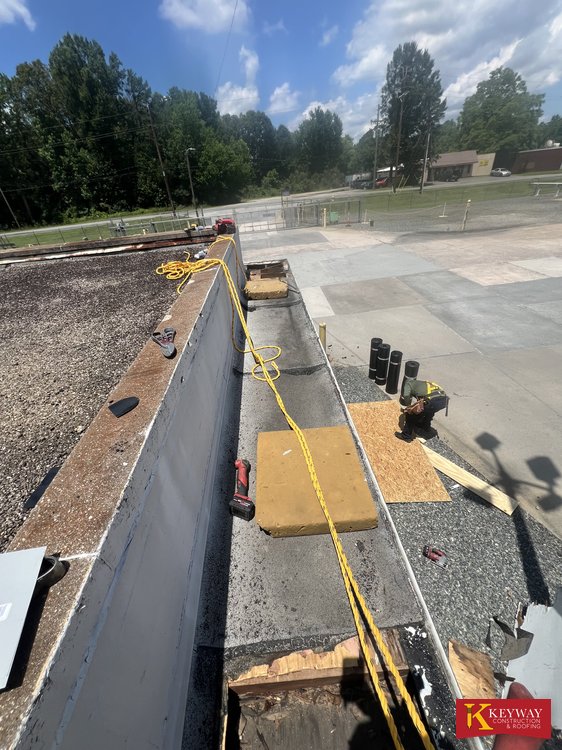
You can see the run of wall with sections cut out. Each opening goes through the membrane and the sheathing into the framing inside. A yellow extension cord, a stack of new sheathing ready to go in, a grinder on the gravel. This is the messy middle of the job, which almost nobody puts on their website.
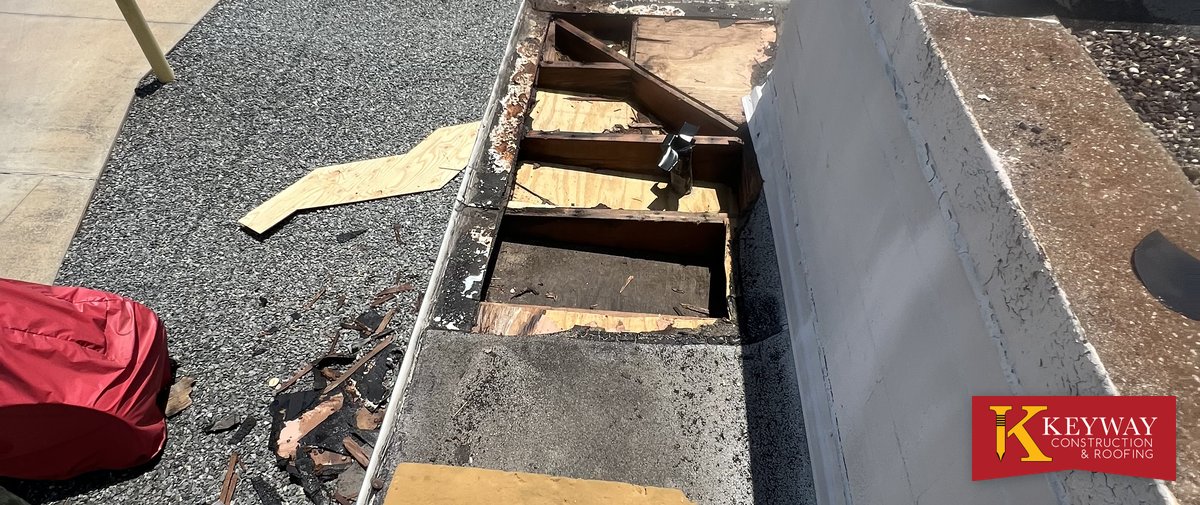
The photo at the top of this page is the close-up. Dark, broken down wood inside the wall and along the deck at its base. That doesn’t happen in one storm. Wood gets that way after it’s been wet, dried, and wet again for seasons.
Here’s the part that matters for your budget. If this had been caught early, it might have been a coping and flashing repair. By the time the wood inside goes soft, you’re rebuilding sections of wall. The longer a parapet leak runs, the more carpentry it turns into.
Why sealant on the surface wasn’t going to work
The quick fix people try first is a bead of sealant or a coat of roof cement where the wall meets the roof. It’s cheap, and it looks like it’s doing something. It isn’t, for two reasons:
- The water isn’t coming in at that joint. It’s entering higher up, at the top or face of the wall, and running down inside. Sealing the bottom just traps it.
- Sealant doesn’t move with the building. Flat roofs swell and shrink with Charlotte’s summer heat and winter cold snaps. A rigid bead cracks within a season or two.
The only lasting fix was to open the wall, remove what was rotted, and rebuild the waterproofing from the top of the wall down.
Already tried patching? Call 704-847-7119 and we’ll tell you whether it’s a repair or a rebuild.
Clues you can spot from the parking lot
You don’t need to get on the roof to suspect a parapet problem. Stand back from the building and look at the outside of the wall, just below the roof line:
- White, chalky staining on brick or block. That’s efflorescence, salts left behind as water moves through masonry and dries out. It means water is getting into the wall from somewhere above.
- Rust streaks running down from the coping. Fasteners or metal are corroding, and water is running over them.
- Peeling paint or bubbling stucco near the top of the wall. Moisture is pushing out from behind the finish.
- Dark, damp patches that stay after the rest of the wall dries. Water is held inside the wall.
- Plants or moss growing out of the top. If seeds can root up there, water is sitting up there.
Any one of those is worth a call. Two or more on the same wall, and we’d want to look soon.
Symptom, cause, fix
| What you see | Likely cause at the parapet | Usual fix |
|---|---|---|
| Stain along an exterior wall inside | Water entering the top of the wall and running down behind the base flashing | Seal or replace the top of the wall, reflash the base |
| Membrane on the wall bubbling or pulling loose | Moisture trapped behind it, adhesive failing | Strip and rewrap the wall in new membrane |
| Soft or spongy roof right next to the wall | Wet insulation or a rotted deck at the base | Cut out and replace the wet material and deck |
| Cracked or open joints in metal coping | Coping laps or cleats failed | Reset or replace coping with proper laps |
| Leak only with wind from one side | Face of the wall absorbing driven rain | Wrap the wall face, not just the top |
What we rebuilt
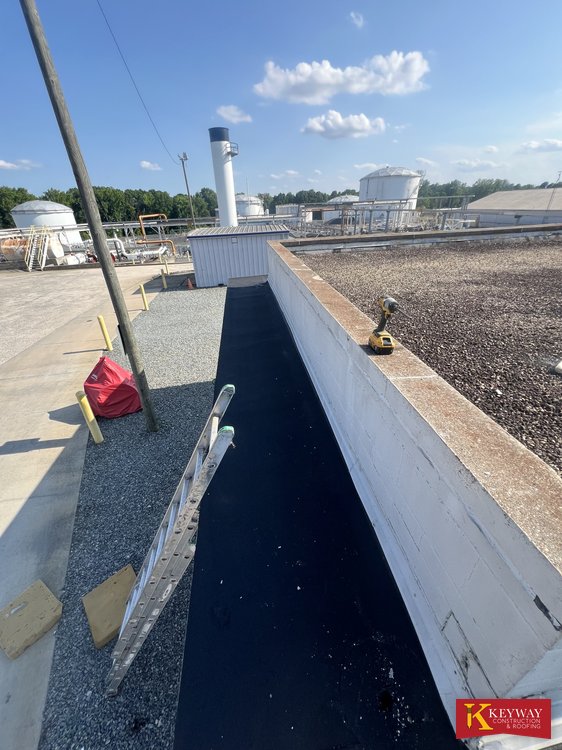
- Rotted wood out. Every soft section of the wall and the deck at its base was cut back to solid material.
- New sheathing in. Fresh panels fastened in so the wall and deck are solid again.
- Parapet rewrapped. New white membrane over the top and down the face of the wall, so water can’t get into the wall from above.
- Base of the wall covered. The strip of roof along the base got new membrane, run up the wall and lapped under the wall wrap so water always flows over a seam, never into one.
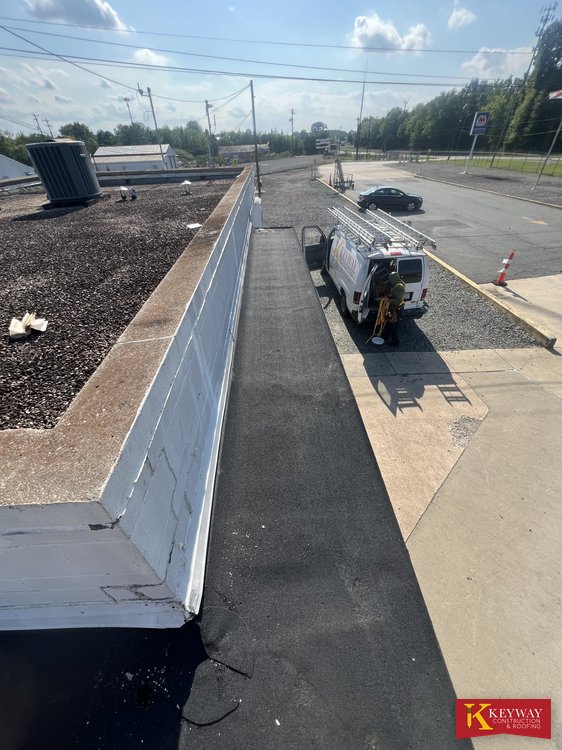
Compare that with the opened up shot above. Same wall. Now it’s one continuous waterproof skin from the top of the parapet down onto the roof.
Does the whole roof need replacing when a parapet leaks?
Usually not. On this building the problem was concentrated at the wall, so that’s where the money went. We’d only steer you toward a full commercial roof replacement if the roof field itself is soaked, past its life, or failing in multiple places at once. A moisture check tells you which.
If you’re weighing it up, our commercial roof leak repair page explains how we trace leaks on flat roofs, and flat roof repair cost in Charlotte covers what drives the price.
How parapet details differ by roof system
Charlotte’s commercial buildings carry a mix of roof types, often from different decades on the same block. The parapet detail has to suit whichever one you’ve got:
- Built-up roofs with gravel. Common on older strip centers and service buildings. The gravel protects the asphalt layers from sun, but it also hides problems, and base flashings on these roofs are often decades old.
- Modified bitumen. Rolled sheets, often with a granulated cap. Base flashing is usually the same material run up the wall, and it bonds well to itself, which makes repairs cleaner.
- TPO. White single ply with heat welded seams. Parapets are often wrapped in the same membrane, and every seam on the wall has to be welded and probed.
- EPDM. Black rubber, glued or ballasted. Wall flashings depend on adhesives and tapes that weaken with age and heat.
Mixing systems badly is its own cause of leaks. New membrane that doesn’t bond to the old just sits on top of it. We match the repair to what’s there, and if the existing roof can’t accept a good tie-in, we’ll tell you before we start.
Keeping tenants and customers in the loop
Roof work on an occupied building goes better when people know it’s coming. A few things we suggest to owners:
- Tell tenants the work days and roughly where on the roof the crew will be.
- Expect some noise from cutting and fastening, mostly during the opening and rebuilding stage.
- Keep the area below the work wall clear if any interior ceiling tiles are already stained, in case we need to check from inside.
- Give us a single contact for questions, so nothing gets lost between the owner, the manager and the tenant.
Small things. They make the job feel shorter to everyone underneath it.
Can the business stay open during the work?
In most cases, yes. Parapet work happens on the roof and from the outside of the wall. The crew stages on the roof, keeps debris contained, and works around your hours where we can. Tell us up front about deliveries, customer parking and anything that can’t be disrupted.
Stop the next one before it starts
Parapets don’t fail overnight. A twice a year look, spring and fall, catches open coping joints, loose wall membrane and cracked sealant while they’re still cheap. That’s the whole idea behind our commercial roof maintenance plans. If you manage a building anywhere around Charlotte, see our main commercial roofing page too.
Keyway has been working on Charlotte area roofs since 1975. Call 704-847-7119 for a free next-day inspection, or see more of our projects.
How we investigate a parapet leak, step by step
- Start inside. We look at where the water shows up, how big the stain is and whether it lines up with an exterior wall, a drain or a rooftop unit.
- Walk the roof. Check the field, the base of every wall near the leak, drains and scuppers, and any rooftop equipment curbs.
- Check the top of the wall. Coping joints, cleats, fasteners and the membrane under the coping.
- Check the face of the wall. Seams, blisters, splits and places where the wrap has pulled loose.
- Probe the base. Press along the roof next to the wall. Soft or spongy spots mean wet insulation or a damaged deck.
- Open a test area if needed. When the evidence points to the wall, a small cut confirms what’s inside before we price a bigger repair.
- Write it up. You get photos of what we found and a repair scope with the options, from the minimum fix to the full rebuild.
Seven steps sounds like a lot. On most buildings it’s one visit.
Repair, rebuild or replace: how we decide
| What we find | What we usually recommend |
|---|---|
| Open coping joints, sound wall, dry wood | Coping repair or reset, reseal, check base flashing |
| Wall membrane failing, wood inside still solid | Strip and rewrap the parapet, new base flashing |
| Rotted wood inside the wall or at its base | Open, cut out, rebuild, then rewrap (this job) |
| Wet insulation across large parts of the roof, roof near end of life | Plan a full replacement and rebuild the parapets as part of it |
We’ll always show you the smallest repair that actually fixes the problem, and tell you plainly if we don’t think it’ll last.
Materials that go into a parapet rebuild
The exact products depend on what’s already on your roof, because the new work has to tie into the old. In general:
- Sheathing to replace rotted wood inside the wall and at the deck, fastened to sound framing.
- Membrane compatible with the existing roof system, so seams between new and old actually bond. On this job the parapet got white membrane and the strip at its base got dark membrane.
- Metal for coping and counterflashing where the design calls for it, with proper laps and cleats rather than face screws through the top.
- Sealant as a secondary seal at terminations, never as the main thing keeping water out.
Our flat roof materials comparison explains how the main membrane types differ.
Is a parapet leak covered by insurance?
Sometimes. Most commercial property policies treat sudden damage, like a storm tearing off coping, differently from slow deterioration, like a wall that’s been wicking water for years. The rot on this building was the slow kind. Every policy is different, so check yours and talk to your agent. What we can do is document what we find with photos and a written description, which is what your adjuster will ask for either way. Our insurance claims page explains how we help.
Other leak sources that get blamed on the parapet
To be fair to parapets, they’re not always the culprit. Before anyone opens a wall, these get ruled out:
- HVAC curbs. Rooftop units sit on raised curbs flashed into the roof. Condensate lines and loose panels add their own water.
- Drains. A clogged or cracked drain bowl backs water up and lets it in around the clamping ring.
- Pitch pans. The little boxes filled with sealant around pipes and supports. The filler shrinks and cracks with age.
- Skylights and roof hatches. Their curbs need the same flashing care as a parapet.
- Splits in the roof field. Membrane seams that open up, often after foot traffic or a dropped tool.
On this building those checked out. The water trail led back to the wall every time.
What drives the cost of a parapet repair
No two walls are the same, so here’s what moves the number:
- Length of wall involved. A few feet at one corner, or the full run of a building.
- How much wood is rotted. Surface repairs cost far less than rebuilding sheathing and blocking inside the wall.
- Whether the deck at the base is damaged. Wet insulation and rotted deck add cut out and replacement work.
- Coping. Resetting existing metal, or fabricating new.
- Membrane type and tie-ins. Matching and bonding to the existing roof system.
- Access and timing. Height, staging, and any after hours work to keep the business running.
Our flat roof repair cost guide goes deeper. Estimates are free and itemized.
A year round checklist for flat roof walls
Spring. Clear pollen and leaves from scuppers and the base of every wall. Look for coping joints that opened up over winter.
Summer. After the first big thunderstorm, walk the interior along exterior walls and look up. Fresh stains are easiest to trace while they’re new.
Fall. Clear the drains again once the leaves drop. Book the professional inspection before winter.
Winter. Watch for leaks during cold rain, when sealant is stiff and gaps are widest.
Fifteen minutes each season. That’s usually the difference between a coping repair and the job on this page.
What property managers should keep on file
If you manage a building, a simple leak log saves money later:
- The date of each leak and the weather that day, especially wind direction
- Where inside it showed up, with a photo
- Who looked at it and what they did
- Roof inspection reports and repair invoices
Patterns jump out fast. Three leaks on the same wall, all during storms from the west, tells a roofer more than any single visit can.
Who did this work
Keyway Construction and Roofing has worked on roofs around Charlotte since 1975. We’re family owned, based in Matthews, Owens Corning certified, accredited with the Better Business Bureau and listed on Angi. Commercial repairs carry our 1-year workmanship warranty. Every photo on this page came from our crew on this job. Learn more about Keyway.
Parapet and flat roof leak questions
How do I know if my flat roof leak is coming from the parapet wall?
Leaks along an exterior wall, leaks that get worse with wind driven rain from one direction, and leaks that keep coming back after surface patches all point to the parapet. A roofer can confirm it by checking the top of the wall, the wall membrane and the base flashing.
Can sealant fix a leaking parapet or coping cap?
Only for a short time. Sealant cracks as the building moves with temperature changes, and it often traps water that’s entering higher up the wall. Lasting fixes reseal or replace the top of the wall and reflash the base.
What's the difference between a coping cap and parapet flashing?
Coping is the cap over the top of the wall. Base flashing is the membrane turned up the wall where it meets the roof. Both have to be sound, because water that gets past the coping runs down inside the wall behind the flashing.
Can you replace part of a commercial roof deck?
Yes. Rotted deck sections can be cut out and replaced locally, as long as the framing underneath is sound. The new deck is then covered with membrane tied into the existing roof.
Does a parapet leak mean the whole roof needs replacing?
Usually not. If the roof field is dry and has life left, repairing the parapet and its flashing solves the problem. Full replacement makes sense when the roof is wet throughout or failing in several places.
How do you know if a commercial roof deck is rotted?
Soft or spongy spots when you walk the roof, sagging near walls or drains, and long running leaks are warning signs. Core cuts and moisture readings confirm how far the damage goes.
Can my business stay open during parapet repairs?
In most cases, yes. The work happens on the roof and outside the wall. We plan staging, debris and timing around your hours and deliveries.
How often should a commercial roof be inspected?
Twice a year, spring and fall, and after major storms. Regular checks catch open coping joints, loose flashing and cracked sealant before water gets into the wall.
What causes a parapet wall to rot inside?
Water getting past the coping or through the wall membrane and soaking the wood sheathing or blocking inside the wall. Because it dries slowly in there, the wood stays wet long enough to rot, often for years before a leak shows inside.
How much of a parapet wall needs to be opened for repair?
Only the sections with damage. We cut test openings where the evidence points, then open as far as the wet or rotted wood goes, so sound sections stay untouched.
Related projects: the Monroe low slope re-roof shows the same idea on a house, where a flat section ties into a steeper roof.
Protect Your Gutters With Gutter Caps
Eliminate tedious maintenance tasks and unsightly clogs with time-saving gutter guards.Proudly Serving
Greater Charlotte
Matthews | Stallings | Mint Hill | Indian Trail | Weddington
Waxhaw | Monroe | Ballantyne | South Park | Arboretum |
Myers Park | Pineville
Matthews | Stallings | Mint Hill | Indian Trail | Weddington
Waxhaw | Monroe | Ballantyne | South Park | Arboretum |
Myers Park | Pineville