

Our Roofing Projects
Quick answer
These are real Keyway Construction and Roofing jobs from around Charlotte, NC, photographed by our own crew, many of them by drone. Each project page shows the roof before, during and after the work, what we found and why we fixed it the way we did. No stock photos.
Any roofer can say they do good work. We’d rather show you.
Every project below is a real job from Matthews, Monroe, Charlotte and the towns around them. You’ll see the finished roof, sure. But you’ll also see the stuff most contractors crop out: rotted decking, wet wood inside walls, crews in the middle of a tear-off. That’s where the quality of a job actually gets decided.
Want this kind of work on your house or building? Call 704-847-7119 for a free next-day estimate.
Recent projects
What each project teaches
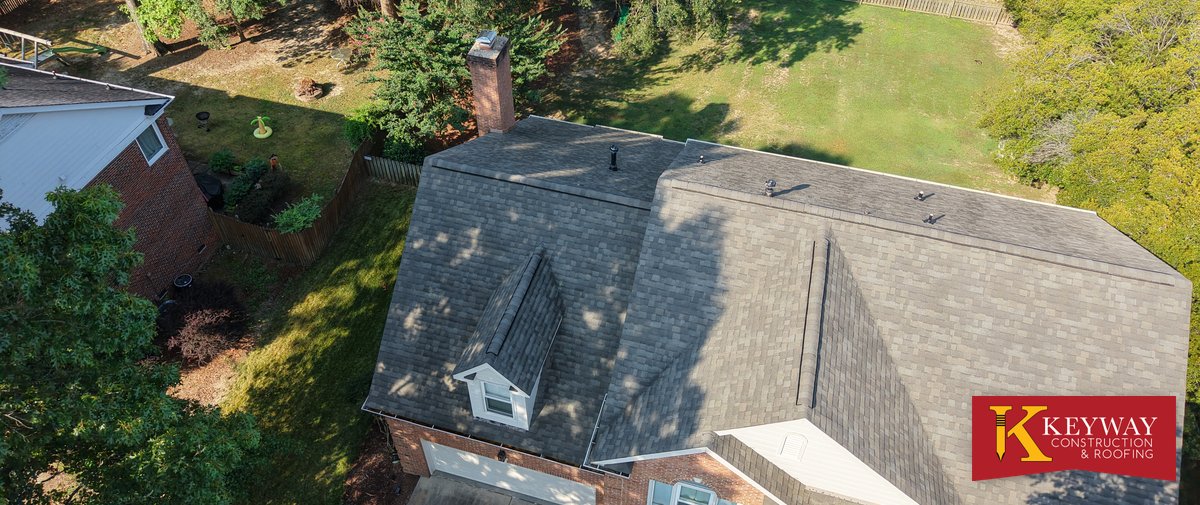
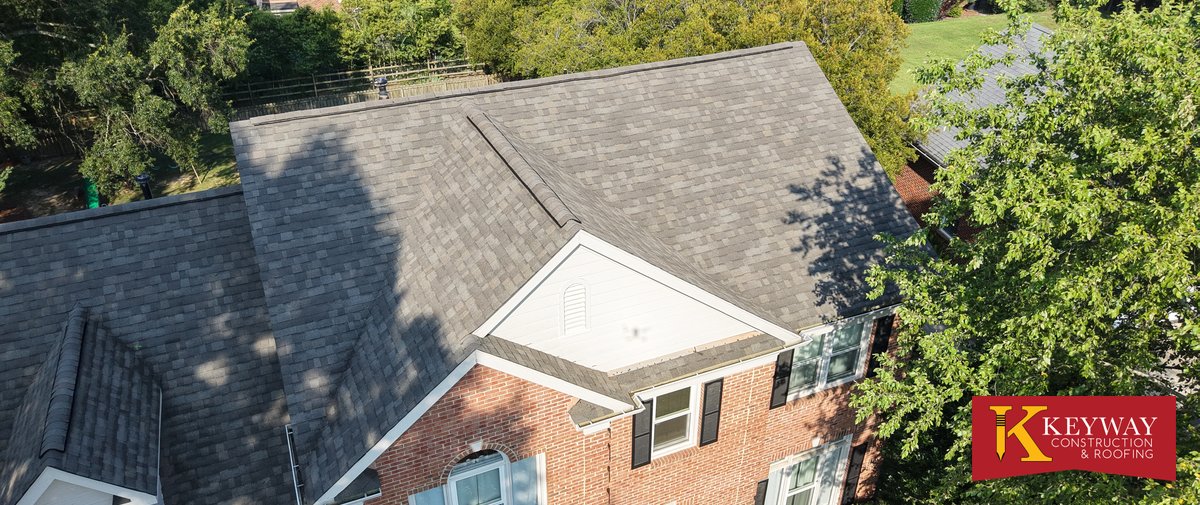
Matthews tear-off. A two story brick colonial with two front dormers, a chimney and a lot of valleys. The lesson is about what you can’t see. The drone shot of the bare deck shows why a full tear-off beats putting new shingles over old ones: the decking gets checked, and every flashing joint at the chimney and dormers gets redone instead of bent around. If your house has a complicated roofline, start here.
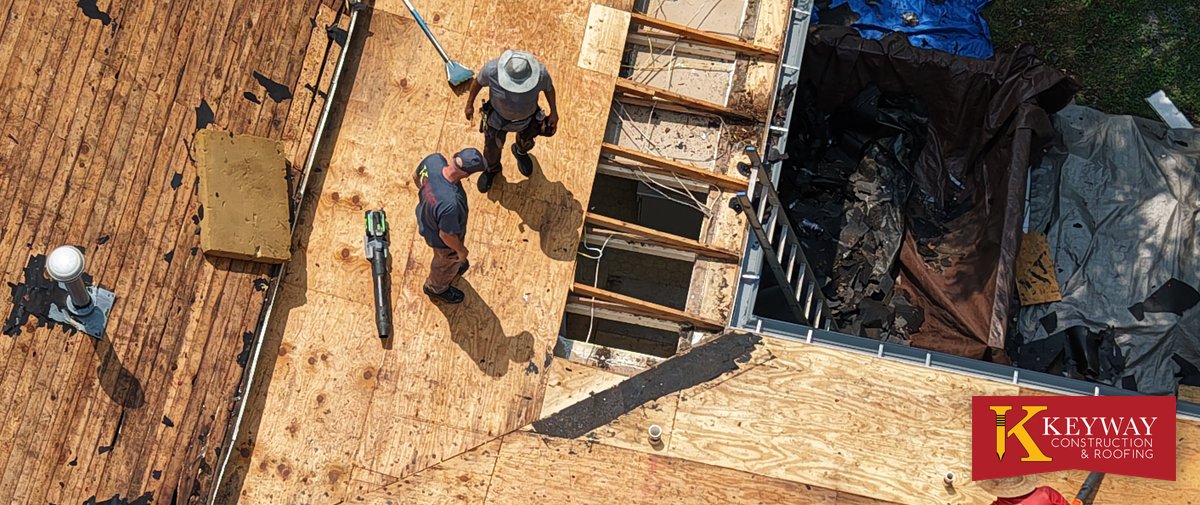
Monroe re-roof with low slope sections. Two surprises on one house. Under the shingles were old plank boards instead of plywood, and two sections at the back were too flat for shingles in the first place. The page explains the pitch limits for shingles, which low slope materials suit a house, and how the joint between the two roofs has to be lapped so it doesn’t funnel water inside.
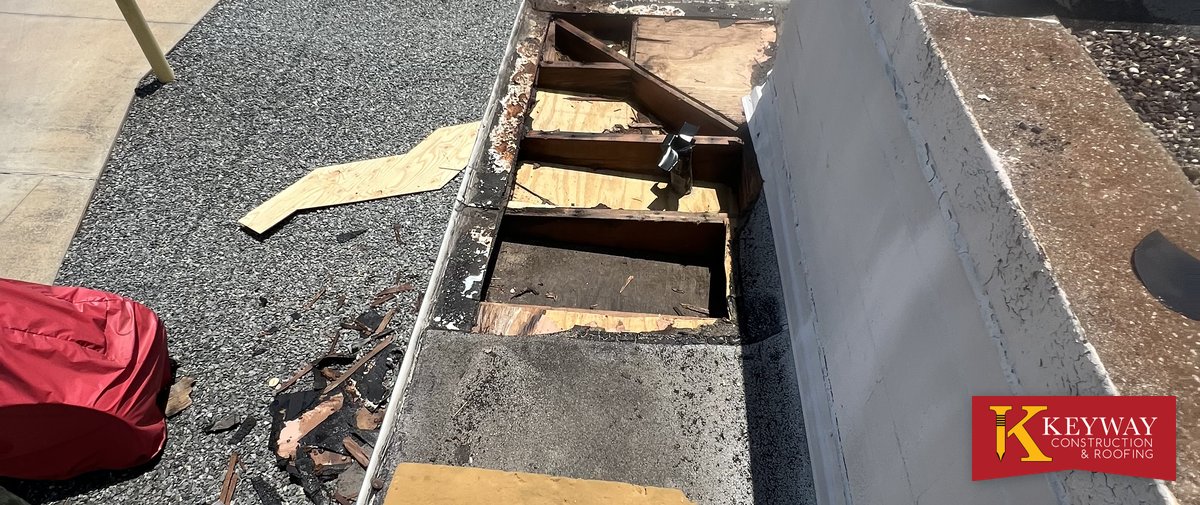
Commercial parapet wall. A flat roof building where the leak wasn’t in the roof at all. Water had been getting into the parapet wall along the roof edge for a long time, and the wood inside had rotted. It’s the most detailed page here on tracing a commercial leak, with a symptom table, a step by step investigation and the clues you can spot from the parking lot.
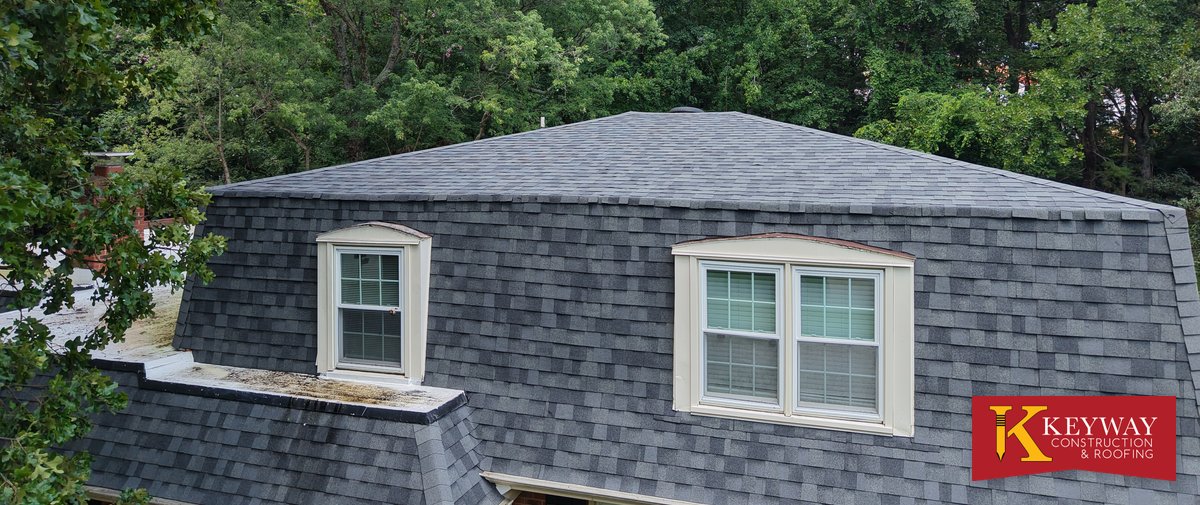
Charlotte mansard roof. Steep shingled faces with dormers out front, and a lot of flat roof behind them that the owner couldn’t see from the ground. The before and after drone shots from matching angles show the ponding stains on the flat sections and the worn shingles, then the finished roof. It’s also where we explain what a drone can and can’t tell you.
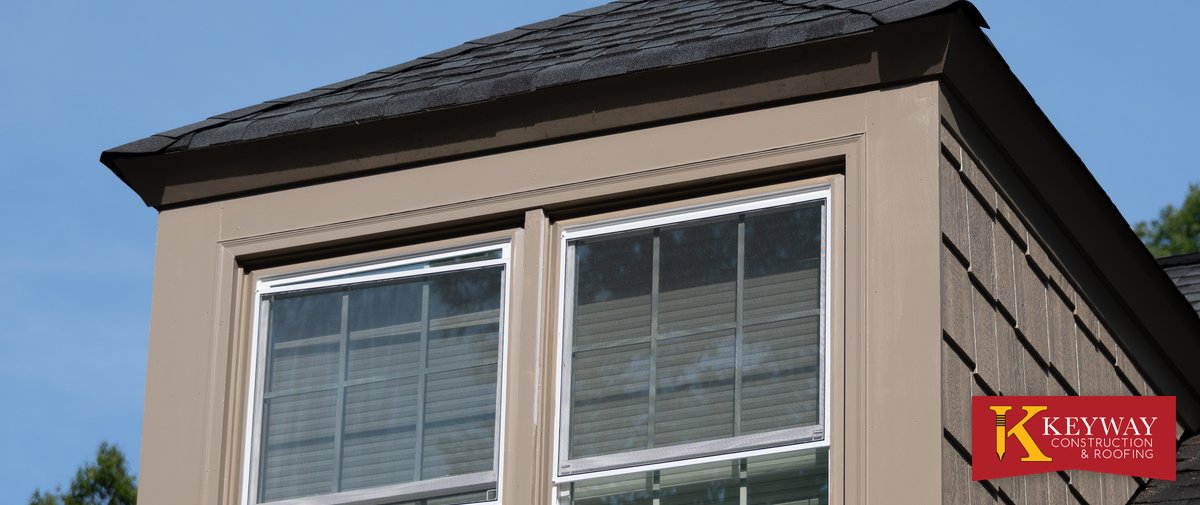
Dormer repair. Our full guide to the small structure that causes an outsized share of leaks and rot. It covers dormer types, the missing kickout flashing behind so many rotted corners, how we water test to find the source, and how the roofing and carpentry get done in one visit.
What you’ll find on each project page
We don’t follow a template here, because no two roofs fail the same way. But every write-up answers the same handful of questions:
- What was wrong, in plain English, with the photo that proves it
- What we found once it was opened up, which is often different from what the homeowner expected
- Why we fixed it the way we did, including the cheaper options we turned down and why
- What went back on, layer by layer
- How to tell if your house or building has the same problem
The photos are ours, taken on the job. We strip location data from every image before it goes online and we don’t publish street addresses. Your neighbors’ privacy matters too.
How every Keyway job runs
The projects look different. The way we run them doesn’t.
- Inspection. We look at the roof, the attic or interior where it matters, and the problem you called about. Usually within a day of your call.
- Estimate. Free, in writing, and itemized, with the repair and replacement options laid out where both make sense.
- Paperwork. Permits pulled, materials ordered, HOA details provided if you need them for an approval.
- The work. Property protected, old material off, problems found and fixed before anything is covered, new system installed in the right order.
- Cleanup and walkthrough. Debris hauled, yard swept for nails, and the finished work walked with you.
- Warranty. Our 1-year workmanship warranty, plus whatever the manufacturer covers on materials.
The full homeowner’s version, including what to do the day before, is in what to expect during a roof replacement.
How to judge any roofer’s project photos, including ours
A gallery is only useful if it’s honest. Ours or anyone else’s, here’s what separates real proof from decoration:
- Before and after from the same angle. If the before shot and the after shot are of different houses, or from angles that don’t match, be skeptical.
- Middle of the job photos. Tear-off, bare decking, opened walls. Stock photo sites don’t have those, and contractors who cut corners don’t show them.
- Local houses. Brick colonials, Union County ranches, flat roofed commercial buildings with gravel. If every roof looks like it’s in Arizona, ask where they were taken.
- A story with each job. What was wrong, what was found, what was done. One sentence captions tell you nothing.
- Problems, not just results. A contractor who shows you the rot they found is telling you they look for it.
We built this page to pass that test. If something here doesn’t, tell us.
Why we photograph jobs from the air
Most of the roof photos on these pages were taken by drone. Partly that’s because it’s the only way to show the whole roof in one frame. But it also changes how the job goes. A drone shot before work starts shows wear patterns across every slope, flat sections hidden behind steep faces and debris in valleys nobody can see from the ground. A matching shot afterward lets you compare like for like.
A drone doesn’t replace a person on the roof, though. It can’t feel a soft deck or look inside a wall. It just tells us where to look first. Our roof inspection page covers what a full inspection includes.
What we leave off these pages, and why
A few things you won’t find here, on purpose.
Street addresses and customer names. These are people’s homes and businesses. We describe the town and the type of building, and strip location data from every photo before it’s uploaded. If you’d like to talk to a past customer, ask, and we’ll check who’s happy to take a call.
Prices for individual jobs. Every roof is priced on its own size, pitch, materials and what’s found underneath. A number from somebody else’s house would mislead you more than it helps. Our roof cost guide explains what actually drives the price.
Stock photos. Not one. If a picture on a project page doesn’t show our crew’s work, it doesn’t go up.
Only the pretty shots. We’d rather show you a rotted wall with a grinder sitting next to it than another sunny photo of finished shingles. The mess in the middle is where you can tell whether a contractor does the job right.
Find a job like yours
Most people don’t search by service. They search by what’s going wrong. So start there:
- “My roof is old and I’m not sure it can be repaired.” Start with the Matthews tear-off, then read roof repair vs replacement.
- “My porch or back addition roof keeps leaking.” The Monroe low slope project is exactly that problem.
- “Our building leaks along an outside wall.” See the parapet wall repair.
- “I can’t even see most of my roof.” The Charlotte mansard roof shows what a drone finds.
- “The trim around my upstairs windows is peeling and soft.” That’s often a dormer problem. Read dormer repair.
Don’t see your problem? Call 704-847-7119. Chances are we’ve fixed it on a house down the street.
The problems behind these projects, and what waiting costs
Every job on this page started as something small. Here’s how each one tends to grow if nobody deals with it:
| Problem | Early sign | If it’s ignored |
|---|---|---|
| Worn out shingles | Granules in the gutters, smooth or curling shingles | Leaks at several spots, soft decking, interior ceiling damage |
| Shingled low slope roof | Moss, standing water, a stain where the porch meets the house | Rotted deck and rafters under the low section, wall damage at the tie-in |
| Failing parapet | Open coping joints, staining on the outside of the wall | Rot inside the wall and at the roof edge, a rebuild instead of a repair |
| Ponding on flat sections | Rust colored rings, puddles a day after rain | Faster membrane wear, leaks into upstairs rooms |
| Dormer flashing or trim | Peeling paint at the bottom corner, soft sill | Rotted sheathing and framing, a stained ceiling inside |
The pattern’s the same every time. The repair stays small while the wood underneath is still dry.
Repair or replace: the same honest test on every job
We’d rather lose a replacement job than sell one you don’t need. On any project, here’s how we decide:
- Is the damage in one place or everywhere? Local damage points to repair. Wear across every slope points to replacement.
- Is the wood underneath still sound? Dry decking and framing keep repair on the table. Widespread rot changes the math.
- How much life does the rest have? Spending on repairs to a roof that has two years left rarely pays off.
- What do you need? Selling soon, staying twenty years, managing a building on a budget cycle. All of that changes the right answer.
Our repair vs replacement guide goes through it in more detail.
When to book
Spring. Storm season starts. Good time for an inspection before the summer thunderstorms, and to catch anything winter opened up.
Summer. Busy, hot and stormy. Replacements still go ahead, with early starts to beat the heat. Leaks get fixed fast, because summer storms find every weak spot.
Fall. Often the most comfortable working weather of the year around Charlotte. A popular time for replacements, so book ahead if you can.
Winter. Repairs and emergency work happen all year. Full replacements are scheduled around cold snaps, since shingles seal best when it’s warmer.
Before you call: what helps us help you
- Photos of any stains or damage inside, and roughly when you first noticed them
- The age of your roof, if you know it, and any past repairs
- Your HOA’s name, if you have one
- For commercial buildings, a leak log and any old roof reports
None of it’s required. It just makes the first visit faster.
Projects by town
We’re based on Stallings Road in Matthews and work across the Charlotte metro. Local pages for the areas in these projects:
We work well beyond the towns in these projects. A quick note on each:
- Mint Hill: about ten minutes from our office. Lots of established neighborhoods with original roofs reaching the end of their life, and plenty of tree cover.
- Ballantyne: newer homes with complex rooflines, plus office parks and flat commercial roofs. Storm damage inspections are a big part of our work here.
- Stallings: our own backyard, since our office sits on Stallings Road.
- Indian Trail: fast growing, with many homes now coming up on their first roof replacement.
- Waxhaw: a mix of historic homes near downtown and large newer houses with steep, cut up roofs.
- Weddington: larger custom homes where dormers, valleys and HOA standards all matter.
- Cornelius: up by the lake, where we handle residential roofing as well.
See the full service area for every town we cover.
Projects by service
- Roof replacement and roof repair
- Flat and low slope roofs
- Commercial roofing
- Wood rot and trim repair
- Siding and windows
We add new projects as jobs wrap up.
Family owned, roofing around Charlotte since 1975, Owens Corning certified, and every job backed by a 1-year workmanship warranty. Call 704-847-7119 or request your free estimate. You can also read what customers say on our reviews page.
Materials you’ll see across these projects
We pick materials for the roof in front of us, not the other way around. Across the jobs on this page you’ll see:
- Architectural asphalt shingles on the steep slopes. We’re Owens Corning certified, and our asphalt shingle roofing page explains the options.
- Synthetic underlayment and ice and water shield under every shingle roof, with the membrane concentrated in valleys and around penetrations.
- Granulated modified bitumen on small low slope sections that tie into shingle roofs, like the Monroe porch and addition roofs.
- Single ply and white membranes on larger flat areas and commercial parapets, where reflecting summer heat matters. Compare them in TPO vs EPDM vs modified bitumen.
- Plywood sheathing to replace rotted decking or cover old plank boards.
- Rot resistant trim and shake style siding on dormers and other wall areas next to the roof. See fiber cement siding.
Homes and commercial buildings: what changes
A house and a commercial building leak for mostly the same reasons: water finds a seam. What changes is everything around the repair.
On homes, the big variables are pitch, the number of dormers, chimneys and valleys, what’s hiding under the old shingles, and HOA rules. Homeowners usually want the job done in a day or two with the yard left clean.
On commercial buildings, it’s mostly flat or low slope roofs, parapets, drains and rooftop equipment, and the job has to fit around a business that’s open. Property managers want documentation, a clear scope and as little disruption as possible. Our commercial roofing page goes into how we handle that side.
Notes on the towns in these projects
Matthews. Our home base. A lot of the housing here went up in the eighties and nineties: brick colonials and traditional two story homes with dormers, chimneys and complicated rooflines, many now on their first or second roof. Mature tree cover keeps roofs shaded and damp. HOA review is common. See residential roofing in Matthews.
Monroe. The Union County seat has a wider spread of house ages than people expect. Older homes with board decking and add-ons from different decades sit near newer subdivisions. Low porch and addition roofs that were shingled anyway are one of the most common problems we see there. See residential roofing in Monroe.
Charlotte. Everything from mid century homes with flat sections to brand new construction, plus a huge range of commercial buildings. Roof types change street to street, which is why we don’t quote from a satellite photo. See roofing in Charlotte.
Who we are
Keyway Construction and Roofing is family owned and has worked on Charlotte area roofs since 1975. We’re based at 740 Stallings Road in Matthews. We’re Owens Corning certified, accredited with the Better Business Bureau and listed on Angi. Our crews handle roofing and the carpentry around it, so a job like a rotted dormer or parapet doesn’t need two contractors. Every project carries our 1-year workmanship warranty. Learn more about Keyway.
Questions about our work
Are these photos of Keyway's own work?
Yes. Every photo on our project pages was taken by our crew on the job, many of them by drone. We don’t use stock photos for project work.
Why do you show photos of rot and damage?
Because that’s where a job is won or lost. The finished roof always looks good on day one. What matters is what was found under the old roof and how it was fixed before it was covered up.
Where does Keyway work?
We’re based in Matthews and work across the Charlotte metro, including Charlotte, Matthews, Mint Hill, Ballantyne, Monroe, Indian Trail, Stallings, Waxhaw, Weddington and Cornelius.
Do you work on commercial buildings as well as homes?
Yes. We handle commercial flat roofs, parapets and leak repairs as well as residential roof replacements, repairs, siding, windows and wood rot repair.
How long does a typical roof replacement take?
For most homes, one to two days of work on the roof. The full process from estimate to cleanup usually runs two to four weeks once materials, permits and any HOA approval are lined up.
What warranty do your projects come with?
Every job includes our 1-year workmanship warranty. Roofing materials also carry the manufacturer’s warranty. If something we installed isn’t right within the year, we come back and fix it.
Can you tell me if my house has the same problem as one of these projects?
Yes. Call 704-847-7119 or request an estimate online. Estimates are free and usually next day, and we’ll tell you honestly whether you need a repair or a replacement.
Will you show me photos of what you find on my job?
Yes. Ask at the estimate and we’ll photograph what we find under the old roof or inside a wall, so you can see what was repaired before it was covered.
Can I use your project photos to compare quotes?
Yes. Use them to see what a complete job includes, then check whether every quote you get covers the same steps, like decking repair, flashing replacement and cleanup.
Protect Your Gutters With Gutter Caps
Eliminate tedious maintenance tasks and unsightly clogs with time-saving gutter guards.Proudly Serving
Greater Charlotte
Matthews | Stallings | Mint Hill | Indian Trail | Weddington
Waxhaw | Monroe | Ballantyne | South Park | Arboretum |
Myers Park | Pineville
Matthews | Stallings | Mint Hill | Indian Trail | Weddington
Waxhaw | Monroe | Ballantyne | South Park | Arboretum |
Myers Park | Pineville