

8 Signs Your Charlotte Home Needs New Windows | Keyway Construction
Signs You Need New Windows in Charlotte, NC
Most windows in Charlotte homes do not fail overnight. They degrade gradually across seasons, and the signs that something is wrong are easy to dismiss as minor inconveniences until the problem is significantly more expensive to address. This guide covers the most consistent signs we see across homes throughout the Charlotte metro, what each one actually means, whether it points toward repair or full replacement, and what Charlotte’s specific climate adds to the equation. If you’re past the reading stage and want a professional set of eyes on your windows, Keyway Construction provides free next-day estimates across Matthews, Mint Hill, Indian Trail, Ballantyne, Waxhaw, and surrounding areas. Call 704-847-7119 or contact us online.
For a deeper look at whether your situation calls for repair or full replacement, see our dedicated guide: Window Repair vs. Replacement in Charlotte, NC.
1. You Feel a Draft Near the Frame on Cold Mornings
A draft near a window frame on a cold morning is a seal failure somewhere in the assembly, the weatherstripping, the caulk joint between the frame and the wall, or the glazing compound holding the glass in the frame. Charlotte’s winter cold snaps make this problem obvious because the temperature differential between inside and outside is large enough to feel clearly, even though our winters are mild compared to much of the country. A failing seal is often fixable with window and door weatherproofing.
The location of the draft matters. A draft from around the operable sash is almost always a weatherstripping replacement, a repair, not a replacement. A draft coming from between the frame and the surrounding wall indicates the caulk joint has opened, also a maintenance repair. A draft that persists after both have been addressed suggests the frame itself has shifted or settled in the opening over time, which is worth a professional look before deciding between repair and replacement.
2. Fog or Condensation Between the Panes
This is the most commonly misunderstood window problem. Fog between the panes of a double-pane window is a failed seal. The insulating gas between the two panes, typically argon, has escaped, and humid air has replaced it. That fog is not on the surface of the glass. It is between the panes, which means wiping the glass does not remove it and the insulating value of the unit has been permanently compromised.
This does not automatically mean you need full window replacement. In many cases the sash, the movable panel holding the glass, can be replaced without replacing the frame, at a fraction of the cost of a new window. The key question is whether the frame is still sound. If the frame is in good condition and the rest of the window performs normally, sash replacement is usually the right call. If the frame is also aging or the surrounding trim is showing wood rot, the calculation changes.
3. The Window Will Not Open, Close, or Lock Properly
Windows that stick, will not close fully, or cannot be latched are a functional problem and a security concern. In Charlotte’s humid summers, wood frames absorb moisture and swell, which can cause seasonal sticking that resolves in cooler weather. That is a normal characteristic of wood windows and does not necessarily mean replacement is needed.
Sticking that does not resolve seasonally, a window that has progressively gotten harder to operate over two or three years, or a frame that has visibly racked or warped tells a different story. The frame has shifted, from long-term moisture infiltration, the house settling, or the window unit degrading beyond the point where it operates correctly within the opening. These situations need professional assessment to determine whether adjustment, repair, or replacement is the right response. A window that cannot be latched is also a security issue worth addressing promptly regardless of the underlying cause.
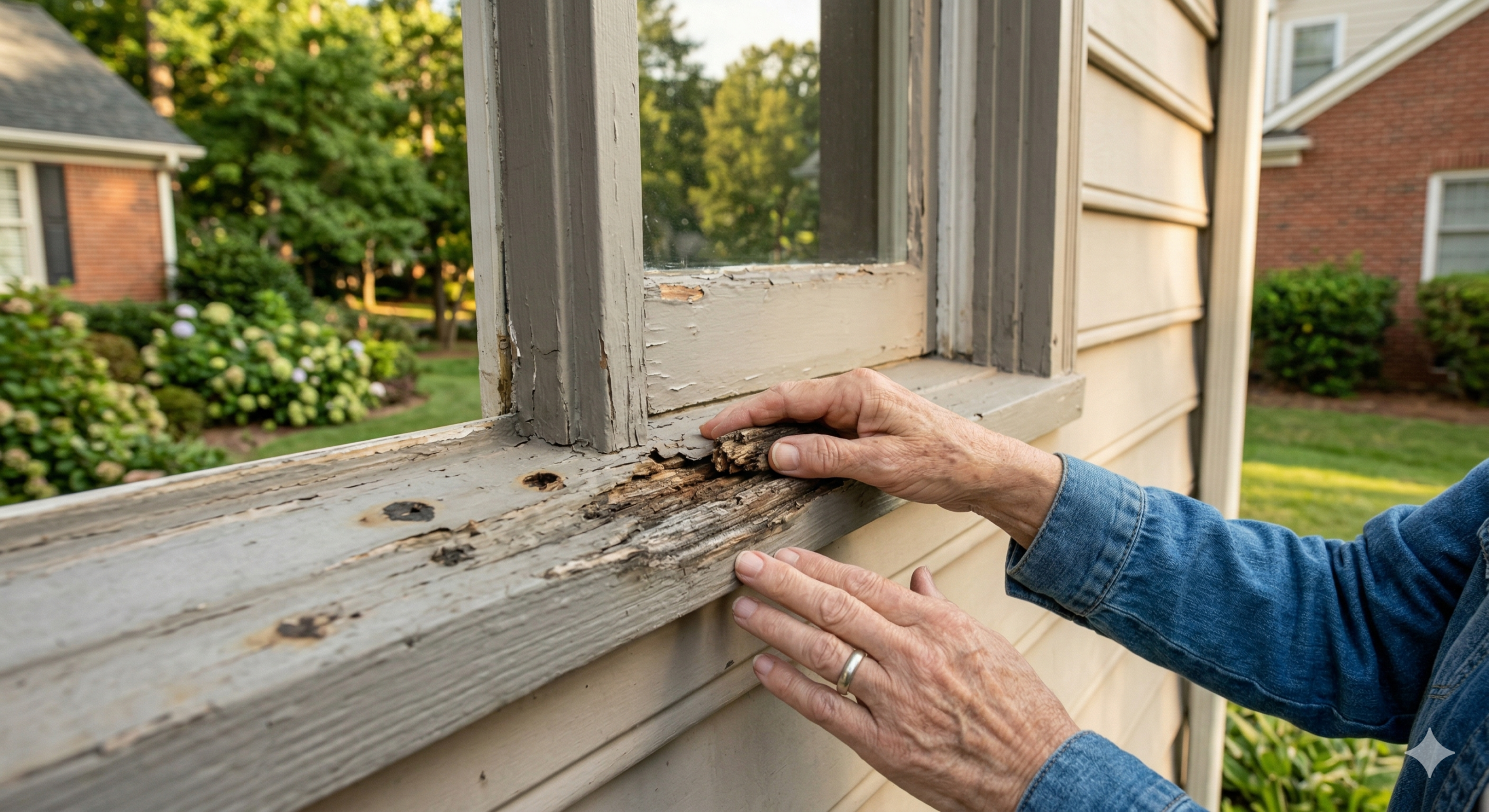
4. Soft or Spongy Wood When You Press the Sill
Press the sill with your thumb or the tip of a pen. Healthy wood does not compress. A sill that gives slightly under moderate pressure has active rot beneath the surface that the paint may still be concealing.
Wood rot around window sills is one of the most common exterior problems on Charlotte homes built before 2000. Charlotte’s summer humidity, UV deterioration of caulk and paint on horizontal surfaces, and end-grain exposure at the corners of window sills create conditions that are hard on exterior wood trim year after year. Catching sill rot early, when it is limited to the sill and lower casing, means a contained repair. Catching it late, after it has worked into the surrounding framing, means a significantly larger scope that goes well beyond the window itself. This is one reason we look at the full opening when we assess windows, not just the glass and frame.
5. Outside Noise is Significantly Louder Than It Used to Be
If traffic noise, neighborhood activity, or rain sounds noticeably louder inside your home than it did a few years ago, and nothing about the outside environment has changed, your windows are likely a factor. Single-pane windows and older double-pane windows with degraded seals provide much less acoustic insulation than modern double-pane units. In neighborhoods along busy corridors, Providence Road, Monroe Road, the Matthews Township Parkway area, this matters more than in quieter residential streets.
Increased noise transmission is rarely the only sign of a failing window, but it is a useful secondary indicator. If noise has gotten worse alongside drafts or fogging, the window is telling you consistently that it is no longer performing at its original level.
6. Noticeably Higher Energy Bills With No Change in Usage
Windows account for a meaningful share of a home’s heat gain in summer and heat loss in winter. Charlotte’s cooling season runs from May through September, and south and west-facing windows on an older home are working against significant solar heat gain during peak hours every day. If your energy bills have trended upward over the past few years without an obvious explanation, windows are worth evaluating as a contributing factor, particularly on homes built before the mid-1990s in neighborhoods like Sardis Forest, Fullwood, Stallings Station, and older Ballantyne subdivisions, where windows often predate current energy standards by 25 or more years.
Two numbers matter most when comparing window energy performance. U-factor measures how well the window prevents heat loss, lower is better. Solar Heat Gain Coefficient (SHGC) measures how much solar heat comes through the glass, also lower is better for Charlotte’s climate, where summer cooling is the dominant energy cost. We discuss both when helping homeowners choose replacement products so the decision is based on your home’s specific orientation and exposure rather than a generic recommendation.
7. Interior Furnishings Fading Near Windows
If upholstery, flooring, or window treatments near a south or west-facing window are fading noticeably faster than furnishings elsewhere in the house, UV transmission through the glass is the cause. Older single-pane and early double-pane windows transmit significant UV into the interior. Modern double-pane windows with Low-E coatings filter UV substantially, which protects interior finishes while also reducing the solar heat gain that drives up cooling costs.
This sign does not indicate the window is structurally failing. It indicates the window is performing at its original design standard, which is simply lower than what current products offer. If UV protection and energy performance are the primary concerns, the window upgrade addresses both simultaneously.
8. Visible Paint Failure or Discoloration at the Frame Corners
Paint failing on vertical surfaces is usually just age. Paint failing on horizontal surfaces, particularly at the corners where the sill meets the side casing, is almost always a moisture signal. The paint is failing from underneath because the wood below it is wet. Visible paint failure on the sill is typically a season or two behind the actual moisture problem, meaning by the time the paint looks bad, the wood is already softening.
Dark staining at casing corners that was not there last year, paint cracking along the caulk line between sill and casing, or trim that has pulled slightly away from the frame are early indicators worth investigating before Charlotte’s summer humidity season drives the problem further into the wood. The same moisture that damages the paint is feeding rot in the sill and eventually the framing around the opening.
9. You Still Have Single-Pane Windows
Single-pane windows were standard in homes built before the late 1980s. If your home has them, common in older sections of Matthews, Mint Hill, and established Charlotte neighborhoods like Dilworth, Elizabeth, and Myers Park, they are working against you on energy costs every month regardless of their physical condition. There is no repair that brings a single-pane window to the performance level of a modern double-pane unit. If the frames are otherwise sound and you are not experiencing drafts or rot, you can continue to maintain them. But if you are evaluating window work for any reason on a home with single-pane glass, replacement rather than repair almost always makes more financial sense over a 10-year horizon.
10. The Window is 20 or More Years Old and Showing Multiple Issues
This is the composite sign that most clearly indicates replacement rather than continued repair. A window that is 22 years old, has a failed seal between its panes, sticks in summer, and has weatherstripping that has already been replaced once is at the end of its practical service life. Each problem individually might be repairable. Together, on an aging window, they indicate you are investing in a component that has reached its natural end rather than addressing a discrete problem that repair can genuinely solve.
This does not mean every window in the house needs to be replaced simultaneously. A south-facing window that has had 20 years of direct sun may be at end of life while a north-facing window in the same house is performing well. We assess each opening individually and give you a clear picture of what we find rather than a blanket recommendation to replace everything.
When Signs Point to Repair Rather Than Replacement
Not every warning sign on this list means a new window. Weatherstripping replacement, caulk joint repair, sash replacement on a sound frame, and hardware adjustment are all legitimate repairs that extend window life at a fraction of replacement cost. The key is identifying which problem you actually have before committing to a scope of work.
Because Keyway is a licensed general contractor, we assess the full picture, the window, the frame, the surrounding trim, and the wall assembly around the opening. If there is wood rot in the framing behind a window that needs replacement, we handle both in the same visit. If a sash replacement genuinely solves the problem, that is what we recommend. We have no incentive to sell you a full window when a targeted repair is the right answer, and we tell you clearly which situation you are in.
For a full breakdown of how to think through this decision, read our guide: Window Repair vs. Replacement in Charlotte, NC, How to Make the Right Call.
Frequently Asked Questions About Window Replacement in Charlotte
How do I know if I need new windows or just a repair?
The most reliable way to tell is to identify exactly where the problem is coming from. Drafts from around the sash are usually weatherstripping, a repair. Fog between panes means a failed seal, sometimes a sash swap, sometimes full replacement depending on frame condition. Soft wood at the sill or casing corners means rot has started, that needs to be addressed whether you repair or replace the window. A professional assessment takes 15 minutes per window and gives you a clear answer on each opening. We offer free estimates across the Charlotte metro with next-day availability.
How long do replacement windows last in Charlotte's climate?
Quality vinyl windows in Charlotte typically last 20-30 years with minimal maintenance. Fiberglass frames tend to last longer, up to 40 years, and handle Charlotte’s UV and temperature swings particularly well. The biggest factor in longevity is installation quality: a well-made window installed with improper flashing or inadequate caulking around the frame will fail prematurely regardless of the product. Wood windows last as long as their paint and caulk maintenance schedule allows, in Charlotte’s humidity, that means consistent attention every 5-7 years or moisture gets in and the rot starts.
Can I replace just one window or do I have to do the whole house?
You can absolutely replace individual windows. Most of our window work in Charlotte involves 1-4 windows at a time rather than whole-house replacements. The main consideration with partial replacement is matching the appearance of the existing windows. We help you find a product that fits the profile and matches the look of what is staying so the result is consistent. If your home has a mix of windows in different conditions, we assess each one and give you a priority order based on what is failing versus what still has useful life remaining.
What is a Low-E coating and do I need it for Charlotte?
Low-E (low-emissivity) is a microscopically thin coating applied to the glass surface that reflects infrared heat while allowing visible light through. For Charlotte’s climate, long hot summers with high UV intensity, Low-E glass is worth specifying on south and west-facing windows in particular. It reduces the solar heat that enters through the glass during peak cooling months, which directly reduces HVAC load. It also filters UV that causes interior fading. The cost difference between standard double-pane glass and Low-E glass is modest relative to the long-term energy savings in our climate, and we recommend it as the default specification for Charlotte window replacement projects.
Ready to find out what your windows actually need? Keyway Construction provides free next-day window assessments across Charlotte, Matthews, Mint Hill, Indian Trail, Ballantyne, Waxhaw, Weddington, and surrounding communities. We are a licensed general contractor based in Matthews, if we find wood rot around your windows, siding issues, or roof edge damage during the inspection, we can scope it all in one visit. Call 704-847-7119 or contact us online for a free estimate.
Recent Posts

Protect Your Gutters With Gutter Caps
Eliminate tedious maintenance tasks and unsightly clogs with time-saving gutter guards.See For Yourself
View Our Gallery of Projects
Proudly Serving
Matthews | Stallings | Mint Hill | Indian Trail | Weddington
Waxhaw | Monroe | Ballantyne | South Park | Arboretum |
Myers Park | Pineville | Fort Mill
Matthews | Stallings | Mint Hill | Indian Trail | Weddington
Waxhaw | Monroe | Ballantyne | South Park | Arboretum |
Myers Park | Pineville | Fort Mill